Difference Between AI Agent and Workflow: An Analytical Guide
Explore the difference between AI agents and workflows with an analytical, example-rich comparison. Learn when to deploy agentic automation versus scripted processes, plus a decision framework, governance guidance, and a side-by-side table.


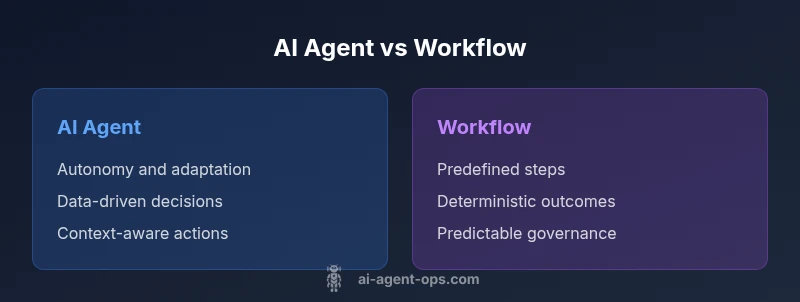
According to Ai Agent Ops, the difference between ai agent and workflow hinges on autonomy and decision-making: AI agents act with minimal human input to pursue goals, while workflows execute predefined steps. In practice, an ai agent adapts to changing data and intents, whereas a workflow remains fixed. Understanding this distinction helps teams choose when to deploy agentic AI versus scripted processes.
What is the difference between ai agent and workflow?
The difference between ai agent and workflow is often treated as a semantic nuance, but it drives architectural decisions, resource allocation, and success metrics. According to Ai Agent Ops, an ai agent is a software entity that perceives, reasons, and acts to achieve goals with limited human prompting. A workflow, in contrast, is a scripted sequence of steps triggered by events or conditions and executed in a fixed order. This distinction matters because it determines how much autonomy you grant the system, how flexible you expect results to be, and how you measure impact in real-world product and engineering contexts. Recognizing this difference between ai agent and workflow helps teams decide where to place emphasis on learning, adaptation, or strict reproducibility across processes.
Core Concepts: AI agent, workflow, and agentic AI
At a high level, an AI agent combines perception, reasoning, and action. It can use memory to inform decisions and adjust strategies over time. A workflow, by contrast, codifies a fixed sequence of steps designed to achieve a repeatable outcome. Agentic AI sits at the intersection, enabling system behavior that evolves with data and feedback while preserving governance through monitoring and constraints. Understanding these core concepts helps product teams map capabilities to business goals and to set realistic expectations for automation initiatives.
Autonomy and Decision-Making: How much control does each pattern give you?
Autonomy is the defining difference between ai agent and workflow. AI agents autonomously select actions to pursue a goal, often adapting strategies based on observations from the environment. Workflows rely on deterministic logic: if this, then that, with explicit branching rules. This fundamental divide affects risk, resilience, and speed. In fast-moving domains, agents can pivot on new information without waiting for human approval; in regulated settings, strict workflows provide traceable, auditable paths that align with compliance requirements. When deciding between an ai agent and a workflow, evaluate how much ambiguity exists in the task, how quickly the environment changes, and how much human oversight you’re willing to provide.
Data Handling and Feedback Loops: How information travels through each pattern
AI agents thrive on data streams, probabilistic reasoning, and feedback loops that improve performance over time. They can fuse signals from multiple sources, learn from outcomes, and refine actions in near real-time. Workflows typically rely on structured inputs and outputs with explicit handoffs. Data provenance in workflows is straightforward, but opportunities for learning are limited unless you incorporate external components to capture post-execution outcomes. A robust agent-based design uses memory, state, and context to inform decisions, while a pure workflow emphasizes deterministic transitions and auditable steps. The difference between ai agent and workflow here is not only technical but strategic: do you want the system to improve itself, or do you want a proven, repeatable blueprint?
Execution Contexts: Where each pattern shines in real-world settings
Different business domains reveal the strengths and limits of each approach. AI agents excel in customer-facing automation, dynamic data processing, and end-to-end task orchestration that touches multiple systems. They can manage contingencies, handle exceptions, and adjust behavior when inputs drift. Workflows shine in finance, compliance, and manufacturing contexts where predictable, auditable sequences are essential. They work well for batch processing, pipeline rituals, and service desk automation where the path is well understood and risk must be tightly controlled. The difference between ai agent and workflow becomes most apparent when the required outcomes balance adaptability and reliability. When speed and learning matter, agents are preferable; when predictability and governance are paramount, workflows win.
Architecture and State Management: Memory, context, and decision traces
A modern AI agent architecture typically includes perception modules, a reasoning layer, and an action executor, aided by a memory store to track context and outcomes. Decision quality improves through reinforcement or supervised learning loops. Workflows depend on a state machine or orchestration engine that preserves step-level context, data passing, and clear exit criteria. The data model for agents often involves embeddings, prompts, and external knowledge sources, while workflows rely on structured data schemas and artifact repositories. The difference between ai agent and workflow in this layer is about how state evolves: agents maintain richer, long-lived context; workflows emphasize transparent, linear state progression with crisp checkpoints.
Integration Patterns and Interoperability: Connecting systems and data flows
Agent-based automation typically requires loose coupling to data sources and external services via APIs and event streams, with authorization and risk controls baked in. Workflows prefer well-defined connectors and ETL-style integrations that emphasize reliability and traceability. In many environments, organizations blend both patterns: an ai agent operating across systems while a workflow handles governance, approvals, and retry logic. The difference between ai agent and workflow here is practical: select a model that aligns with your integration maturity, data governance stance, and incident response processes. By combining patterns, teams can achieve both adaptability and reliability at scale.
Governance, Risk, and Compliance: Managing safety, ethics, and auditability
Governance for ai agents requires monitoring of autonomy, decision boundaries, and data usage, plus risk controls to prevent unintended actions. Workflows demand strict versioning, access control, and auditable step histories. The imperative is to design guardrails: limit what actions an agent can take, enforce human-in-the-loop for sensitive steps, and maintain rigorous logging for compliance reviews. The difference between ai agent and workflow in governance terms is that agents introduce emergent behavior risk, while workflows introduce process control risk. A mature plan uses both approaches with clear policies, escalation paths, and ongoing validation.
Implementation Maturity and Roadmapping: From pilots to scale
Organizations typically start with a small experimental agent or a lightweight workflow to test concepts, measure impact, and refine requirements. As capabilities mature, teams define a hybrid architecture where agents handle exploratory tasks and workflows govern repeatable operations. Maturity models emphasize governance, observability, and safety mechanisms. The difference between ai agent and workflow scales is the pace and complexity of adoption: you may begin with guardrails around an agent, then expand into a combined pattern that preserves both adaptability and control. Building a clear roadmap helps translate strategic goals into concrete milestones, metrics, and responsible ownership.
Real-World Scenarios and Case Illustrations: Concrete applications
Consider a customer support experience where a chatbot uses an AI agent to triage requests and propose next steps, while a separate workflow ensures that high-priority tickets trigger supervisor approval. In this scenario, the agent handles perception, intent inference, and action selection, whereas the workflow standardizes escalation, documentation, and compliance checks. In another case, a marketing automation pipeline uses an ai agent to optimize send times and content based on audience signals, with a workflow that orchestrates data ingestion, audience segmentation, and campaign launch. The difference between ai agent and workflow becomes evident in how much variation you allow in daily operations and how quickly you can respond to new inputs without breaking governance.
Pitfalls, Misconceptions, and How to Avoid Them
A common pitfall is treating AI agents as miracle workers and assuming they will replace all workflows. Real-world systems perform best when you define clear decision boundaries and handoffs between agents and workflows. Misconceptions include underestimating the need for robust data governance, overestimating the agent’s ability to generalize, and neglecting the human-in-the-loop for sensitive tasks. To avoid these hazards, start with a concrete use case, set measurable objectives, and design a governance model that covers data quality, safety constraints, and auditing requirements. Iterative testing, bias checks, and performance monitoring should accompany any deployment of agentic automation to ensure responsible outcomes.
Comparison
| Feature | AI Agent | Workflow |
|---|---|---|
| Autonomy | High autonomy: acts toward goals with limited human input | Low autonomy: strictly script-driven |
| Decision-Making | Adaptive decisions based on data and goals | Predefined decisions or rules in the script |
| Data Handling | Fuses signals from multiple sources, memory-enabled | Relies on structured inputs/outputs with explicit handoffs |
| Adaptability | Can pivot with new information | Rigid unless reconfigured |
| Governance Needs | Requires ongoing governance and monitoring | |
| Best For | Dynamic, data-driven tasks and end-to-end orchestration | Repeatable, well-defined processes with high predictability |
Positives
- Enables rapid iteration and learning from outcomes
- Improves time-to-value on complex tasks
- Reduces manual effort for variable workloads
- Can scale decision-making across systems
What's Bad
- Higher governance and monitoring requirements
- Greater initial design and integration complexity
- Potential for unexpected agent behavior without safeguards
AI agents excel in dynamic environments; workflows shine in predictable, compliant contexts
Choose AI agents when adaptability and data-driven decisions are priorities. Opt for workflows when governance, reproducibility, and compliance are paramount. A blended approach often delivers the best balance.
Questions & Answers
What is an AI agent?
An AI agent is a software entity that perceives data, reasons about options, and takes autonomous actions to achieve a goal. It can learn from outcomes and adapt behavior over time, subject to governance constraints.
An AI agent perceives data, reasons about actions, and acts autonomously within defined rules.
What is a workflow?
A workflow is a predefined sequence of steps with clear inputs and outputs, executed in a fixed order. It emphasizes repeatability, predictability, and auditable traceability.
A workflow is a fixed series of steps designed to be repeated reliably.
Can AI agents replace workflows entirely?
Not usually. Agents handle dynamic decisioning and actions, while workflows provide structured governance and repeatable processes. Most systems benefit from a hybrid approach that combines both patterns.
Usually not. Agents handle learning and adaptation, workflows keep things predictable and auditable.
How do governance and risk differ between the two?
Agents introduce unpredictable behavior risk that must be managed with safeguards, monitoring, and escalation paths. Workflows emphasize clear process controls, versioning, and compliance through auditable step histories.
Agents need safeguards; workflows need strict process controls and traceability.
What are common cost considerations?
Initial integration and governance costs for agents can be higher, but long-term benefits include faster decision cycles. Workflows often have lower upfront complexity but may require ongoing maintenance for changes in rules.
Agents may cost more upfront but can reduce long-term cycle times; workflows are usually cheaper to start but need upkeep.
What is a practical starting point for teams?
Begin with a well-defined use case that benefits from either automation pattern. Build a small pilot, establish governance, and measure impact. Scale gradually, validating risk controls at every step.
Start with a clear use case and pilot, then measure impact and scale with governance.
Key Takeaways
- Define the core goal: adaptability vs predictability
- Use a hybrid pattern for scale and governance
- Pilot with clear metrics and guardrails
- Plan governance and risk early in the design