What is an AI agent vs bot? A practical comparison
Explore the difference between AI agents and bots, how they operate, when to use each, and practical patterns for building agentic workflows in business and development contexts.


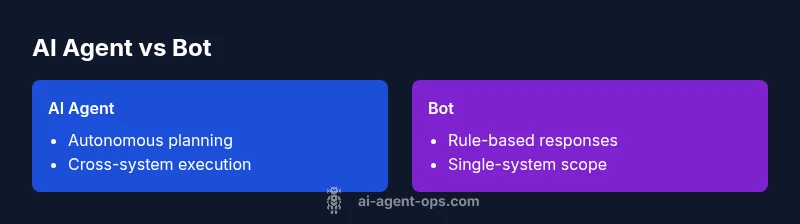
An AI agent is an autonomous component that can plan, learn, and act across multiple steps, while a bot typically performs scripted tasks or responds to single prompts within a defined scope. The two overlap in automation, but AI agents pursue long-term goals with context awareness, whereas bots execute narrow, rule-based workflows.
What is the difference between an AI agent and a bot?
In practice, many teams talk about AI agents and bots interchangeably, but the distinction matters for design, governance, and outcomes. This article clarifies what is an ai agent vs bot by unpacking intent, scope, and capability. According to Ai Agent Ops, an AI agent is an autonomous actor that can perceive state, reason about goals, plan actions, and adapt behavior to changing contexts. A bot, by contrast, tends to operate within a fixed rule set or scripted prompts, delivering predictable responses or completing narrow tasks. The distinction is not about intelligence alone; it is about autonomy, goal-directed behavior, and the ability to operate across multiple steps without direct human input. Understanding this difference helps product teams choose the right pattern for automation, orchestration, and agentic AI workflows.
Core definitions and scope
An AI agent is a software entity designed to take initiative toward a goal, using perception, reasoning, and action to influence its environment. It can hold a model of its current state, set subgoals, and adjust its plan as new data arrives. A bot is typically a scripted executor that responds to user prompts or events within a bounded rule set. Bots excel at reliability and speed for simple tasks, like answering a fixed set of questions or triggering a predefined workflow. The scope of an AI agent often spans multiple tools, services, and data sources, enabling cross-domain automation. In contrast, a bot’s scope remains narrow and domain-specific. Mapping these definitions helps teams align architecture, governance, and performance expectations.
Comparison
| Feature | AI Agent | Bot |
|---|---|---|
| Definition | Autonomous, goal-driven agents capable of planning and acting across multiple steps | Scripted, task-specific bots that respond within a fixed scope |
| Autonomy | High autonomy with goal-directed planning | Low autonomy; executes predefined paths |
| Decision-making | Context-aware planning with iterative reasoning | Rule-based or prompt-based decision rules |
| Learning/memory | May incorporate ongoing learning and memory | Typically lacks learning; static behavior |
| Data needs | Access to multiple data sources; contextual data | Limited to defined inputs and outputs |
| Integration patterns | Cross-tool orchestration; APIs, agents | Single-system or API wrapper |
| Maintenance | Ongoing governance, monitoring, updates | Lower ongoing complexity but frequent rework when processes change |
| Best for | End-to-end workflows; dynamic environments | Simple, repeatable tasks with strict SLAs |
Positives
- Greater automation reach across tools and domains
- Autonomous planning and adaptive behavior
- Potential to reduce human bottlenecks in complex workflows
- Scalable orchestration across services with proper governance
What's Bad
- Higher upfront setup and governance needs
- Risk of unpredictable behavior without strong controls
- Requires data quality and monitoring to avoid drift
- Can be harder to explain decisions to stakeholders
AI agents outperform bots for complex, end-to-end automation; bots excel at simple, high-frequency tasks.
Choose AI agents when you need adaptive planning and cross-system orchestration. Choose bots for straightforward, repeatable tasks with low risk and fast deployment. The Ai Agent Ops team recommends a blended strategy where agents handle orchestration and bots handle routine sub-tasks.
Questions & Answers
What is an AI agent?
An AI agent is a software entity that can perceive its environment, reason about goals, plan a sequence of actions, and execute across multiple systems. It operates autonomously within a defined objective and adapts as conditions change.
An AI agent is an autonomous software that plans and acts across systems to reach a goal.
What is a bot?
A bot is a scripted or rule-based tool that responds to prompts or events within a fixed scope. It excels at predictable, repetitive tasks but lacks broad autonomy.
A bot follows fixed rules to perform specific tasks.
Can AI agents learn from experience?
Many AI agents include learning components that improve strategies over time, either online or from historical data. Governance and data quality are essential to prevent drift and ensure safe behavior.
Some AI agents learn from experience, but governance keeps behavior trusted.
How do you decide between an agent and a bot?
If the task requires cross-system automation, goal-driven planning, and adaptation, choose an AI agent. For narrow, repeatable tasks with low risk, a bot is usually the quicker path to value.
Choose an AI agent for complex automation; choose a bot for simple tasks.
Are AI agents secure?
Security questions focus on access control, data handling, and auditable decisions. Implement least privilege, robust logging, and clear incident response for agent orchestration.
Security comes from governance, access controls, and audit trails.
What are common pitfalls?
Creep of scope, overreliance on data quality, and insufficient monitoring are common. Start with a defined pilot, then scale with governance and observability.
Watch for scope creep and drift; monitor closely as you scale.
Key Takeaways
- Define goals before choosing automation patterns
- Prefer AI agents for cross-domain workflows
- Use bots for simple, repeatable tasks
- Invest in governance, monitoring, and data quality