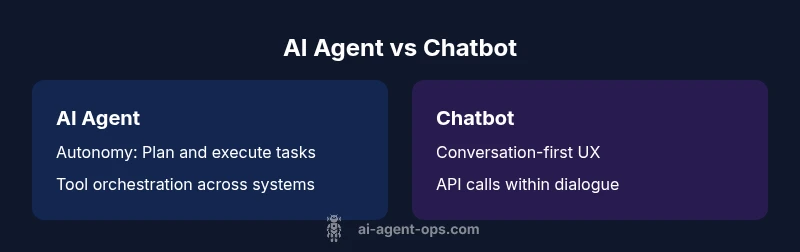
Difference Between AI Agent and Chatbot: A Comprehensive Comparison
A practical guide distinguishing AI agents from chatbots, covering definitions, architectures, deployment scenarios, and decision criteria for automating workflows and enhancing customer interactions.


AI agents are autonomous, goal-directed systems that orchestrate tools and data to complete end-to-end tasks. Chatbots are conversational interfaces designed to simulate natural dialogue with users. This comparison explains the key differences, typical use cases, and how teams can blend both approaches for smarter automation.
The core distinction: autonomy vs conversation
In the landscape of modern AI, the difference between ai agent and chatbot centers on autonomy, scope, and how they interact with the wider software ecosystem. AI agents are designed to operate with a degree of self-direction, planning a sequence of actions, selecting tools, and monitoring outcomes across multiple systems. Chatbots, by contrast, specialize in natural language dialogue with users, guiding conversations or answering questions within a defined domain. According to Ai Agent Ops, the boundary is primarily about autonomy and orchestration scope: agents orchestrate tasks across tools, while chatbots orchestrate dialogue with humans. This fundamental distinction drives how teams approach architecture, security, governance, and measurement. As you read, keep in mind that many teams adopt a hybrid strategy—deploying agents to automate workflows while using chatbots to provide user-friendly interfaces for those workflows. The Ai Agent Ops team emphasizes that choosing the right mix hinges on the problem you aim to solve, the level of automation required, and the context of user interaction.
From a product perspective, this distinction matters because it affects data access patterns, latency budgets, and the governance model you’ll need to manage risk and compliance across systems.
Core Definitions: AI agents vs chatbots
At a high level, AI agents are software entities with agency. They can interpret goals, plan a sequence of steps, decide when to invoke external tools, and adapt behavior based on feedback from the environment. Chatbots are conversational programs designed to simulate human-like dialogue, often focusing on intent recognition, context maintenance within a session, and providing helpful responses. The key difference is not just how they talk to users but what they are allowed to do beyond conversation. If you expect an automation task to involve multiple apps, data transforms, or decision points, an AI agent is usually the appropriate choice. If the need is to answer questions, provide support, or guide a user through a step-by-step flow in a conversation, a chatbot generally suffices. Understanding this distinction helps teams align project goals with technical requirements and governance constraints.
Autonomy and decision-making
Autonomy defines how much initiative an AI system takes without human prompting. AI agents can formulate goals, select tools, reason about consequences, and adjust their approach based on feedback. They trade off interpretability for flexibility because the decision path may involve planning across several steps and means to an end. Chatbots, meanwhile, rely on user input to trigger actions and respond with dialogue-driven outputs. They excel at maintaining context within a conversation, but their ability to autonomously execute multi-step tasks across systems is limited unless integrated with external orchestrators. The distinction matters when you’re designing for resilience, auditability, and end-user experience: agents enable proactive automation; chatbots provide guided human-in-the-loop interactions.
Tooling and integration patterns
AI agents are typically embedded in a larger orchestration layer that can coordinate multiple services, databases, and APIs. They require tool registries, policy frameworks, and a planning engine to decide which action to take next. The integration pattern often includes connectors to enterprise systems, event streams, and data transformation components. Chatbots rely on NLP models and dialogue management to interpret user intents and maintain conversation context. They may call APIs to fetch information or trigger simple actions, but they usually don’t manage cross-system workflows without an added orchestration layer. When designing for scale, you’ll want to separate the agent’s task execution logic from the chatbot’s conversational layer to keep concerns clean and auditable.
Conversation design and user experience
Chatbots focus on natural language interactions, tone, and user-friendly dialogue flows. They are designed to handle intent recognition, slot filling, and graceful error handling within the chat interface. The UX goal is to feel as natural as possible, with helpful prompts, clarifying questions, and fallback behaviors. AI agents shift the UX toward transparency about actions, progress, and results. Users may not see the orchestration behind the scenes, but they experience faster task completion and automation outcomes. A hybrid approach can combine the best of both: a chatbot that initiates a task and an agent that completes the task across tools while providing progress updates in the chat.
Architecture and components
An AI agent combines a planning component, action/controller layer, and a tool integration layer. The planner decides the next action; the controller executes it by calling tools, APIs, or automation scripts; the integration layer handles data routing, authentication, and error handling. A chatbot architecture centers on natural language understanding, dialogue state, and a response generator. While the chatbot may integrate with external services, the orchestration of multi-step tasks generally requires a separate workflow engine or an agent framework. Understanding these architectural boundaries helps teams design maintainable, scalable systems with clear ownership of tasks and conversations.
Real-world use cases by domain
Across industries, AI agents power workflow automation: orchestration of data pipelines, multi-step approvals, cross-system task execution, and predictive decision support. In finance, agents can aggregate data from multiple sources, trigger compliant workflows, and monitor risk signals with minimal human intervention. In e-commerce, agents can manage order orchestration, inventory checks, and shipping updates across partners. In IT operations, agents can perform remediation tasks by coordinating monitoring tools and runbooks. Chatbots align with customer-facing needs: answering product questions, guiding onboarding, and providing conversational access to knowledge bases. A blended approach is common: chatbots initiate actions, and agents complete complex workflows behind the scenes, delivering a seamless user experience.
Implementation patterns and best practices
When implementing, focus on clear separation of concerns: define the agent’s autonomy boundary, establish tool contracts, and implement robust monitoring and governance. Start with a measurable task cluster, then incrementally add tools and capabilities. For chatbots, invest in robust intent recognition, contextual memory, and fallback strategies. For agents, design explicit safety checks, auditing, and rollback plans. Key best practices include: 1) explicit task scopes, 2) transparent decision logs, 3) strong data governance, and 4) ongoing evaluation against defined success metrics. A hybrid architecture can provide the agility of chat-driven interfaces with the reliability of automated workflows.
Evaluation metrics, ROI considerations, and governance
Evaluation for AI agents and chatbots should cover both effectiveness and efficiency. For agents, track task completion rates, time-to-resolution for multi-step workflows, and error drift across tool integrations. For chatbots, measure dialogue quality, user satisfaction, and containment to prevent escalations. ROI depends on baseline process efficiency, the complexity of tasks automated, and maintenance costs for connectors and models. Governance is critical: implement access controls, auditable action trails, and risk assessments for tools and data. A well-governed hybrid system yields faster automation with a positive user experience and controlled risk.
Security, privacy, and compliance
Security considerations differ by mode. AI agents require robust authorization to external tools, secure secrets management, and runtime monitoring to detect anomalous behavior. Chatbots must safeguard conversation data, enforce data minimization, and ensure compliance with privacy regulations in conversations. Both modes benefit from a shared security model: least privilege access, registry-based control of tools, and continuous auditing. Implement data redaction for sensitive fields, encryption at rest and in transit, and clear data retention policies. Regular security reviews, threat modeling, and incident response planning are essential for maintaining trust as automation scales.
Roadmap to adoption: a practical, phased approach
Begin with clear business goals and a problem list suitable for automation. Phase 1 focuses on pilot projects pairing a chatbot with a lightweight automation trigger. Phase 2 expands to an AI agent capable of coordinating multiple tools for end-to-end tasks within a defined domain. Phase 3 scales across teams, adds governance controls, and refines metrics. Throughout, maintain a feedback loop with users, monitor performance, and adjust tool inventories. A pragmatic hybrid approach often yields the best outcomes, combining conversational UX with robust automation.
Authority sources
This article references widely respected sources to support best practices and governance expectations. See:
- https://www.nist.gov/topics/artificial-intelligence (NIST AI guidance)
- https://plato.stanford.edu/entries/artificial-intelligence/ (Stanford encyclopedia on AI)
- https://www.sciencedaily.com/releases/ai/ (Science news coverage on AI topics)
Comparison
| Feature | AI Agent | Chatbot |
|---|---|---|
| Autonomy & goal-directed behavior | Autonomous, multi-step task orchestration across tools | Reactive, dialog-focused responses within a conversation |
| Tool integration & orchestration | Orchestrates tools, data flows, and APIs across ecosystems | Calls APIs within a chat flow; limited cross-tool orchestration |
| Decision-making style | Planning-based, goal-first reasoning with state awareness | Intent-driven, context-preserving dialogue and retrieval |
| Use-case focus | End-to-end automation, multi-step workflows, system-wide tasks | Guided information retrieval, support, and conversational tasks |
| Required infrastructure | Agent framework, tool registry, policy engine | NLP/dialogue platform, basic integration hooks |
| Best for | Automation-heavy environments needing cross-system coordination | Conversation-centric interfaces demanding natural dialogue |
| Cost considerations | Higher upfront complexity but potential for greater automation ROI | Lower upfront cost with ongoing API and model usage |
Positives
- Automates repetitive tasks across multiple tools, reducing manual work
- Enables end-to-end workflows with minimal human intervention
- Consistent decision-making across complex processes
- Scales automation across domains with proper governance
- Supports proactive recommendations and orchestration insights
What's Bad
- Higher initial setup and integration effort
- Requires robust security and governance to prevent drift
- Risk of task drift if context is incomplete or tools change
- Potentially higher ongoing costs due to API calls and compute
AI agents offer superior automation and orchestration; chatbots excel in conversational tasks
The Ai Agent Ops team recommends prioritizing AI agents for automation-heavy workflows while employing chatbots for customer-facing conversations. A hybrid approach often yields the best balance of efficiency and user experience, with governance to manage risk.
Questions & Answers
What exactly is an AI agent, and how is it different from a chatbot?
An AI agent autonomously selects actions to achieve goals, coordinating tools and data across systems. A chatbot focuses on conversational interaction with users, often without cross-system orchestration. The difference lies in autonomy, scope, and the ability to perform tasks beyond dialogue.
An AI agent acts on tasks across tools; a chatbot guides conversations. The agent automates workflows, the chatbot talks with users.
When should I use an AI agent instead of a chatbot?
Use an AI agent when your goal is end-to-end automation across multiple tools and domains. Use a chatbot when the primary need is user-facing conversation, information retrieval, or guided steps within a single domain.
Choose an AI agent for automation; choose a chatbot for conversation.
Can I combine AI agents and chatbots in the same product?
Yes. A common pattern is a chatbot that initiates actions, while an AI agent completes complex workflows behind the scenes. This hybrid approach provides a smooth user experience with robust automation.
Yes—start the chat, and let the agent handle the rest.
What governance considerations matter for AI agents?
Governance should cover access control, auditing of actions, tool contracts, data handling, and compliance with privacy and security standards. Establish clear ownership and rollback plans for automated tasks.
Set up access controls, audits, and clear ownership for automated tasks.
What metrics indicate success for AI agents?
Key metrics include task completion rate, time-to-resolution for automated flows, error drift across tools, and the return on automation investment. For chatbots, track user satisfaction and resolution rate.
Look at task completion, time saved, and user satisfaction.
Are there common pitfalls when starting with AI agents?
Common pitfalls include scope creep, insufficient tool coverage, noisy data affecting decisions, and underestimating maintenance costs for connectors and policies. Start with a well-defined pilot and incrementally expand.
Define a tight pilot, then scale carefully with governance.
Key Takeaways
- Define the problem clearly before choosing an approach
- Use agents for end-to-end automation and cross-tool orchestration
- Leverage chatbots for guided conversations and information access
- Adopt a hybrid strategy with strong governance
- Measure outcomes with task completion, user experience, and cost metrics