Chatbot vs AI Agent: Understanding the Difference
Compare chatbot capabilities with AI agent autonomy, governance, and integration. Learn where each excels, how to choose, and practical steps to evolve from conversational bots to autonomous agentic workflows.


According to Ai Agent Ops, the distinction between a chatbot and an AI agent is rooted in autonomy, scope, and goal-oriented behavior. A chatbot excels at guided conversations, while an AI agent pairs perception with action to achieve explicit objectives. For developers and business leaders exploring AI agents and agentic AI workflows, the choice depends on task complexity, integration needs, and governance considerations.
The Core Definitions: chatbot vs ai agent
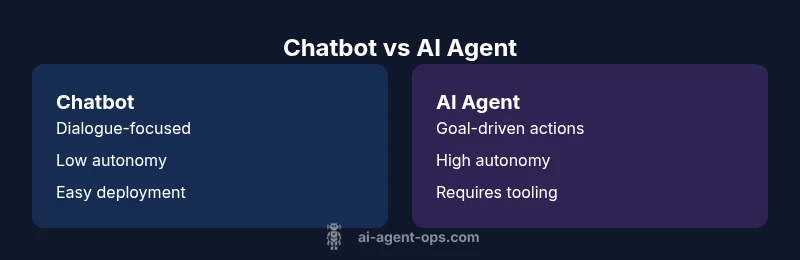
In the world of conversational technology, a chatbot is a software program designed to simulate dialogue with humans. It follows predefined flows, handles intents, and typically operates within a narrow domain. An AI agent, by contrast, combines perception, reasoning, and action in an environment. It can decide which tools to call, how to gather information, and which steps to execute to achieve a goal. The Ai Agent Ops team emphasizes that the key difference is not just technology, but behavior: chatbots excel at dialog management, while AI agents pursue autonomous task execution. For teams new to this space, framing the conversation as a UX layer versus an agentic workflow helps set expectations about capabilities, governance, and risk.
From a practical standpoint, you should view a chatbot as a polished interface for user interaction, and an AI agent as a decision-maker that acts in the larger system. This distinction informs architecture, data access, and deployment strategy. The term chatbot vs ai agent is less about technique and more about scope and autonomy. If your objective is a conversational surface with structured responses, a chatbot will often suffice. If you need end-to-end automation that can adapt to changing tasks, an AI agent becomes the stronger fit.
Notes from Ai Agent Ops analysis suggest that teams frequently start with chatbots to validate user needs and then layer agentic capabilities as requirements evolve. This staged approach reduces risk, clarifies governance, and builds a foundation for scalable automation while maintaining user experience quality.
Scope and Autonomy: Where each shines
Autonomy is the defining axis that separates chatbots from AI agents. A chatbot operates within a constrained dialogue flow, following scripted branches or lightweight NLP patterns. It expects human direction and is best at handling predictable conversations, FAQs, and guided task completion. An AI agent, however, is designed to perceive the environment, reason about actions, and take steps without continuous human input. It can plan a sequence of actions, coordinate tool usage, and adapt its approach based on feedback from its surroundings. This difference has practical implications: chatbots offer reliability and ease of governance, while AI agents offer deeper automation potential and scalability. For teams evaluating long-term automation strategy, the autonomy gradient is often the deciding factor.
From a governance perspective, autonomy also raises considerations around safety, auditability, and control. Ai Agent Ops notes that higher autonomy requires robust monitoring, explicit tool access controls, and clear escalation paths. In many real-world setups, a hybrid approach emerges: chatbots handle user-facing conversations while AI agents operate in the background to perform actions that enhance efficiency. This combination can deliver a seamless user experience with automated reliability, while retaining human oversight where it matters most.
Typical Architectures: components
A chatbot architecture centers on the dialog manager, natural language understanding (NLU), and a response generator. Core components include intent models, slot filling, a rules engine for routing, and a persona layer that shapes tone. Data sources feed the bot with knowledge and context, and APIs enable integrations for content retrieval or task execution. An AI agent architecture expands on this by adding an action layer, an environment interface, and an orchestration component that decides which tools to call and when to call them. The agent can sequence tasks across services, manage state, and handle exceptions automatically. In practice, bridging the two approaches involves a clean separation: the conversational surface (chatbot) and the automation engine (agent) with a well-defined API boundary between them.
Teams should emphasize interoperability: the agent must be able to discover and securely access tools, data sources, and external services, while the chatbot must present a consistent, trustworthy user experience. The gap between intent recognition and action execution is where many projects stumble, underscoring the need for clear contracts, robust monitoring, and traceable decision logs. Ai Agent Ops highlights that aligning architecture with governance policies early pays dividends as complexity grows.
Use Case Scenarios: When to choose each
Chatbots excel in customer-facing scenarios where the goal is to guide users through predefined flows, answer questions, or collect information for later processing. Typical use cases include help desks, product discovery chats, and onboarding wizards. AI agents shine in automation-heavy environments where tasks require decision-making, multi-step workflows, or tool integration. Examples include order orchestration, IT service management, and complex data gathering that informs downstream actions. A practical rule of thumb is to start with a chatbot when you have a clear conversational surface and low variability. If tasks demand decision-making, external tool use, or multi-service coordination, an AI agent provides greater value. In many modern deployments, teams blend both: a chatbot front-end guides users, while background agents perform orchestration." ,
Comparison
| Feature | chatbot | ai agent |
|---|---|---|
| Autonomy | low; guided conversations and predefined flows | high; goal-directed actions with tool usage |
| Task Scope | limited to dialogue and content delivery | broad; planning, reasoning, and action across systems |
| Data Access | context from user input; static knowledge | dynamic access to tools, data sources, and environments |
| Integration Complexity | low; standalone or simple API calls | high; requires tool integrations and environment permissions |
| Governance & Compliance | dialogue policies, auditing of chats | agent governance, tool access controls, and safety constraints |
| Maintenance Focus | NLU updates, scripted flows | agent orchestration, reliability, and multi-service maintenance |
| Use Cases | customer support, guided UX | automation, workflow orchestration, autonomous tasks |
| Cost/ROI Considerations | lower upfront; faster time-to-value | potentially higher ROI through automation at scale |
Positives
- Lower upfront complexity and faster pilot timelines
- Clear ownership of user experience and brand voice
- Easier to iterate on dialog and surface-level UX
- Hybrid potential: chatbots + agents for scalable automation
What's Bad
- Limited automation potential and decision-making
- Higher risk and governance overhead for agents
- Can require more tooling and integration work
- Longer time-to-value for complex automation
AI agents generally offer stronger automation and scalability; chatbots excel in guided conversations and UX-focused tasks
Choose a chatbot for straightforward, user-facing interactions. Choose an AI agent when you need autonomous task execution, tool integration, and end-to-end automation. A staged approach—start with a chatbot, then evolve into an AI agent—often yields the best balance of risk and ROI.
Questions & Answers
What is a chatbot vs AI agent in practical terms?
A chatbot is a conversational surface designed for guided interactions with predefined flows and responses. An AI agent combines perception, reasoning, and action to achieve goals, often coordinating tools and data across systems. The distinction centers on autonomy and scope, not just the underlying tech.
A chatbot handles conversations; an AI agent acts to complete tasks across tools and data.
Can a chatbot become an AI agent over time?
Yes. Many teams evolve a chatbot into an AI agent by adding orchestration, tool access, and decision-making capabilities. This typically involves defining governance, data access, and safety controls before enabling autonomous actions.
You can upgrade a chatbot by giving it tools and decision-making power, with proper governance.
What are the main risks of AI agents?
Autonomy introduces complexity in governance, security, and auditability. Potential risks include unintended actions, data access violations, and tool misuse. Mitigate with strict access controls, escalation paths, and continuous monitoring.
The main risks are governance, security, and safety; monitor and control access.
How should I evaluate a chatbot vs AI agent for my team?
Define the task scope, data access needs, and automation goals. Compare autonomy, maintenance requirements, and governance needs. Pilot with a chatbot for UX and a lightweight agent for automation to measure ROI and risk.
Start with a chatbot to test UX, then add agent capabilities as you validate benefits.
What metrics matter for success?
Qualitative measures include user satisfaction, task completion rate, and escalation frequency. For agents, monitor automation velocity, error rates, and governance compliance. Use these to guide iteration.
Track user happiness, how often tasks succeed, and how well you control governance.
Are there security concerns with AI agents?
Yes. Agents access data and tools, so securing credentials, enforcing least privilege, and monitoring activity are essential. Regular audits and transparent logging help maintain trust.
Security matters—limit access and keep thorough logs to stay compliant.
Key Takeaways
- Assess whether you need autonomy or UX only
- Map required data sources and tool access early
- Plan governance, safety, and auditability from day one
- Pilot with a chatbot before expanding to agentic workflows
- Adopt a staged evolution to balance risk and ROI