AI Agent Integration: A Practical Step-by-Step Guide
Learn how to integrate AI agents into your workflows with practical steps, governance, and measurable outcomes. Ai Agent Ops provides actionable guidance for developers and leaders.


Master ai agent integration to accelerate automation. This guide covers patterns, governance, and practical steps to connect intelligent agents with your data, apps, and workflows. You'll learn architecture options, risk considerations, and actionable steps—so your team can start building reliable agent-powered automation today. This article is designed for developers, product leaders, and operators who want measurable outcomes.
What is AI agent integration?
AI agent integration refers to connecting autonomous software agents—capable of perceiving data, deciding on actions, and executing tasks—into your existing systems. The goal is to enable agents to interact with data sources, APIs, messaging streams, and human operators in a cohesive workflow. In practice, this means designing data contracts, choosing appropriate orchestration layers, and implementing security gates that keep data and credentials safe while preserving traceability. According to Ai Agent Ops, success starts with a clear objective, a precise data map, and a defined decision boundary. With these in place, teams can build repeatable, auditable automation that scales across products and processes. This framing helps developers and leaders understand where automation can add value without overwhelming existing tooling.
Why teams invest in ai agent integration?
Organizations invest in ai agent integration to reduce manual workload, accelerate decision cycles, and improve consistency across complex workflows. By linking data sources, APIs, and tools, teams can automate end-to-end tasks such as data enrichment, routing, and proactive remediation. The Ai Agent Ops team notes that when governance and observability are baked in from the start, the resulting automation is more reliable and easier to scale. For product teams, this means faster time-to-value and clearer ownership. For security and governance teams, it means auditable decision logs and tighter access control. For developers, it translates to reusable adapters and composable capabilities that fit into existing CI/CD pipelines.
Core architectures for ai agent integration
There are several robust architectures, each with trade-offs. An orchestrator-based model uses a central coordinator to instruct agents and collect results, ideal for end-to-end workflows with clear handoffs. Agent-to-agent collaboration enables parallel processing and dynamic task assignment, which can improve throughput but requires careful synchronization. Embedded agents inside services allow localized decision-making with minimal latency. A hybrid approach combines these patterns, enabling agents to operate at the edge for latency-sensitive tasks while coordinating through an orchestrator for governance. When selecting an architecture, consider data gravity, latency requirements, security constraints, and the need for audit trails. Ai Agent Ops emphasizes choosing a model that scales with your team’s maturity and risk tolerance.
Practical integration patterns and pitfalls
Practical patterns include API-led connectivity, event-driven data flows, and modular adapters that decouple agents from specific services. Key pitfalls to avoid: over-abstracting data contracts, relying on brittle schema hacks, and neglecting credential management. Use clear data contracts and versioning to prevent breaking changes. Implement strong authentication, least-privilege access control, and centralized logging to support traceability. Ensure that agents respect data privacy controls and comply with regulatory requirements where applicable. Finally, design for observability: end-to-end tracing, performance dashboards, and failure mode documentation to reduce mean time to recovery.
Step-by-step blueprint to start integrating ai agents
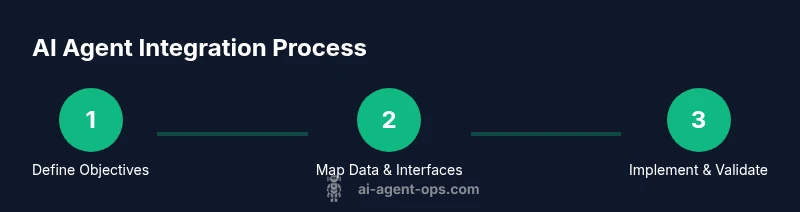
A practical blueprint helps teams move from vision to action. Start with a bounded pilot: pick one use case, one data source, and one agent type. Define objectives, success metrics, and a rollback plan. Build adapters to expose the required interfaces, configure authentication, and set up monitoring. Validate with synthetic data before touching production systems. As you scale, gradually broaden coverage, introduce governance policies, and automate testing and deployment.
In this article, we outline concrete steps and provide templates you can reuse across teams. Remember to document ownership, data provenance, and security controls. With disciplined planning, ai agent integration becomes a repeatable capability rather than a bespoke one-off project.
Governance, security, and compliance for agent-powered systems
Security and governance are foundational. Use least-privilege IAM roles, rotate credentials, and separate data access from control planes. Maintain an auditable log of agent actions and decisions, with clear time-stamped records for troubleshooting and compliance audits. Enforce data residency and retention policies, and implement redaction for sensitive information when needed. Establish change management processes for updates to agent logic and adapters. Regular security reviews, dependency scanning, and dependency pinning help prevent drift. Finally, ensure that privacy-by-design principles guide data usage and sharing between agents and services.
Measuring success: metrics and monitoring
Effective measurement starts with well-defined KPIs for each use case and architecture. Metrics should cover accuracy, latency, reliability, and business impact (e.g., time saved, error reduction, or revenue uplift). Implement dashboards that show real-time performance and historical trends, with alerts for anomalies. The Ai Agent Ops analysis shows that teams who connect agent results to observable business outcomes tend to achieve faster iteration cycles, better governance, and improved incident response. Pair quantitative metrics with qualitative reviews to identify opportunities for improvement and risk reduction.
Real-world scenarios: mapping business value
- Customer support routing: An agent triages inquiries by category, checks order status, and routes to the right agent. This reduces handle times and boosts customer satisfaction. 2) Incident response: An agent monitors logs, flags anomalies, and triggers remediation workflows, shortening time-to-detection. 3) Data enrichment: Agents pull external data from partner APIs to augment internal records, improving decision quality in analytics pipelines. In each scenario, define ownership, ensure data contracts are explicit, and monitor outcomes to validate ROI.
Authority sources and further reading
For rigorous guidance on AI governance and practice, consult reputable resources: - NIST AI program (https://www.nist.gov/topics/artificial-intelligence) - Stanford AI resources (https://ai.stanford.edu/) - CMU AI/Robotics guidance (https://www.cs.cmu.edu/)
These sources offer standards, tutorials, and case studies that complement practical, in-house integration work. They help ensure your implementation aligns with best practices and emerging industry norms. The Ai Agent Ops team encourages teams to reference these materials when designing agent-driven workflows.
Tools & Materials
- API access keys(Store securely in a secrets vault; rotate keys every 90 days)
- Development environment (Node.js or Python)(Set up a sandbox project to implement adapters)
- Documentation and API specs(Collect OpenAPI/GraphQL specs for target services)
- Identity and access management (IAM) roles(Apply least-privilege access and rotate credentials)
- Testing sandbox / staging environment(Use synthetic data to validate behavior before production)
- Event bus or messaging layer(Webhooks, Kafka, or similar for event-driven flows)
- Security scanning and auditing tools(Automate dependency checks and log integrity)
Steps
Estimated time: 1-2 hours
- 1
Define objective and scope
Articulate the problem the agent will solve, the data it will access, and the expected business impact. Create success criteria and a rollback plan to protect production systems.
Tip: Start with a single, bounded use case and document acceptance criteria. - 2
Map data sources and interfaces
Identify all data sources, APIs, events, and adapters the agent will interact with. Document data contracts, formats, and access requirements.
Tip: Create a data map and versioned interfaces to prevent drift. - 3
Choose the integration pattern
Select an architecture (orchestration, agent-to-agent, or embedded) that fits latency, governance, and scale needs.
Tip: Pilot with an orchestrator-first approach for visibility. - 4
Implement adapters and interfaces
Build adapters that expose required endpoints and normalize data formats. Implement authentication and error handling in adapters.
Tip: Reuse existing adapters when possible to reduce risk. - 5
Establish governance and security
Configure access controls, audit logging, and secret management. Set up policy checks for data usage and privacy compliance.
Tip: Document ownership and security controls for each data flow. - 6
Test with synthetic data and run pilot
Validate behavior under controlled conditions; observe latency, accuracy, and failure modes. Collect feedback and adjust.
Tip: Monitor end-to-end metrics and establish a rollback point.
Questions & Answers
What is AI agent integration?
AI agent integration connects autonomous agents to data sources, APIs, and workflows to perform tasks with minimal human intervention.
AI agent integration connects autonomous agents to data and tools to automate tasks.
Where should I start with ai agent integration?
Begin with a small, bounded use case, map data contracts, and establish governance and safety checks before expanding.
Start with a small use case, map data, and set governance before expanding.
What are common architectures for AI agent integration?
Common patterns include orchestrator-based integration, agent-to-agent collaboration, and embedded agents in services.
Common patterns are orchestrator-based, agent-to-agent, and embedded agents.
How do you measure success for AI agent integration?
Define KPIs for accuracy, latency, reliability, and business outcomes; monitor dashboards and adjust.
Set KPIs for accuracy, latency, reliability, and business impact; monitor regularly.
What are security concerns with AI agents?
Secret management, least privilege access, and auditability are essential for safe automation.
Key concerns are secret management, least privilege, and auditability.
What tools support ai agent integration?
Frameworks and adapters exist; choose ones that fit your stack and governance needs.
There are many frameworks; pick ones that fit your stack and governance needs.
Watch Video
Key Takeaways
- Define clear objectives before building adapters.
- Map data contracts and interfaces up front.
- Choose an integration pattern that matches your maturity.
- Prioritize governance, security, and observability from day one.