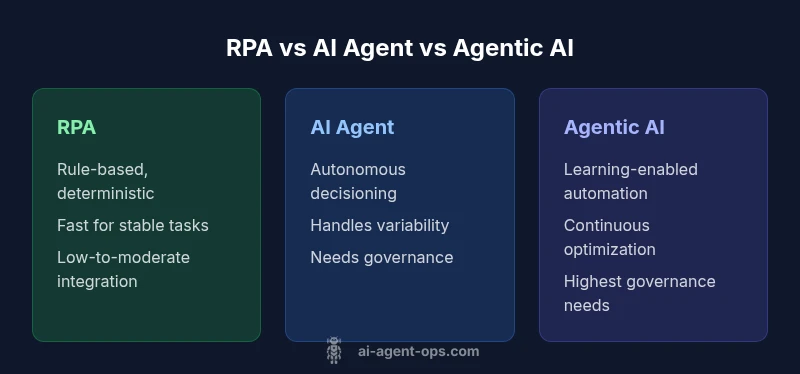
RPA vs AI Agent vs Agentic AI: A Practical Comparison for Automation
Compare RPA, AI agents, and agentic AI to decide the right automation approach for your team. This guide covers definitions, use cases, governance, and decision frameworks for smarter automation.


RPA vs AI Agent vs Agentic AI refers to three automation approaches: RPA (robotic process automation) for rule-based tasks; AI agents for autonomous action within defined goals; and agentic AI, which adds learning and self-improvement to agent behavior. According to Ai Agent Ops, the right choice depends on task complexity, governance, data access, and how you plan to scale automation across teams. In short, start with RPA for stable processes and explore AI agents or agentic AI as complexity grows.
Definitions and Core Concepts
RPA, AI agents, and agentic AI sit on a continuum of automation capabilities. RPA, or robotic process automation, uses software bots to mimic repetitive human actions at the UI level, often in structured processes with little variation. AI agents are autonomous decision-makers that can perceive inputs, select actions, and pursue predefined goals, sometimes beyond a fixed script. Agentic AI adds a meta-layer: agents that can learn from feedback, refine strategies, and adapt behaviors within governance constraints. The distinction matters because it determines data needs, integration patterns, risk profile, and how you measure success. According to Ai Agent Ops, most organizations begin with RPA to stabilize workflows and then layer AI-driven agents to tackle variability and evolving requirements. Viewing these approaches as a spectrum helps product teams design scalable automation roadmaps rather than chasing a single technology upgrade. In practice, you’ll often blend all three in a staged program, applying RPA first, then introducing AI agents, and finally experimenting with agentic AI in controlled pilots.
When to Use RPA
RPA excels at repetitive, rule-based tasks and structured workflows where inputs and outputs are highly predictable. It shines in back-office operations like data entry, form processing, report generation, and system-to-system data transfers. The key advantage is reliability and speed for well-defined processes, with low tolerance for human-like ambiguity. When a process is documented, stable, and rules are unlikely to change in the near term, RPA delivers fast time-to-value and easier governance. However, RPA struggles with exceptions, unstructured data, and processes that require judgment beyond explicit rules. In those cases, you’ll either augment with AI components or pivot toward AI agents to capture decision logic and adaptation.
When to Use an AI Agent
AI agents introduce autonomy to act toward defined goals using perceptions, plans, and actions. They handle more dynamic environments where inputs can vary, and outcomes depend on context. Use AI agents when processes involve decision-making under uncertainty, multi-step reasoning, or interactions with humans and other software systems. While not universally capable of perfect judgment, AI agents excel at handling exceptions that would derail rigid scripts and can coordinate tasks across disparate services, APIs, and data sources. They require governance around goal formulation, success criteria, and safety constraints to avoid unintended actions.
What Is Agentic AI?
Agentic AI combines agentive behavior with learning capabilities. These systems not only pursue goals but also improve their strategies over time through feedback loops, experimentation, and model updates. Agentic AI is best suited for long-running automation programs where processes evolve as the business learns. It enables continuous improvement across workflows, enabling teams to reduce manual intervention while maintaining control through policy, monitoring, and auditing. The trade-offs include greater complexity, higher data requirements, and the need for robust governance to prevent drift and ensure accountability.
Core Differences at a Glance
- Decision Autonomy: RPA is low; AI agents are moderate; Agentic AI is high due to ongoing learning.
- Data Needs: RPA relies on structured data; AI agents need context and perception data; Agentic AI requires feedback signals for learning.
- Handling Unstructured Input: Minimal for RPA, better with AI agents, best with agentic AI when integrated with robust perception.
- Learning Capability: None for RPA; limited learning for AI agents; continuous learning for agentic AI.
- Governance & Compliance: Simple for RPA; more complex for AI agents; most complex for agentic AI due to adaptive behavior.
- Integration: RPA integrates readily with legacy systems; AI agents need middleware and API orchestration; agentic AI demands end-to-end data pipelines and monitoring.
Governance, Data, and Security Considerations
Automation governance is essential regardless of approach. RPA requires audit trails, change control, and strict versioning of scripts. AI agents introduce policy controls and safety nets; you need to define what constitutes acceptable decisions, boundaries, and escalation paths. Agentic AI adds a layer of monitoring to detect drift, misalignment with business objectives, and data privacy concerns. Data access, consent, and retention policies should be established early, with clear ownership for models, simulations, and decision logs. From a security perspective, access to sensitive systems must be tightly controlled, with least-privilege principles and secure endpoint configurations. A practical approach is to implement a tiered governance model: baseline controls for RPA, formal policy wrappers for AI agents, and continuous oversight for agentic AI with dashboards and alerting.
Integration and Ecosystem Fit
RPA typically acts as a bridge between legacy systems, often at the UI layer or via API adapters. It is most effective when the existing stack is stable and well-documented. AI agents require more sophisticated integration, including data connectors, event streams, and orchestration platforms to coordinate actions across multiple services. Agentic AI demands even stronger integration: data pipelines for feedback, monitoring systems for drift detection, and governance layers that enforce ethical and legal constraints. Organizations should map their current tech stack, identify choke points, and choose integration patterns that minimize risk while maximizing agility. A phased integration plan—starting with RPA, then AI agents, then agentic AI—can reduce disruption while delivering measurable value.
Economic Considerations: Cost and Value
Costs for automation projects vary with scope, complexity, and governance requirements. RPA typically involves licensing, bot maintenance, and integration work, with relatively predictable monthly costs. AI agents and agentic AI introduce ongoing data, model, and infrastructure expenses, but can unlock greater productivity by handling uncertainty and reducing manual interventions. A pragmatic approach is to quantify value in terms of time saved, error reduction, and decision accuracy. Consider total cost of ownership, including training, onboarding, and the cost to extend automation to new domains. A staged program allows you to realize early ROI from RPA while preparing for more ambitious, learning-enabled automation later.
Real-World Scenarios and Patterns
Across industries, teams often pilot RPA to stabilize core processes first. Ai Agent Ops analysis shows that this staged approach yields faster wins and helps build governance scaffolds before introducing AI agents to handle exceptions and dynamic workflows. In customer service, RPA can automate data handoffs; AI agents can triage requests; agentic AI can learn from outcomes to improve routing decisions. In finance, RPA handles reconciliations, while AI agents optimize approval workflows and agentic AI refines anomaly detection over time. A key pattern is progressive integration: start with rule-based automation, add autonomous decision-making, and finally enable learning-enabled optimization under strict controls.
Roadmapping a Hybrid Approach
The most resilient automation strategies blend all three capabilities in a controlled roadmap. Begin with RPA to stabilize repetitive tasks, implement AI agents for adaptive decisioning on higher-volume processes, and pilot agentic AI within a governed sandbox to measure learning gains. Define success metrics early, such as cycle time reduction and error rate improvements, and establish escalation protocols for edge cases. Budget for data management, monitoring, and governance tooling to ensure safety and accountability as you scale. The result is a flexible automation platform capable of handling both predictable workloads and evolving business needs.
Common Pitfalls and How to Avoid Them
Common mistakes include over-scoping a single solution, underinvesting in governance, and assuming models will be perfect out of the box. Start with a small, bounded pilot to validate gains before expanding. Invest in data quality, explainability, and observability so stakeholders can trace decisions. Avoid chasing the newest technology for its own sake; prioritize compatibility with your existing processes and teams. Create clear owner roles, escalation paths, and documentation to sustain momentum and manage risk as you mix RPA, AI agents, and agentic AI.
How to Decide: A Step-by-Step Framework
- Inventory processes: categorize by rule-based vs. decision-driven vs. learning-enabled needs. 2) Define governance: set policies for escalation, monitoring, and accountability. 3) Pilot with a phased plan: start with RPA, then add AI agents, finally test agentic AI in a controlled environment. 4) Measure value: track time saved, defect reduction, and learning impact. 5) Scale with safeguards: implement access controls, audits, and drift detection. This framework aligns with Ai Agent Ops guidance and helps teams choose the right mix for their automation journey.
Feature Comparison
| Feature | RPA | AI Agent | Agentic AI |
|---|---|---|---|
| Decision Autonomy | Low (predefined rules) | Moderate (goal-driven actions with context) | High (learning-enabled with evolving goals) |
| Data Requirements | Structured data, deterministic inputs | Contextual data and perception signals | Extensive data with feedback loops |
| Handling Unstructured Data | Poor; relies on structured screens | Good with NLP/AI components | Excellent with multimodal data and feedback |
| Learning Capability | None; static workflows | Learning within defined goals | Ongoing learning and adaptation |
| Governance & Compliance | Straightforward auditing; centralized scripts | Policy-driven controls and monitoring | Robust governance with model monitoring |
| Integration & Ecosystem | Low-to-moderate; UI/API hooks to legacy apps | Middleware and API orchestration | End-to-end data pipelines and telemetry |
| Best Use Case | Back-office, data entry, form processing | Dynamic decision tasks and cross-system orchestration | Continuous improvement across flows |
Positives
- Clarifies which automation layer fits a given problem
- Helps avoid over-commitment to a single approach
- Supports staged, lower-risk implementation
- Encourages governance and measurable ROI
- Promotes scalability from simple tasks to adaptive processes
What's Bad
- RPA can become brittle if processes change frequently
- AI agents require more data, governance, and risk controls
- Agentic AI increases complexity and monitoring needs
- Integration across legacy systems can be challenging
RPA for fixed processes; AI agents for adaptive tasks; agentic AI for learning-enabled automation when governance is strong
No one-size-fits-all solution. Begin with RPA to stabilize operations, layer AI agents for variability, then explore agentic AI in controlled pilots to optimize over time. A staged, governed approach minimizes risk while maximizing ROI.
Questions & Answers
What is RPA and when should I use it?
RPA is software that mimics human interactions to automate rule-based, repetitive tasks. It’s ideal for stable processes with clear steps and well-defined inputs and outputs. Use RPA to stabilize workflows before introducing AI components.
RPA automates repetitive, rule-based tasks and is best for stable processes. Start with RPA to get reliable baseline automation before adding smarter tools.
What is an AI agent?
An AI agent is a software entity that perceives its environment, plans actions, and executes tasks to achieve predefined goals. It can operate with less human intervention and handle some variability beyond fixed scripts.
An AI agent acts on goals, perceives context, and makes autonomous decisions to move toward outcomes.
What is agentic AI?
Agentic AI combines autonomous agents with learning capabilities, enabling continuous improvement and adaptation within governance constraints. It is most valuable when processes require long-run optimization.
Agentic AI learns from results and improves over time under guardrails and governance.
How do I decide which approach to use?
Start by classifying tasks as rule-based, decision-driven, or learning-enabled. Apply a staged plan: RPA first, then AI agents, then agentic AI in controlled pilots with clear metrics and governance.
Classify tasks, pilot in stages, and measure outcomes to decide the right mix.
Can these approaches be combined?
Yes. A hybrid strategy often yields the best outcomes: RPA handles stable steps, AI agents tackle dynamic decisions, and agentic AI optimizes over time with feedback.
Absolutely—combine them in a staged roadmap to balance reliability and learning.
What are the security and governance considerations?
Security requires role-based access, audit trails, and strict controls over data and actions. Governance should define escalation paths, monitoring, and policies for model behavior and drift, especially for agentic AI.
Ensure access controls, audits, and clear policies for drift and accountability.
Key Takeaways
- Start with RPA for reliability in stable processes
- Add AI agents to handle variability and decisioning
- Evaluate agentic AI only after governance and data readiness
- Pilot, measure, and govern—don’t sweep all three into production at once