AI Agents vs RPA: A 2026 Comprehensive Comparison
An analytical side-by-side examination of AI agents and RPA, detailing capabilities, use cases, costs, risks, and implementation strategies for developers, product teams, and business leaders exploring agentic automation.


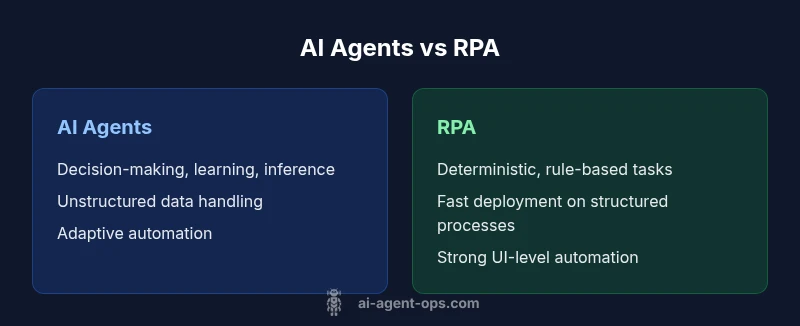
AI agents generally outperform traditional RPA in cognitive tasks, adaptability, and decision making, while RPA remains strong for rule-based, high-volume automation. When choosing between ai agents vs rpa, the best option depends on whether you need autonomous reasoning or predictable process execution. A hybrid approach often yields the strongest ROI in modern automation environments.
Defining ai agents vs rpa
The terms AI agents and RPA describe two approaches to automation that serve different purposes in modern software ecosystems. Robotic process automation (RPA) is a family of software bots designed to imitate human actions on user interfaces, following deterministic rules to complete repetitive tasks. RPA shines in environments where tasks are structured, data formats are stable, and exceptions are rare. By contrast, AI agents combine elements of artificial intelligence—planning, perception, learning, natural language understanding, and sometimes computer vision—to operate with a degree of autonomy and adaptivity. When teams refer to ai agents vs rpa, they are comparing two ends of a spectrum: one emphasizes rule-based reliability, the other emphasizes cognitive flexibility. The core strength of RPA is speed and accuracy in well-defined processes, with minimal need for large data sets. AI agents, however, can reason about uncertain situations, extract insights from unstructured data, and improve their behavior over time through learning. In practical terms, most automation programs today are not a pure choice between ai agents and rpa; they sit on a continuum where lightweight RPA is augmented by AI components, or AI agents are orchestrated within a governance framework that preserves compliance and auditability. This blended approach often provides the most resilient path to scalable automation.
According to Ai Agent Ops, the decision to pursue AI-powered agents vs traditional RPA should be guided by task complexity, data availability, and governance maturity. This lens helps teams avoid over-engineering simple workflows while ensuring critical processes are capable of learning and adapting over time.
Capabilities and limitations
When evaluating ai agents vs rpa, capabilities diverge in meaningful ways. RPA excels at deterministic, rule-based tasks that touch user interfaces, backend systems, and data entry with high accuracy and speed. It requires minimal training for straightforward processes and benefits greatly from well-defined exception handling. AI agents push the envelope by incorporating planning, natural language understanding, and sometimes perception modules such as computer vision to interpret unstructured data and act with limited human intervention. They can guide decision-making, adapt to new contexts, and improve over time through feedback loops. However, AI agents demand higher data quality, robust data pipelines, and more sophisticated governance to manage bias, explainability, and risk. Ai Agent Ops analysis shows that cognitive flexibility often correlates with faster adaptation but requires ongoing data governance and monitoring. In practice, successful deployments often combine both approaches, using RPA for stable, high-volume routines and AI components to handle unstructured inputs, complex decision logic, and exception patterns that evolve over time. The result is a layered automation stack that maintains reliability while expanding reach and resilience.
Use cases across industries
AI agents vs RPA play different roles across sectors. In financial services, RPA handles structured account reconciliations and data migration while AI agents interpret natural language inquiries and summarize risk reports. In healthcare, RPA automates appointment scheduling and claims processing, whereas AI agents extract insights from medical notes and support clinical decision workflows. Manufacturing benefits from RPA for invoicing, order processing, and inventory updates, with AI agents coordinating supply chain signals, forecasting needs, and anomaly detection. In technology and software, AI agents enable conversational automation and autonomous onboarding, while RPA accelerates CI/CD hygiene and ticket routing. The public sector can rely on RPA for permissioning and records processing, while AI agents improve citizen-facing chatbots and document analysis. Across these domains, the combination of both approaches often yields the best outcomes, enabling routine tasks to be automated with RPA while empowering teams to tackle unstructured, ambiguous, or evolving tasks using AI agents.
For teams starting from scratch, map processes first to identify which steps are rule-based and which involve interpretation, data inference, or decision-making. This mapping informs a staged rollout that minimizes risk and accelerates time-to-value.
Architecture and integration patterns
A practical view of ai agents vs rpa in architecture reveals complementary layers. RPA typically sits at the edge of legacy systems, acting as a bridge across screens, forms, and interfaces with a lightweight orchestration layer. AI agents sit higher in the stack, integrating with data lakes, APIs, NLP models, and perception modules to interpret inputs and generate actions. Common patterns include event-driven automation where RPA triggers are initiated by structured events, with AI components providing interpretation or decision support. A service-oriented or microservices approach helps decouple automation logic from business rules, enabling easier governance and testing. Security and governance are central: ensure role-based access control, audit trails, and explainability for AI-driven decisions. Data quality, model monitoring, and bias checks are essential to prevent drift. In hybrid patterns, RPA handles predictable, repeatable tasks, while AI agents manage unstructured data and dynamic decision-making, all orchestrated through a centralized governance layer that tracks outcomes, exceptions, and learning signals.
teams should design with modularity in mind, building reusable components, validated data schemas, and standardized interfaces to reduce integration friction and accelerate experimentation.
Cost, ROI, and TCO considerations
Cost considerations for ai agents vs rpa hinge on complexity, data needs, and governance requirements. RPA deployments can be quick and inexpensive for simple, repetitive processes, with predictable licensing and infrastructure costs. AI-powered automation typically requires investment in data pipelines, model hosting, and monitoring infrastructure, which increases total cost of ownership but expands capabilities beyond rigid rules. ROI depends on time-to-value, error reduction, and the scope of processes that can be automated end-to-end. A hybrid approach may improve ROI by rapidly automating high-volume, rule-based tasks with RPA while lifting more nuanced processes with AI components, reducing manual intervention and cycle times. Organizations should plan for ongoing maintenance, model updates, and governance reviews to ensure long-term value and risk mitigation. Ai Agent Ops’s ongoing guidance emphasizes balancing speed, risk, and capability growth when budgeting for ai agents vs rpa implementations.
Practical budgeting strategies include piloting in a contained domain, gradually expanding scope, and investing in a data strategy that supports both automated rule-based work and AI-driven insights. This approach helps teams realize early wins while building a scalable foundation for intelligent automation.
Tip: avoid paying for capability you won’t use; prioritize use cases that clearly differentiate AI agents from RPA and quantify expected improvements to time, accuracy, and decision quality.
Security, governance, and risk considerations
Automation at scale introduces governance, security, and risk considerations that apply to both ai agents and RPA, but with different emphasis. RPA often emphasizes access controls, audit trails, and deterministic behavior, which makes compliance straightforward if processes are well documented. AI agents add layers of risk related to data privacy, model bias, explainability, and drift. Governance must address model lifecycle management, monitoring for anomalous behavior, and clear escalation paths for uncertain decisions. Data governance is critical when AI components process sensitive information; ensure end-to-end data lineage, retention policies, and encryption. Security considerations include secure APIs, least-privilege access, and robust authentication for automation agents interacting with enterprise systems. Regular security testing, including penetration testing of automation scripts and model injection checks, helps prevent exploitation. Finally, risk management should align with regulatory obligations and internal controls, providing traceability across decisions and actions performed by AI agents and RPAs. A well-designed program treats AI agents as augmenters of human capability while preserving human oversight where appropriate, which is especially important in regulated industries and mission-critical workflows.
Implementation roadmap for teams evaluating ai agents vs rpa
- inventory current processes: separate rule-based, highly structured tasks from those requiring interpretation or decision-making.
- define success metrics: accuracy, time-to-value, error rate, and governance compliance.
- pilot scope: start with a single, high-volume rule-based process for RPA and a loosely structured process for AI agents.
- establish data strategy: ensure data quality, lineage, and privacy controls for AI components.
- select architecture: choose a hybrid stack with a centralized monitoring and governance layer.
- implement incrementally: deploy, measure, and iterate with clear rollback paths.
- scale responsibly: broaden automation in stages, maintaining strong risk controls and audits.
- foster talent and governance: train teams in AI literacy and implement ongoing model management practices.
- evaluate outcomes and refine: use insights to optimize both automation fronts and reassess priorities.
This practical roadmap helps teams avoid common pitfalls and accelerates maturity in automation programs that combine ai agents and RPA.
Hybrid patterns: combining AI agents and RPA for best ROI
Hybrid automation patterns leverage the strengths of both approaches. One common pattern is 'RPA as the runner, AI as the thinker': RPA handles deterministic screen-level actions while AI agents interpret unstructured input, decide on next steps, and adapt to exceptions. Another pattern is 'AI-assisted RPA': AI components prepare data, classify intent, or extract information that RPA uses to execute reliable workflows. A third pattern is 'orchestrated layers': a governance layer coordinates task assignments, monitors outcomes, and routes activity between RPAs and AI agents based on risk, confidence scores, and business rules. The key to success is clear boundaries, well-defined interfaces, and robust monitoring—ensuring predictability where needed while maintaining flexibility where data or context change. Organizations should also invest in proper change management and stakeholder alignment to realize the full ROI of hybrids, including faster onboarding, reduced manual intervention, and improved user experiences across departments.
Measuring success and maturity models
Measuring success requires a combination of operational metrics and capability maturity indicators. Quantitative metrics include cycle time reduction, error rate improvement, and throughput gains for automated processes. Qualitative measures cover user satisfaction, decision quality improvements, and the perceived reliability of automated tasks. A maturity model helps teams track progress from ad hoc automation to fully governed, intelligent automation. Level 1 focuses on isolated RPAs, Level 2 adds AI-enabled components for data interpretation, Level 3 achieves end-to-end intelligent processes with measurement and governance, and Level 4 emphasizes continuous optimization and governance excellence. Establishing a continuous improvement loop is essential: collect feedback, audit outcomes, retrain models when appropriate, and recalibrate automation rules as business needs evolve. This structured approach supports sustained value realization and helps organizations navigate the evolving landscape of ai agents vs rpa with confidence.
Comparison
| Feature | AI agents | RPA |
|---|---|---|
| Decision making | Advanced reasoning, planning, and contextual judgment | Rule-based decisions following predefined steps |
| Cognitive capabilities | NLP, vision, learning, adaptation | Limited to structured inputs and exceptions |
| Process scope | End-to-end intelligent workflows including unstructured data | Structured, high-volume tasks with predictable paths |
| Integration complexity | Higher, requires data pipelines and model management | Lower, lighter integration with UI-based automation |
| Data requirements | Needs quality data and ongoing governance | Requires less data, more process documentation |
| Time to value | Longer due to model development and training | Shorter for quick wins with defined flows |
| Best for | Environments needing cognition, learning, and adaptability | High-volume, rule-based tasks with minimal variation |
Positives
- Stronger cognitive capabilities and learning enable broader automation
- Adaptability to new tasks without full reprogramming
- Potential for end-to-end intelligent automation across departments
- Ability to handle unstructured data and complex patterns
- Hybrid patterns can maximize ROI
What's Bad
- Higher upfront complexity and longer time to value
- Increased data and governance requirements
- Greater risk of drift and bias without proper monitoring
- More demanding on skilled resources and operational maturity
Hybrid AI agents plus RPA generally offers the strongest ROI for most organizations.
AI agents excel at cognition and adaptation, while RPA delivers reliability on structured tasks. A blended approach provides speed, scale, and flexibility, supported by governance and data strategies.
Questions & Answers
What is the main difference between AI agents and RPA?
The main difference is that RPA automates rule-based tasks with deterministic steps, often by mimicking human UI interactions, while AI agents add cognition—planning, learning, and perception—to handle unstructured data and adapt to new situations. AI agents can operate with less human input over time, whereas RPA relies on well-defined rules and stable processes.
RPA handles predictable tasks with clear steps, while AI agents add thinking and learning to tackle unstructured data and evolving workflows.
Can AI agents replace RPA entirely?
Not universally. AI agents are powerful for cognitive tasks, but many processes are still best served by traditional RPA for reliability and speed. The strongest strategies combine both to cover structured, unstructured, and decision-driven work.
AI agents and RPA each cover different needs; most organizations benefit from a hybrid approach.
How do I start evaluating ai agents vs rpa in my stack?
Begin with a process inventory to classify tasks as rule-based or cognitive. Run small pilots for both approaches in parallel, with clear success metrics and governance checkpoints. Use a phased plan to scale based on measurable value.
Map processes, run pilots for both approaches, and track clear success metrics before scaling.
What governance practices are essential for AI-enabled automation?
Establish data governance, model monitoring, explainability, and risk controls. Maintain auditable logs for actions taken by AI components, with escalation paths for uncertain decisions and regular reviews of bias and drift.
Governance means data controls, model monitoring, and clear escalation for AI decisions.
What are signs a hybrid approach is needed?
If your processes involve both structured routines and unstructured inputs, and if you need faster adaptation to changing data, a hybrid stack is often warranted. Look for recurring exceptions that resist pure rule-based automation.
If you see structured tasks plus unstructured data and evolving rules, consider a hybrid approach.
Do AI agents require more data and training?
Yes, AI agents typically require quality data and ongoing training or fine-tuning. However, you can start with modular AI components and progressively expand as data quality improves and governance matures.
AI needs data and training, but you can start small and scale with better data governance.
Key Takeaways
- Start with a process map to separate rules from cognition
- Pilot hybrid automation to test end-to-end impact
- Invest in data governance for AI components
- Measure outcomes with a mix of speed, accuracy, and user impact
- Plan governance early to avoid drift and risk