ai agent vs traditional ai: a comprehensive comparison for teams
A rigorous, vendor-agnostic comparison of ai agent vs traditional ai, exploring autonomy, architecture, use cases, and governance to guide teams deciding which approach to adopt.


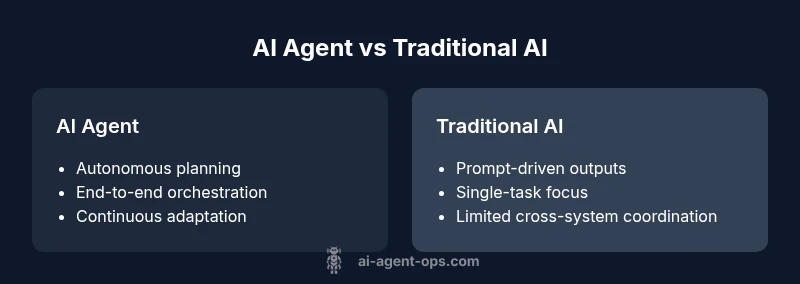
AI agents extend traditional AI by enabling autonomous, goal-directed actions across workflows. This quick answer contrasts ai agent vs traditional ai, highlighting how agentic capabilities expand decision scope, coordination, and integration with business processes. In short: AI agents automate end-to-end tasks with higher adaptability, while traditional AI remains strong for well-defined, standalone tasks.
Overview: What ai agent vs traditional ai means in practice
In modern AI practice, teams distinguish between AI systems that operate within a fixed prompt-response loop and those that act as autonomous agents coordinating multiple steps, inputs, and outcomes. An ai agent vs traditional ai represents a shift from isolated reasoning to goal-directed action across a network of services, data sources, and human-in-the-loop checks. According to Ai Agent Ops, autonomy is not magic; it's a carefully designed set of capabilities that enable an agent to choose among actions, allocate resources, and monitor results without constant manual guidance. The Ai Agent Ops team found that successful agent-based patterns rely on clear objectives, bounded decision spaces, and predictable fail-safes. For many organizations, the core distinction is not just how smart the system is, but how much of the work it can own. The keyword here is agentic AI: systems that can autonomously plan, execute, adapt, and report back, while traditional AI remains excellent at specialized tasks, pattern recognition, and rule-based reasoning. When you compare them under the umbrella of the phrase ai agent vs traditional ai, you see a spectrum from rigid automation to dynamic, end-to-end orchestration across workflows. This article uses that framing to help developers, product teams, and business leaders decide where to start.
Comparison
| Feature | ai agent | traditional ai |
|---|---|---|
| Autonomy and decision-making | High autonomy with goal-directed planning and self-monitoring | Limited to predefined prompts/rules |
| Orchestration and scope | Orchestrates multiple steps across services and data sources | Executes a single task or narrow pipeline |
| Data and integration | Requires ongoing data feeds and governance across systems | Depends on explicit inputs and static data sources |
| Learning and adaptation | Continual learning within agent workflows; feedback loops | Learning often confined to model updates or offline retraining |
| Explainability and control | Operational transparency with action logs and guardrails | Explainability focused on model outputs; less on action-level traceability |
| Cost and ROI considerations | Potential higher upfront and governance costs but faster automation | Lower upfront costs but slower automation for end-to-end tasks |
| Best-fit scenarios | Complex, multi-step processes requiring coordination | Well-defined, narrow tasks with immediate value |
| Risk and governance | Requires governance frameworks and safety nets | Fewer safeguards beyond model-level monitoring |
Positives
- Increases automation by enabling end-to-end workflows
- Improves adaptability to changing data and tasks
- Facilitates better alignment with business processes
- Provides modular, reusable components and patterns
- Encourages experimentation and rapid iteration
What's Bad
- Requires stronger governance and oversight
- Increases integration and monitoring complexity
- Higher upfront design and maintenance costs
AI agents are typically superior for autonomous, end-to-end workflows, while traditional AI excels at narrowly defined tasks.
The choice hinges on the scope of work, governance readiness, and risk tolerance. Start with a tightly scoped pilot of agent-driven automation, then expand as confidence and governance mature. The Ai Agent Ops team recommends aligning the approach with business outcomes and establishing guardrails from day one.
Questions & Answers
What is the difference between an AI agent and traditional AI?
An AI agent acts autonomously to achieve goals by planning, executing, and adjusting actions across multiple systems. Traditional AI typically handles a single task or narrow scope, often in a fixed prompt-response loop. The agent architecture enables cross-domain coordination, while traditional AI concentrates on isolated problems.
AI agents act on goals across systems, while traditional AI focuses on individual tasks.
When should I choose an AI agent over traditional AI?
Choose an AI agent when your workflow requires multi-step coordination, dynamic decision-making, and the ability to adapt to changing data. If the task is well-defined, isolated, and stable, traditional AI may be the simpler, more predictable option.
If you need end-to-end automation, go with an AI agent; for fixed tasks, traditional AI may suffice.
What are common risks with agentic AI?
Key risks include drift in decision quality, integration fragility, governance gaps, and potential safety issues if guardrails are weak. Mitigations focus on robust monitoring, explainability, escalation paths, and clear ownership.
Expect governance and monitoring to be as important as the tech itself.
What metrics matter when evaluating AI agents?
Focus on end-to-end outcomes, cycle times, automation rate, error propagation, and governance indicators like explainability and auditability. Balance these with component-level performance metrics to avoid optimization blind spots.
Look at both end results and how reliably the agent gets there.
Can AI agents replace humans entirely?
No. AI agents are designed to augment human decision-making, handling repetitive or complex coordination tasks while humans oversee strategic choices, safety, and governance. Hybrid models often yield the best outcomes.
AI agents help people focus on higher-value work, not replace them.
Key Takeaways
- Define clear autonomy boundaries before building
- Choose AI agents for cross-functional tasks
- Invest in governance and monitoring from day one
- Prototype with a small end-to-end workflow
- Evaluate ROI with balanced metrics