AI Agent vs Automation: A Data-Driven Comparison
Explore a rigorous, practical comparison of AI agents and automation to help teams decide where cognitive agents add value. Get architecture, ROI, governance, and implementation patterns for both approaches.


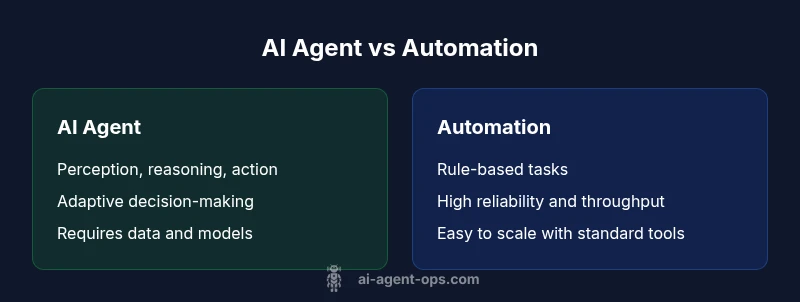
AI agent vs automation: a practical distinction that shapes how teams design smarter workflows. An AI agent combines perception, reasoning, and action, while automation emphasizes repeatable, rule-based tasks. According to Ai Agent Ops, the decision hinges on complexity, adaptability, and governance needs. For most teams, start with automation to stabilize processes, then layer AI agents where cognitive judgment and dynamic decision-making create measurable value.
Defining AI Agents and Automation
AI agents and automation sit at the core of modern workflow design, yet they serve different purposes. An AI agent is a software entity that perceives its environment, reasons about goals, and takes autonomous actions to achieve outcomes. It often relies on models, data streams, and natural language understanding to adapt to new situations. Automation, by contrast, emphasizes repeatable, rule-based execution that may run without human intervention but follows explicit instructions. The distinction matters for architects, developers, and business leaders because it shapes where to invest in data, compute, and governance. In practice, many teams start with automation to reduce manual toil and error, then layer in AI agents to handle ambiguity, edge cases, or strategic decisions that require flexible thinking. The conversation around ai agent vs automation isn't about replacing one with the other; it's about designing synergistic systems where automation handles the steady state and AI agents tackle the dynamic, uncertain terrain. Ai Agent Ops’s perspective adds a practical lens on where each approach shines and how they can co-evolve.
Core Capabilities: Perception, Reasoning, and Action
The core difference lies in capabilities. Automation is built on perception-through-logs and rule sets that translate inputs into predictable outputs. It excels where inputs are well-defined, environments are stable, and failure modes are understood. AI agents, by contrast, blend perception (sensors, data streams, text or image inputs), reasoning (planning, goal management, causal inference), and action (API calls, system commands, or agent-initiated processes). Modern AI agents rely on large language models, retrieval augmented generation, and sometimes reinforcement learning to update plans as conditions change. The synergy comes when perception feeds adaptive reasoning that triggers actions, while automation handles deterministic controls. In practical terms, design teams should map tasks to the strongest capability: use automation for repeatable steps and AI agents for decisions that require nuance, ambiguity handling, or learning from new data. Ai Agent Ops recommends starting with governance-friendly automation and layering cognitive capabilities only where they add measurable value.
When to Use AI Agents vs When to Use Automation
Choosing between AI agents and automation requires a clear decision framework. If the task is highly structured, with clear success criteria and a high degree of predictability, automation delivers reliability and scale at a lower cognitive cost. If the task involves perception, uncertain inputs, multi-step reasoning, or evolving goals, an AI agent offers adaptability and learning potential. Consider data availability, model maturity, latency constraints, and risk tolerance. In early-stage projects, automate first for baseline throughput, observability, and error reduction. Then evaluate AI agents for a subset of workflows where cognitive judgment, natural language understanding, or perception of unstructured data yields a meaningful uplift. Ai Agent Ops highlights that the most successful programs use a staged approach, validating value at each maturity level before expanding to broader domains.
Architecture and Integration Patterns
Both AI agents and automation sit atop modern architectures, but they favor different integration patterns. Automation benefits from mature orchestration engines, robotic process automation (RPA), and event-driven pipelines that can be embedded in existing ERP or CRM ecosystems. AI agents often require modular microservices, data lakes or streams, and model-serving layers that support continuous learning and hot-swapping of components. A common pattern is to implement a shared event bus where automation handles routine tasks and AI agents subscribe to events, reason about them, and emit actions. Orchestrators like workflow engines can coordinate both kinds of components, exposing clear SLAs and audit trails. Scalability hinges on decoupling concerns: keep perception and reasoning inside agent modules, keep deterministic tasks in automation services, and maintain consistent data contracts across layers. Ai Agent Ops emphasizes robust observability to track decisions, data provenance, and action outcomes across both paradigms.
Governance, Compliance, and Risk
Governance becomes more complex when you mix AI agents with automation. Deterministic automation provides traceable logs, while AI agents introduce probabilistic behavior that requires explainability, safety rails, and rigorous auditing. Establish guardrails, access controls, data lineage, and model risk management strategies. Use constraints on input types, threshold-based approvals, and predefined fallback paths to mitigate failure modes. Implement explainability dashboards for decisions that rely on model inferences, and keep human-in-the-loop where appropriate. Regular safety reviews, bias audits, and security testing should accompany any deployment, especially when agents interact with real users or sensitive data. Ai Agent Ops underscores that governance must evolve in parallel with capability growth, not as an afterthought.
Cost and ROI Considerations
Cost modeling for AI agents differs from automation. Automation typically incurs predictable, license-driven and infrastructure costs tied to throughput and uptime. AI agents may require data pipelines, model training, tuning, and hosting costs, along with potential latency implications. The ROI implications span more than raw cost per task: improvements in decision quality, time-to-value, and the ability to handle unstructured data can unlock new revenue streams or risk reductions. A staged approach helps: baseline automation to stabilize processes, then pilot AI agents in high-impact, high-uncertainty domains to demonstrate measurable uplift. Ai Agent Ops advocates tracking both direct metrics (throughput, error rate) and indirect metrics (customer satisfaction, compliance posture) to capture a complete ROI picture.
Security and Data Privacy Implications
Security and privacy considerations evolve as cognitive capabilities are added. Automation often exposes data flows and process controls that can be hardened with standard IAM, encryption, and least-privilege principles. AI agents increase surface area for data exposure through model inputs, logs, and external APIs. Mitigate risk with data minimization, anonymization, secure model-serving endpoints, and robust monitoring for anomalous behavior. Regular penetration testing and red-teaming should include cognitive components that may react to adversarial prompts or data poisoning attempts. Data governance policies, consent management, and audit-ready records are essential when agents interpret or act on sensitive information.
Industry Use Cases by Sector
Across sectors, AI agents and automation solve different problems with varying degrees of impact. In finance, automation handles high-volume reporting and reconciliation with strict controls, while AI agents monitor fraud signals and perform anomaly detection with context-aware responses. In healthcare, automation streamlines scheduling and billing, whereas AI agents assist clinicians by summarizing patient data, extracting insights from medical literature, and guiding treatment recommendations under supervision. In manufacturing, automation optimizes supply chain steps and quality checks, and AI agents coordinate dynamic scheduling based on real-time sensor readings. E-commerce benefits from automation for order routing and returns processing, while AI agents personalize recommendations, handle customer inquiries with natural language interfaces, and detect shifting demand patterns. The key is to select use cases where each approach’s strengths align with the problem structure.
Implementation Roadmap: From Pilot to Production
A practical path to success follows a staged, measurable approach. Start with a narrow automation pilot to establish baselines, metrics, and governance. Define success criteria that include reliability, latency, and error reduction. Then identify domains where AI agents can add cognitive value, beginning with unstructured inputs, decision support, or dynamic orchestration. Build a modular architecture that supports gradual expansion, with clear interfaces between automation services and agent components. Implement robust monitoring, versioning, and rollback plans. Test thoroughly in sandbox environments, gradually move to staging, and finally production with a controlled rollout. Documentation, change management, and stakeholder alignment are essential at every stage.
Common Pitfalls and Best Practices
Common pitfalls include overloading automation with opaque decision logic, underestimating data requirements for AI agents, and neglecting governance. Best practices emphasize starting small, measuring early, and building reusable components. Favor clean data contracts and well-defined SLAs, and ensure access controls remain consistent across both automation and AI services. Invest in a unified observability layer that captures data provenance, decision rationales, and action outcomes. Regularly revisit models, prompts, and safety rails to adapt to changing business needs. Finally, cultivate cross-disciplinary teams that bring product, data science, security, and operations perspectives to ongoing improvement.
The Future: Agentic AI and Beyond
Agentic AI envisions agents that operate autonomously with goals, memory, and more advanced planning capabilities. The trajectory suggests tighter integration with human oversight, more powerful orchestration across services, and continuous learning loops that improve over time. However, with greater autonomy comes greater responsibility: safety, alignment, and governance must scale in parallel. For organizations, the path forward is to embrace agentic patterns where appropriate while maintaining guardrails, explainability, and accountability. Ai Agent Ops believes the next decade will see increasingly hybrid systems where cognitive agents and automation co-design the operating model, delivering smarter, faster, and safer automation.
Practical Evaluation Checklist
- Define clear objectives and success metrics for both automation and AI agents.
- Map tasks to capabilities: deterministic tasks to automation, uncertain or cognitive tasks to AI agents.
- Establish data pipelines, governance, and security controls upfront.
- Start small with pilot domains and increase scope only after measurable value.
- Implement observability across perception, reasoning, and action paths.
- Prepare a staged rollout with safety rails and human-in-the-loop as needed.
- Maintain a living documentation of changes, risks, and decisions.
Final Note on ai agent vs automation
The choice is rarely binary. The most effective architectures blend automation with AI agents, each playing to its strengths. With deliberate governance, clear ROI expectations, and a scalable architecture, teams can unlock substantial value while managing risk. The Ai Agent Ops team recommends a staged, evidence-based approach to maximize learning and impact over time.
Comparison
| Feature | AI Agent | Automation |
|---|---|---|
| Core capability | Perception, reasoning, and action with autonomous decisions | Rule-based execution and deterministic task completion |
| Context handling | Adapts to changing inputs and goals over time | Operates within fixed context windows and predefined flows |
| Decision-making | Dynamic, goal-driven decisions using models/data | Deterministic paths with predefined outcomes |
| Data requirements | Requires data streams, models, and often training | Requires process data; less modeling or training |
| Integration complexity | Higher initial complexity; needs orchestration and services | Lower complexity; leverages existing automation tools |
| ROI indicators | Decision quality, adaptability, and long-term value | Throughput, accuracy, and predictable cost per task |
| Best for | Ambiguous, evolving problems that benefit from learning | Stable, repeatable processes at scale |
Positives
- Allows handling of unstructured data and complex decisions
- Improves adaptability in dynamic environments
- Enables automation of cognitive tasks beyond fixed rules
- Potential for continuous improvement via learning
- Can unlock new revenue opportunities through advanced analytics
What's Bad
- Higher upfront and ongoing data/model costs
- Increased governance and safety requirements
- Longer time-to-value due to model development
- Potential explainability and compliance challenges
AI agents complement automation; staged adoption yields best ROI
AI agents excel where perception and flexible decision-making are needed. Automation remains strongest for consistent, high-throughput tasks. A blended approach, governed effectively, offers the best path to measurable impact.
Questions & Answers
What is the key difference between an AI agent and automation?
An AI agent perceives, reasons, and acts to achieve goals in uncertain environments, while automation follows predefined rules to execute tasks reliably. The agent handles cognitive, adaptive problems; automation handles repetitive, structured work. Together, they enable smarter, scalable workflows.
AI agents think and act in uncertain situations; automation runs predictable tasks. Use both for a balanced, scalable system.
Can an AI agent replace automation entirely?
In most cases, automation remains essential for reliability and scale. AI agents add cognition and adaptability to handle exceptions and learning. A staged approach typically yields the best results, using automation first and AI agents where value justifies the increased complexity.
Automation provides reliability; AI agents add cognition when needed.
How do you measure ROI when using AI agents?
ROI for AI agents comes from improved decision quality, reduced cycle times, and better user outcomes. Track metrics such as latency, success rate of decisions, data processing speed, and the cost of errors, then compare against a baseline with automation-only.
Measure decision quality, speed, and error reduction to gauge ROI.
What governance is needed when mixing AI agents and automation?
Establish data lineage, explainability for AI-influenced decisions, access controls, audit logs, and safety rails. Define who can override decisions, how models are updated, and how incidents are reviewed. Governance should scale with capability growth.
Put guardrails, logs, and clear ownership around both systems.
What skills are required to implement AI agents?
A multidisciplinary team is ideal: product owners, data scientists, ML engineers, software engineers, and security experts. Focus areas include data engineering, model integration, API design, and robust testing for reliability and safety.
You’ll need product, data, and security experts working together.
What are common architectural patterns for AI agents?
Common patterns include modular agent services with a shared data layer, event-driven orchestration combining automation and agent actions, and layered architectures where agents act as decision layers above automation primitives. Emphasize clear interfaces and observable metrics.
Use modular, event-driven designs with clear interfaces.
Key Takeaways
- Start with automation to stabilize core processes
- Layer AI agents where cognitive tasks matter
- Invest in governance and data quality from day one
- Measure both direct and indirect ROI for true value
- Plan a phased roadmap with clear milestones