difference agentic ai and genai: Key Distinctions for Builders and Leaders
Explore how agentic AI and GenAI differ in autonomy, governance, and real-world applications. This Ai Agent Ops analysis helps developers and leaders choose the right approach for scalable automation and reliable outcomes.


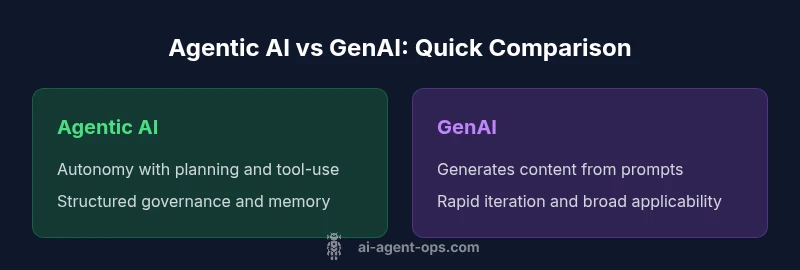
Agentic AI and GenAI are not the same thing: GenAI excels at rapid content generation from prompts, while agentic AI combines generation with autonomous action, planning, and tool use to accomplish goals. The difference agentic ai and genai centers on autonomy, decision-making, and governance. For teams, GenAI is ideal for exploration and draft outputs, whereas agentic AI is better for executing tasks within a controlled workflow.
difference agentic ai and genai: overview
Agentic AI and GenAI describe two distinct approaches on the AI spectrum. This article examines the difference agentic ai and genai, focusing on autonomy, decision-making, and governance to illuminate when to deploy each pattern. According to Ai Agent Ops, the practical distinction hinges on whether the system operates with self-directed goals or primarily generates content in response to prompts. Ai Agent Ops's analysis shows that organizations often begin with GenAI to prototype workflows and then layer agentic capabilities as automation needs mature. The goal is to minimize risk while maximizing impact by matching the technology to the task and the governance context. While GenAI emphasizes creative generation and rapid iteration, agentic AI emphasizes execution, orchestration, and measurable outcomes within a managed boundary.
Throughout this article, you’ll see how these paradigms differ in autonomy, control, tool integration, and governance, along with concrete examples that help teams design practical experiments. Expect practical checklists, architecture patterns, and decision criteria you can apply in real projects. The distinction is not a binary choice but a spectrum where teams often blend both approaches to achieve scalable automation with responsible risk management.
2
Comparison
| Feature | Agentic AI | GenAI |
|---|---|---|
| Autonomy level | high | low |
| Decision-making style | goal-directed planning with tools | prompt-driven inference |
| Best for | automation/orchestration of complex tasks | content generation and rapid experimentation |
| Governance needs | high—guardrails, audits, and tool permissions | moderate—prompt controls and usage policies |
| Tooling & integrations | planner, memory, and tool-use loops | prompts, retrieval, and adapters |
| Implementation complexity | high | low to moderate |
| Cost & resources | higher compute, memory, and orchestration overhead | lower per-inference cost but potentially many prompts |
| Latency & throughput | potentially higher due to planning cycles | generally lower latency per request |
Positives
- Clearer alignment with business outcomes through autonomous task execution
- Enhanced reliability via guardrails and governance for automated workflows
- Improved efficiency in end-to-end processes through tool integration
- Better risk management when combined with structured workflows
What's Bad
- Higher implementation and operational complexity
- Increased governance overhead and monitoring requirements
- Potentially higher ongoing costs due to orchestration and memory usage
- Integration challenges with existing systems
Hybrid approaches often win: use GenAI for generation and experimentation, and agentic AI for execution and orchestration within governed workflows.
GenAI is ideal for rapid content creation and experimentation. Agentic AI shines in automating end-to-end tasks with planned actions and tool use. A staged, governance-oriented blend typically offers the best balance of speed and control.
Questions & Answers
What is GenAI?
GenAI, or Generative AI, refers to models that produce new content or inferences based on prompts. It excels at drafting text, images, code, or data-like outputs from contextual cues. GenAI often relies on large-scale pre-trained models and retrieval methods to generate diverse results.
GenAI is all about generating new content from prompts. It’s great for drafting ideas, texts, or code that you can refine later.
What is agentic AI?
Agentic AI refers to systems designed to take autonomous actions toward achieving explicit goals, often using planning, decision-making, and tool use. These systems operate within a defined governance framework and can interact with external tools to complete tasks.
Agentic AI acts on its own to get tasks done, using plans and tools in a controlled way.
When should I use agentic AI vs GenAI?
Use GenAI when you need rapid content generation, ideation, or experimentation without heavy task execution. Choose agentic AI when you require autonomous task completion, sequence-of-actions, and tool integration within a governed workflow.
If you need ideas fast, start with GenAI. If you need tasks done automatically in a controlled way, go with agentic AI.
What governance considerations apply to both approaches?
Both approaches require guardrails, auditing, and clear ownership. Logging decisions, tracking prompts and tool usage, and setting safety constraints help ensure accountability and risk management.
Governance matters for both. Keep logs and set safety constraints to stay in control.
Is agentic AI always more expensive?
Not necessarily. Agentic AI can involve more complex architecture and tool integration, which may increase upfront and maintenance costs. Costs depend on task complexity, infrastructure, and governance requirements.
Agentic AI can be pricier due to planning and tool use, but it depends on the project.
How do I assess reliability between the two approaches?
Reliability depends on governance and task structure. GenAI can be volatile without prompts, while agentic AI benefits from explicit workflows and auditing, though planning cycles may add latency.
GenAI can be unpredictable with prompts; agentic AI offers more control but with added setup.
Key Takeaways
- Define autonomy needs before architecture
- Use GenAI for rapid prototyping and content work
- Deploy agentic AI for execution with guardrails
- Invest in governance, logging, and audits from day one
- Plan a phased rollout to minimize risk and maximize learning