How Agentic AI Differs from Earlier AI: A Comprehensive Comparison
An analytical comparison of how is agentic ai different from earlier forms of ai, focusing on autonomy, planning, governance, and real-world ROI in AI agent workflows.


Agentic AI marks a shift from passive, prompt-driven systems to autonomous agents that set goals, plan actions, and adapt across tasks. It embeds planning, environment awareness, and tool orchestration into the agent, differentiating it from earlier AI forms that relied on static prompts or narrow models. Governance and safety rails remain essential to prevent unintended actions.
What is agentic AI and why it matters
A core question in AI research is how is agentic ai different from earlier forms of ai, and the answer centers on autonomy, goal setting, and long-horizon planning. Agentic AI refers to systems that can choose goals, devise action plans, and execute them with limited human prompting. This is a departure from many earlier AI models, which primarily reacted to input or followed rigid rules. The Ai Agent Ops team emphasizes that the defining trait is agency: the system operates in a loop of goal selection, planning, action, monitoring, and adjustment, all within governance constraints. In practice, this means agents can coordinate across software tools, data sources, and human operators to deliver end-to-end outcomes—not just individual tasks. Importantly, agency does not imply sentience or unlimited freedom; it requires design-time constraints, safety rails, and oversight. When organizations implement agentic AI, they craft decision policies, success criteria, and escalation paths so the agent can act autonomously within safe boundaries. The result is faster workflow execution, improved scalability, and a shift toward orchestration where humans specify intents and constraints rather than step-by-step instructions.
How agentic AI is defined, in practice
Agentic AI blends goal-driven reasoning with automated action. At its core, an agent maintains a set of objectives, analyzes the current state, selects actions that advance its goals, and seeks feedback to refine plans. Unlike traditional models that map inputs to outputs, agentic systems use planning horizons, execution monitoring, and environment interaction to adapt to changing data, tool availability, and user constraints. This requires governance overlays to ensure alignment with policy, ethics, and operational risk. For developers and product teams, the practical takeaway is that agentic AI enables end-to-end automation across workflows, rather than isolated modules that require hand-offs for each step. In the broader AI landscape, this shift moves from mere inference to orchestration, where agents coordinate tools, data streams, and human inputs in a cohesive loop. The keyword how is agentic ai different from earlier forms of ai guides designers toward automating intent, not just reactions.
A quick note on scope and limits
While agentic AI expands capability, it is not a panacea. Autonomy must be bounded by explicit goals, guardrails, and robust monitoring to prevent misalignment or unsafe outcomes. In many cases, hybrid systems—combining agentic components with traditional prompts—offer the best balance between flexibility and control. For organizations evaluating the shift, the critical question remains how agentic ai differentiates from earlier forms of ai in terms of governance, planning, and end-to-end orchestration. This is the core determinant of ROI, risk, and long-term viability in production environments.
Comparison
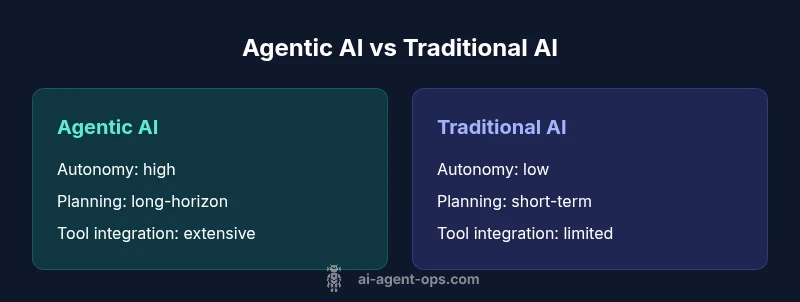
| Feature | Agentic AI | Traditional AI |
|---|---|---|
| Autonomy | high autonomy with goal-driven action and self-monitoring | low autonomy; relies on prompts or rigid workflows |
| Planning Horizon | long-horizon planning with iterative refinement | short-term or reactive planning; limited foresight |
| Decision-Making Style | self-directed with governance constraints | prompt-driven or rule-based; limited self-initiated actions |
| Environment Interaction | active orchestration across tools, data sources, and actuators | passive data processing; limited external actions |
| Tool Integration | deep integration across enterprise tools and APIs | basic or isolated tool usage |
| Best For | end-to-end automation, complex orchestration | narrow tasks with predefined prompts |
Positives
- Enables scalable, end-to-end automation across large workflows
- Improves adaptability to changing data and tool availability
- Enhances human–agent collaboration by handling routine planning
- Supports modular, reusable agent-based architectures
What's Bad
- Increases architectural and governance complexity
- Requires strong safety rails and ongoing monitoring
- Higher upfront design and integration effort
- Potential for misalignment if goals and constraints are poorly defined
Agentic AI generally outperforms traditional AI in complex, end-to-end automation scenarios, when governance is properly in place.
Choose agentic AI for workflows that demand autonomous planning and multi-tool orchestration. Use traditional AI for well-defined, narrow tasks where prompts suffice and governance needs are lighter.
Questions & Answers
What is agentic AI and how is it different from earlier AI?
Agentic AI refers to systems that can set goals, plan actions, and execute tasks autonomously within defined constraints. Earlier AI often relied on fixed prompts or narrow decision rules without long-horizon planning. The distinction lies in agency and orchestration across tools and data.
Agentic AI can plan and act on its own within safe bounds, unlike older AI that mostly followed prompts.
What are the main benefits of agentic AI?
Key advantages include end-to-end automation, scalability across complex workflows, faster decision cycles, and better alignment with business goals through governance. These benefits depend on well-defined goals and robust safety constraints.
It offers bigger automation gains and quicker, organized actions.
What risks come with agentic AI and how can they be mitigated?
Risks involve misalignment, unpredictable behavior, and safety gaps. Mitigations include explicit goals, guardrails, continuous monitoring, audits, and human-in-the-loop interventions when needed.
Autonomy brings risk—design guardrails and monitor continuously.
How is ROI measured for agentic AI?
ROI is typically assessed via cycle-time reduction, throughput gains, error reductions, and cost savings across end-to-end processes. Context matters; metrics should align with specific business outcomes.
Look at time saved and output quality to gauge value.
Where is agentic AI most effective in practice?
Agentic AI shines in complex, multi-step tasks requiring orchestration across tools (APIs, databases, workflows) and dynamic environments where autonomous planning adds value.
Great for big, end-to-end automation jobs.
What are practical steps to start implementing agentic AI?
Start with a high-value, well-scoped workflow, define clear goals and constraints, select orchestration tools, implement guardrails, and begin with a small pilot to learn and iterate.
Begin with a small pilot and scale up carefully.
Key Takeaways
- Define clear goals and guardrails before deployment
- Agentic AI enables autonomous planning and multi-tool orchestration
- Governance, safety, and monitoring are essential from day one
- Measure ROI via end-to-end workflow improvements and cycle-time reductions