How is Agentic AI Different from Traditional Automation?
Examine how agentic AI differs from traditional automation, focusing on autonomy, learning, governance, and practical deployment for developers, product teams, and leaders in 2026.


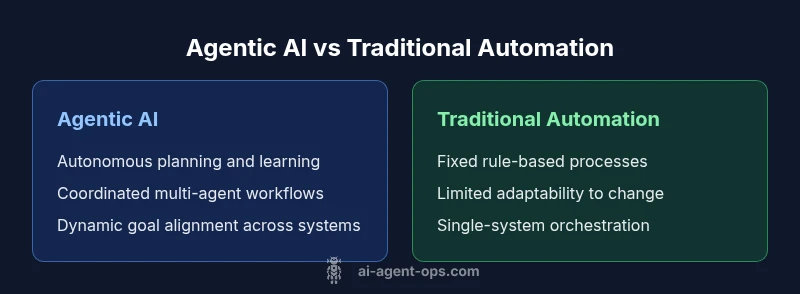
Agentic AI represents a shift from fixed rules to adaptive, goal-driven automation. It combines autonomous reasoning, planning, and coordination across multiple agents, enabling dynamic responses to changing data and objectives. In contrast, traditional automation relies on predefined workflows and limited learning, requiring more human intervention. This comparison helps you see where agentic AI adds value in complex environments.
What is Agentic AI?
Agentic AI is a class of intelligent automation that blends autonomous reasoning, planning, and action across multiple agents or components. Rather than executing a fixed sequence of steps, agentic AI assesses goals, generates plans, and adapts as data changes. This capability makes it especially powerful for environments with uncertainty, evolving rules, or cross-system coordination. In plain terms, agentic AI can set goals, navigate tradeoffs, and adjust its actions without waiting for every instruction to come from humans. According to Ai Agent Ops, this evolving capability marks a meaningful shift in how organizations approach automation, not merely a stretch of existing tools. The phrase how is agentic ai different from traditional automation captures the move from rigid repetition to flexible problem solving.
Key ideas to keep in mind include (a) autonomy at the task level, (b) multi-agent orchestration, and (c) continuous learning from outcomes. These elements enable automation to scale beyond repetitive processes into domains that require judgment, planning, and coordination across systems. The Ai Agent Ops team emphasizes that agentic AI does not eliminate humans; it changes the human role toward governance, design, and exception handling. When well governed, agents can align with business goals and respond to new information with minimal manual reconfiguration.
How Agentic AI Differs from Traditional Automation
Agentic AI introduces three core shifts compared to traditional automation: autonomy, adaptability, and orchestration. First, autonomy means agents interpret high-level objectives and decide on concrete actions without step-by-step prompts. Second, adaptability comes from learning from data and outcomes, allowing models to refine strategies over time rather than sticking to static scripts. Third, orchestration refers to coordinating several agents or services to achieve an overarching goal, including conflict resolution and goal alignment across domains. Traditional automation typically relies on hand-built workflows, rule sets, and static decision trees, which become brittle as the environment changes. In this sense, agentic AI is less about replacing people and more about shifting decision-making to systems capable of proactive planning, continuous improvement, and cross-functional collaboration. Ai Agent Ops notes that deployment strategies should emphasize governance, safety, and explainability to avoid opaque behavior that erodes trust. The net effect is a more resilient automation layer that can handle ambiguity, exceptions, and rapidly shifting priorities.
Core Capabilities that Define Agentic AI
The following capabilities are often cited as defining features of agentic AI:
- Autonomous planning: Agents generate and revise plans to achieve goals with minimal human input.
- Multi-agent coordination: Several agents collaborate, negotiate, and share context to optimize outcomes.
- Data-driven learning: Systems continuously update models with fresh data and feedback loops.
- Goal alignment and feedback: Mechanisms ensure actions stay aligned with business objectives and policies.
- Self-monitoring and safety checks: Agents detect inconsistencies, escalate when needed, and maintain audit trails.
- Explainability at action level: Traces show why an agent chose a particular plan or action, supporting governance.
These capabilities enable automation to handle complex workflows, cross-system dependencies, and dynamic environments while preserving governance and visibility. The Ai Agent Ops team highlights that effective agentic AI programs typically start with clear goals, bounded scope, and transparent decision pathways to build trust and reliability.
Real-World Use Cases Across Industries
Across manufacturing, finance, healthcare, and customer experience, agentic AI can transform how teams orchestrate tasks and optimize outcomes. In manufacturing, autonomous planning can reallocate resources in real time to mitigate bottlenecks and adjust to supply disruptions. In finance, adaptive agents can monitor market signals, adjust hedging strategies, and coordinate compliance checks across platforms. In healthcare, multi-agent workflows can coordinate patient data, scheduling, and treatment recommendations while ensuring patient safety and privacy.
Customer service can benefit from agentic AI through dynamic routing, proactive issue resolution, and personalized support paths that adapt to user history. The overarching theme is that agentic AI shines when goals are evolving, data is noisy, and decisions touch multiple systems. The Ai Agent Ops analysis suggests that teams adopting agentic AI often report improved adaptability and throughput, especially when governance practices keep models transparent and auditable. As organizations explore pilot programs, it’s essential to frame expectations around governance, risk, and measurable outcomes.
Challenges, Risks, and Governance
Agentic AI introduces new governance and risk considerations compared to traditional automation. First, transparency and explainability become essential, because autonomous plans and cross-agent decisions can be opaque unless properly traced. Second, safety and alignment checks must be built into planning loops to avoid harmful or unintended actions. Third, data governance is critical: models should be monitored for bias, data drift, and privacy compliance across all data streams. Teams should design governance with roles for model owners, data stewards, and cross-functional reviewers. Fourth, the deployment architecture should include robust logging, versioning, and rollback capabilities to support audits and regulatory requirements. The Ai Agent Ops team emphasizes that a strong governance model reduces risk and increases stakeholder trust, particularly when agents operate across several business units. Finally, organizational readiness—skills, culture, and collaboration between IT, data science, and business owners—often determines success more than the technical sophistication of the agents themselves.
Implementation Considerations and Migration Path
Adopting agentic AI typically follows a staged approach. Start with a narrow scope where the problem space is well defined but dynamic enough to benefit from autonomous planning. Next, build a lightweight orchestration layer to coordinate a small set of agents, with clear success metrics and governance checks. Gradually expand scope, adding more agents, more data sources, and more complex workflows, while maintaining strong audit trails and rollback capabilities. Data readiness is critical: ensure clean, labeled data streams, robust observability, and secure data access. Architecture choices should favor modular, service-oriented design, with clear interfaces and contracts between agents and external systems. Change management matters as well: invest in cross-functional training, documentation, and a culture that embraces experimentation and controlled risk-taking. The 2026 Ai Agent Ops framework highlights the importance of starting with governance design in parallel with technical prototyping to avoid misaligned objectives and scope creep.
Measuring Success: Metrics and ROI
Quantifying the impact of agentic AI requires a mix of process metrics, quality indicators, and business outcomes. Typical metrics include cycle time reduction, throughput gains, error rate improvements, and the rate of goal achievement across workflows. Qualitative indicators, such as improved collaboration among teams and greater stakeholder confidence, also matter. It’s important to establish baselines before piloting, then track progress with transparent dashboards and regular review cycles. Ai Agent Ops Analysis, 2026 notes that organizations that integrate governance, observability, and outcome-focused KPIs tend to realize more consistent benefits over time. In practice, measure both efficiency (fewer manual steps, faster decisions) and effectiveness (better decision quality, aligned outcomes), and always monitor for unintended consequences or bias.
Best Practices for Teams Adopting Agentic AI
- Start with a clear governance model and documented use cases.
- Define high-value, bounded problems before expanding scope.
- Build explainability and auditing into every agent’s decision path.
- Invest in data quality, observability, and security from day one.
- Foster cross-functional collaboration among product, data, and operations teams.
- Plan for continuous iteration, not one-off deployments.
- Establish a staged rollout with measurable milestones and safety checks.
- Align incentives and governance with business objectives to sustain momentum.
The combination of disciplined governance, careful scoping, and iterative rollout is essential for long-term success. The Ai Agent Ops team recommends embedding cross-functional review at each expansion step to preserve alignment and trust.
The Future of Agentic AI in Automation Ecosystems
Looking ahead, agentic AI is likely to become a central pillar of automation ecosystems, enabling more autonomous orchestration across clouds, devices, and enterprise data sources. We can expect advances in multi-agent coordination, better alignment with organizational policies, and more transparent decision traces. As more industries experiment with agentic AI, standards for governance, safety, and explainability will emerge, reducing risk and speeding adoption. The Ai Agent Ops team envisions a future where agentic AI acts as an intelligent layer that couples human judgment with scalable, autonomous decision-making, while remaining auditable and controllable. However, that future also depends on robust data governance, clear ownership, and ongoing investment in skills and culture to harness the benefits without compromising safety or trust.
Comparison
| Feature | Agentic AI | Traditional Automation |
|---|---|---|
| Decision Autonomy | High | Low |
| Learning & Adaptation | Continuous, data-driven | Static learning or none |
| Goal Alignment | Proactive, dynamic | Predefined/static |
| Human-in-the-Loop | Flexible, minimal needed | Mandatory and explicit |
| Explainability | Contextual reasoning with traces | Limited traceability |
| Deployment Complexity | Medium-High | Medium |
| Cost of Ownership | Higher upfront with potential long-term gains | Lower upfront, steady maintenance |
| Best For | Dynamic, complex environments | Static, repeatable tasks |
Positives
- Higher adaptability to changing goals and data
- Potential efficiency gains with reduced manual toil
- Better scalability across complex, cross-system workflows
- Improved coordination across multiple agents and services
What's Bad
- Greater governance and risk management needs
- Higher initial investment and specialized skills required
- Potential opacity in decision-making if not properly designed
- Complexity can slow initial time to value
Agentic AI is the more capable choice for dynamic environments, with caveats around governance and skills.
Adopt agentic AI for evolving goals and cross-system coordination, but implement strong governance, explainability, and phased rollout to manage risk and build trust.
Questions & Answers
What is the key difference between agentic AI and traditional automation?
The key difference is autonomy and learning: agentic AI can set and adjust goals, plan actions, and adapt to new data, while traditional automation follows predefined rules. This shift enables proactive handling of complexity and variability.
Agentic AI is more autonomous and adaptable than traditional automation, handling changing goals and data with less human input.
What are common use cases for agentic AI?
Common use cases include dynamic decision workflows, cross-system orchestration, and adaptive process optimization where goals evolve. It shines in contexts with uncertainty and multi-domain coordination.
Think dynamic decision-making and cross-system orchestration.
What governance or risk considerations should teams plan for?
Plan for transparency, explainability, audit trails, safety checks, and alignment with business goals. Establish ownership, versioning, and rollback protocols to manage risk.
Prioritize governance: explainability and audits are essential.
How should organizations evaluate ROI for agentic AI?
Evaluate ROI by balancing upfront costs with long-term efficiency gains, reduced manual toil, and improved decision quality. Use phased pilots to quantify value progressively.
Measure ROI through throughput, cost reductions, and better decisions.
What skills are needed to implement agentic AI?
Teams need data engineering, model governance, orchestration design, and cross-functional collaboration. Build capabilities for monitoring, auditing, and rapid iteration across agents.
Key skills include data, governance, and orchestration.
Is agentic AI suitable for every industry?
Not every scenario benefits equally. Agentic AI excels where goals change, data is uncertain, and cross-system coordination exists. Assess your data maturity and governance readiness before starting.
Some industries benefit more; assess goals and data first.
Key Takeaways
- Identify high-value, bounded problems for piloting agentic AI
- Prioritize governance and explainability from day one
- Plan staged rollouts with clear success metrics
- Invest in data quality, security, and cross-functional collaboration
- Expect greater long-term payoff in dynamic environments