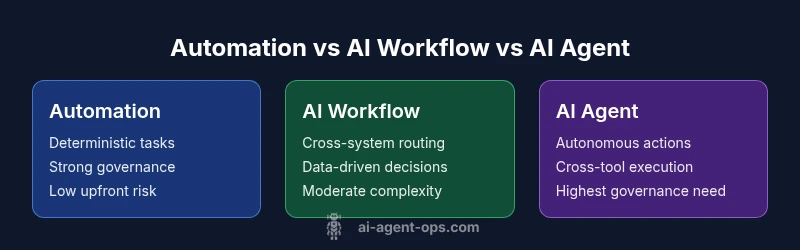
Automation vs AI Workflow vs AI Agent: A Practical Comparison
A detailed, analytical comparison of automation, AI-driven workflows, and AI agents, with a practical framework to decide which approach fits your team, project, and governance needs.


Automation excels at stable, repeatable tasks with strong governance. AI workflows orchestrate data and decisions across steps, improving coherence and traceability. AI agents add autonomous action across apps, enabling end‑to‑end task execution. The right mix depends on governance, scale, and desired autonomy.
Defining the trio: automation, AI workflow, and AI agent
The search for operational efficiency often boils down to three concepts: automation, AI workflow, and AI agent. At a high level, automation covers rules-based, repeatable tasks that can run without human intervention. An AI workflow introduces cognitive capabilities to coordinate data processing, model routing, and decision points across multiple systems. An AI agent goes a step further, acting as an autonomous actor that can trigger apps, fetch data, and perform actions across tools with minimal (or no) human prompting. This article dissects each approach and explains how they can complement each other in a modern tech stack. According to Ai Agent Ops, organizations that frame these concepts as a spectrum rather than isolated silos unlock greater agility and governance. The core idea is to map business goals to capabilities and embed guardrails to keep AI agents from overstepping. When you compare automation vs ai workflow vs ai agent, you’re really comparing layers of control, decision making, and action in an orchestrated system.
In practice, you’ll see automation as the backbone for standard operating procedures, AI workflow as the conductor managing data and logic, and AI agents as the autonomous actors executing tasks across software boundaries. The distinctions matter especially when you design for scale, compliance, and rapid iteration. A disciplined approach aligns outcomes with risk tolerance, giving product teams a clear path from rule-based routines to agentic capabilities without losing visibility or control.
The Ai Agent Ops team highlights that the value is not choosing one over the others but composing them into a cohesive architecture that aligns with business objectives and governance requirements. In other words, automation, AI workflows, and AI agents are not just technologies; they are complementary patterns for building resilient, scalable automation ecosystems.
The scope of each approach: boundaries and overlap
Automation, AI workflow, and AI agent sit on a spectrum of capabilities. Each has its own scope, but there is meaningful overlap that enables smoother handoffs and better governance. Automation focuses on deterministic steps and repeatable sequences. It shines when inputs, outputs, and outcomes are well-defined and when the cost of mistakes is high. AI workflows add intelligence to the orchestration layer, enabling data-driven routing, contextual decision points, and adaptive processing based on model outputs or external signals. AI agents extend this further by acting as autonomous decision-makers that can select tools, initiate actions across platforms, and maintain ongoing contexts across sessions.
The practical implication is that a modern automation strategy rarely relies on a single pattern. You might automate mundane data extraction while routing the results through an AI workflow that decides the next processing step. If the task requires proactive actions across systems—like updating tickets, notifying teams, or triggering downstream processes—an AI agent can execute those steps with minimal human input. The balance is guided by risk, governance, and the desired level of human oversight. In some environments, agents operate within strict guardrails, while in others they function as semi-autonomous collaborators that handle routine cycles under supervision.
From a governance perspective, automation provides traceability through auditable run logs. AI workflows add interpretability through decision timestamps and model inputs. AI agents demand stronger policy controls, context preservation across sessions, and robust fallbacks to prevent drift. The combination yields a layered, auditable, and scalable automation fabric that supports both efficiency and accountability.
Key differentiators: control, autonomy, and complexity
Control, autonomy, and complexity are the three levers you should weigh when comparing automation vs ai workflow vs ai agent. Control defines who or what drives the process: humans, automated scripts, or AI-driven decision points. Autonomy refers to how much the system can act without human prompts or interventions. Complexity captures the integration and governance overhead required to implement and maintain the pattern.
- Automation: High control by design, low autonomy, and relatively low integration complexity when well-scoped. Best for repeatable, well-understood tasks with strict error handling.
- AI Workflow: Moderate autonomy within a defined workflow, higher complexity due to data routing, model orchestration, and monitoring. Best for cross-functional processes that require data-driven decisions.
- AI Agent: Highest potential autonomy, but also the greatest governance and safety challenges. Best for end-to-end task execution across tools when guardrails, logging, and fallback strategies are in place.
Common missteps include under-specifying inputs, overestimating the agent’s reliability, and neglecting data governance. The right approach often combines the patterns: use automation for deterministic steps, AI workflows for decision-making paths, and AI agents for end-to-end action where appropriate.
Decision criteria: when to use which approach
To decide which pattern to deploy, map your decision criteria to business outcomes. Consider domain complexity, data quality, compliance requirements, and the desired level of human oversight. If you need fast payoff with low risk, start with automation for well-defined tasks. If your processes involve multiple data sources, model outputs, and conditional paths, an AI workflow provides a pragmatic upgrade. If your goal is to reduce manual handoffs and enable agents to perform cross-tool actions, an AI agent can deliver tangible throughput gains—but only with strong governance. Across all options, design for observability, rollback, and safety.
In a typical journey, teams often begin with automation, layer in AI-driven orchestration to handle more complex routes, and then introduce AI agents to automate cross-application actions. This progression maintains control and provides measurable milestones while allowing the organization to test, learn, and adapt. The result is a scalable approach that harmonizes human judgment with machine efficiency without sacrificing safety or traceability.
Architecture and integration patterns: how to connect the dots
A practical architecture starts with a solid integration layer. You’ll need adapters or connectors to reach data sources, business systems, and collaboration tools. A central orchestration layer then coordinates the task flow, model inferences, and decision logic. For automation, you’ll implement rules, triggers, and state management. For AI workflows, you’ll design decision points, data routing, and model inputs/outputs. For AI agents, you’ll define action schemas, tool catalogs, and context propagation across sessions.
- Unified data model: Standardize data formats to reduce transformation cost.
- Observability stack: Instrument logs, metrics, and traces across automation, workflow, and agent actions.
- Guardrails: Implement safety constraints, permission checks, and fail-safes to prevent unintended actions.
- Iterative testing: Use synthetic data and staged environments to validate models and agents before production.
A practical migration pattern starts with stabilizing automated flows, then introducing orchestrated AI decision points, followed by optional agent-level automation. This staged approach reduces risk and improves the likelihood of user adoption and governance alignment.
Data governance and compliance considerations
Data governance is central to any pattern—automation, AI workflows, and AI agents all depend on reliable data, secure access, and auditable trails. Start by defining data ownership, access controls, and retention policies. Ensure data lineage is traceable from input through processing to output, particularly when models influence decisions or agents trigger external actions. Compliance requires documenting decision criteria, model provenance, and human approvals where necessary.
Be mindful of privacy and security requirements. Encryption, access controls, and secure connections matter more as you increase autonomy. Establish risk thresholds and define escalation paths when model outputs or agent actions could violate policy. Finally, implement regular reviews to detect drift in data quality, model performance, or agent behavior. Governance is not a one-time setup—it’s an ongoing discipline that scales with your automation footprint.
Implementation patterns: routes to scale
Organizations typically implement automation, AI workflows, and AI agents using a layered approach that aligns with team capabilities and product goals. Start with pilots that focus on a single department or process. Use clear success metrics such as cycle time improvements, error rate reductions, or throughput gains. As confidence grows, widen the scope while preserving governance controls.
- Pattern A: Rule-based automation for well-defined tasks coupled with lightweight AI-driven routing for exception handling.
- Pattern B: An AI workflow layer that coordinates data across systems, with automation for routine steps and an AI agent for cross-tool actions.
- Pattern C: A fully agentic setup where AI agents operate within guardrails to manage end-to-end processes across apps, with strong observability and safety nets.
Documentation is essential. Maintain playbooks that describe how to respond to model failures, how to override agent decisions in emergencies, and how to revert to a safe baseline. Training and support for teams are critical since adoption hinges on trust and clarity about responsibilities.
Risks, tradeoffs, and how to mitigate them
No pattern is risk-free. Automation can entrench brittle routines if not designed for change. AI workflows introduce data dependencies and model drift. AI agents raise concerns about autonomy, security, and governance. Mitigate these risks with least-privilege access, explicit guardrails, thorough testing, and clear escalation paths. Build redundancy into critical paths so that a single failure does not paralyze operations. Establish metrics to detect drift early and implement deterministic rollback procedures. A thoughtful combination—automation for reliability, AI workflows for intelligence, and AI agents for action—often yields the best balance of speed and control.
Real-world scenarios and decision aids
To ground the discussion, consider three representative scenarios. A retailer wants to automate order processing (automation), route exceptions through an AI workflow to decide the best fulfillment path, and allow an AI agent to place orders with suppliers when inventory thresholds are met. A healthcare provider aims to automate patient intake checks (automation), coordinate data from multiple systems (AI workflow), and use AI agents to update patient records and notify teams (AI agent). A financial services firm pilots a data pipeline where automation handles data extraction, an AI workflow governs scoring decisions, and AI agents execute trades or alerts within policy limits.
Checklists help teams decide: start with clearly defined tasks, confirm governance coverage, pilot with a non-critical process, measure outcomes, and iterate. The journey is not linear, but a staged approach with checkpoints keeps risks manageable while delivering progressive value.
Migration paths toward agentic AI: stepping stones
A practical path toward agentic AI emphasizes incremental changes and governance. Begin by documenting current processes and identifying repeatable tasks that can be automated with minimal risk. Next, introduce an AI workflow layer to handle data routing, decision logic, and monitoring across components. Finally, deploy AI agents in controlled environments where they can perform cross-tool actions under supervision, with robust logging and a clear override mechanism. Over time, refine policies and guardrails based on observed behavior, ensuring alignment with business goals. The result is a mature, modular automation fabric capable of evolving toward agentic AI while maintaining safety and accountability.
mainTopicQuery
ai agent
Feature Comparison
| Feature | Automation | AI workflow | AI agent |
|---|---|---|---|
| Scope of automation | Deterministic tasks, rule-based | Broad orchestration across steps and data | End-to-end autonomy across apps |
| Autonomy | Low autonomy | Moderate autonomy within processes | High autonomy with guardrails |
| Data needs | Stable inputs, explicit rules | Cross-system data, model outputs | Context from multiple sessions, tool access |
| Governance | Strong traceability | Moderate governance for routing | Rigorous policy controls and logging |
| Implementation complexity | Lower | Medium | Higher due to tool catalogs and context |
| Best for | Stable routines | Data-driven routing across steps | Autonomous actions across platforms |
Positives
- Increases operational efficiency with repeatable tasks
- Provides clear governance and auditability for automated flows
- Allows scaling by combining tasks into larger pipelines
- Improves traceability across human and machine steps
What's Bad
- Requires upfront design to avoid brittle automations
- Guardrails are essential but add complexity
- Agent-level autonomy introduces governance and security risks
- Migration can be incremental and slow if ownership is unclear
Use a layered approach: automate for reliability, layer in AI workflow for intelligent routing, and deploy AI agents where autonomous action adds value—with strong governance.
Automation, AI workflows, and AI agents each serve different roles. Deploy them where they fit best, ensure guardrails, and plan for gradual migration to agentic capabilities. The Ai Agent Ops team recommends starting with well-scoped automation and progressively introducing orchestration and agents as governance and data maturity allow.
Questions & Answers
What is the core difference between automation, AI workflow, and AI agent?
Automation handles predefined steps, AI workflows orchestrate data and decisions, and AI agents perform autonomous actions across tools. Together, they form a spectrum from deterministic processing to end-to-end autonomy.
Automation covers rules; AI workflows coordinate; AI agents act across apps.
When should I start with automation rather than AI?
Start with automation for stable, rule-based tasks where outcomes are predictable and governance needs are strong. It creates a reliable baseline before layering in AI capabilities.
Begin with automation for predictable tasks, then add AI as you grow.
How do I measure success across these patterns?
Track cycle time, error rates, and throughput for automation. For AI workflows, monitor decision accuracy and data quality. For AI agents, measure completion rates and safety incidents.
Look at speed, accuracy, and safety when evaluating results.
What governance considerations are most important for AI agents?
Ensure guardrails, access controls, and audit trails. Define override mechanisms and clear escalation paths for failures or policy violations.
Guardrails and logs are essential for agent safety.
Can I migrate from automation to AI agents gradually?
Yes. Start with automation, add AI-driven routing, and introduce AI agents in a controlled, gated manner with monitoring.
Yes—migrate in stages with guardrails and audits.
What are common pitfalls to avoid?
Over-automation, under-specification, or under-investment in governance can cause drift, risk, and failed deployments.
Avoid over-automation without guards and clear ownership.
Key Takeaways
- Map tasks to the right pattern based on risk and data needs
- Layer governance and observability into every stage
- Pilot incrementally to manage risk and prove value
- Use automation to stabilize, AI workflow to coordinate, AI agents to act
- Plan migrations as staged capabilities, not a single leap