How to Use AI in Real Estate: A Practical Guide for Agents and Teams
A practical, step-by-step guide for real estate teams on using AI to enhance valuations, match properties, automate outreach, and scale operations with responsible governance.


By the end of this guide, you’ll know how to use AI in real estate to speed up property matching, improve valuation accuracy, and automate routine tasks across sales, brokerage, and property management. You’ll identify essential tools, data needs, governance considerations, and a practical, risk-aware path to piloting AI within your team.
Why AI is Transforming Real Estate
Understanding how to use ai in real estate starts with recognizing what AI can do for property discovery, pricing, and client relationship management. According to Ai Agent Ops, AI is moving from experimental pilots to core workflows that reduce time, improve pricing accuracy, and personalize client experiences. Real estate teams leverage AI to analyze MLS data, CRM interactions, and market trends to surface high-confidence matches, predict demand shifts, and automate repetitive tasks. This section outlines the strategic shift from manual processes to intelligent automation that scales with demand while preserving human judgment where it matters most. Expect better lead qualification, faster due diligence, and more precise property valuations when AI is integrated with domain expertise.
Key takeaways:
- AI accelerates decision-making across acquisitions, leasing, and brokerage.
- Data quality and governance determine the reliability of AI outputs.
- Human oversight remains essential for nuance, empathy, and ethical considerations.
Core Use Cases of AI in Real Estate
AI brings practical, measurable improvements across a broad spectrum of activities in real estate. Here are the core use cases you’re likely to implement first:
- Property valuation and comps: AI aggregates market data, property attributes, and historical sales to deliver faster, more consistent valuations.
- Lead scoring and client matching: AI models prioritize prospects and match buyers with listings based on past behavior and stated preferences.
- Market analysis and sentiment: AI analyzes news, listings, and social signals to gauge market momentum and pricing trends.
- Marketing automation: AI tailors outreach, creates listing descriptions, and optimizes ad spend with performance insights.
- Portfolio risk and maintenance forecasting: AI identifies potential vacancies, lease expirations, and maintenance needs before they surface.
- Operational automation: AI handles scheduling, document routing, and contract review to free up agents for higher-value work.
These use cases translate into faster cycles, lower costs per deal, and more scalable service. When selecting use cases, begin with tasks that are repetitive, data-rich, and have clear success metrics. Ai Agent Ops notes that prioritizing high-impact, data-ready workflows delivers early ROI while minimizing risk.
How to Choose AI Tools for Real Estate
Choosing the right AI tools for real estate involves aligning capabilities with business goals, data readiness, and governance requirements. Start by defining a small, concrete pilot scope (e.g., AI-assisted valuations for a subset of listings or lead scoring for a single market). Consider the following criteria:
- Data compatibility and quality: Ensure your MLS feeds, CRM, marketing platforms, and transaction data can be ingested with minimal cleaning. Poor data quality yields unreliable insights.
- Integrations and APIs: Look for tools that plug into your current stack (CRM, MLS, website, marketing platforms) with well-documented APIs.
- Security and compliance: Prioritize access controls, encryption, and data handling practices that respect privacy laws and brokerage policies.
- Vendor support and roadmap: Evaluate onboarding, training, and the vendor’s commitment to updates and security.
- No-code vs. custom: Decide whether you need no-code automation for speed or custom models for domain-specific needs. ai-tools and agent-orchestration options can offer fast wins, while in-house models provide long-term control.
Ai Agent Ops’s guidance emphasizes starting small, measuring ROI, and ensuring governance from day one. A phased approach reduces risk while building organizational capability.
Data, Privacy, and Compliance for Real Estate AI
Data privacy and regulatory compliance are foundational for real estate AI. Real estate teams handle sensitive client data, lease terms, financial information, and contract details. To avoid pitfalls, implement a data governance framework that includes:
- Data minimization and purpose limitation: Collect only what you need and document the purpose for each data stream.
- Access controls and auditing: Enforce role-based access and maintain logs of data usage.
- Data quality management: Establish data cleaning routines, deduplication, and provenance tracking.
- Consent and disclosures: Provide clear disclosures when AI assists decision-making and obtain any required consents.
- Security practices: Use encryption at rest and in transit, secure key management, and regular vulnerability assessments.
Adhering to governance reduces risk and builds trust with clients and regulators. Ai Agent Ops recommends embedding privacy by design into every AI project and maintaining an ongoing data stewardship program.
Implementing an AI-Driven Real Estate Workflow: A Step-by-Step Example
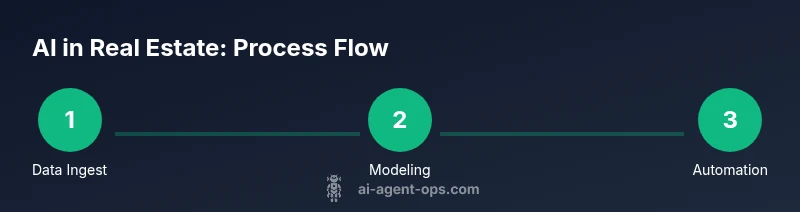
Imagine a brokerage that wants to accelerate matching, pricing insights, and personalized outreach. The following narrative outlines how to implement an AI-driven workflow in three phases: data preparation, model-enabled decisioning, and operations integration. In Phase 1, you ingest MLS feeds, CRM history, and listing metadata, then clean and map fields to a unified schema. Phase 2 introduces AI models to generate price guidance, predict days-on-market, and rank leads. Phase 3 automates routine tasks, from email outreach to contract routing, while ensuring human review at critical steps. This approach yields faster response times, more accurate pricing, and a scalable outreach engine. Ai Agent Ops suggests documenting outcomes at each phase to inform future scaling decisions.
Practical Considerations for Getting Started
Getting started with AI in real estate requires a pragmatic mindset: start small, measure outcomes, and incrementally broaden scope. Allocate time for data cleanup, define clear success metrics, and establish a support model for users. Train staff on how to interpret AI outputs, and create guardrails to prevent overreliance on automated decisions. Build a culture of iteration and governance to sustain long-term adoption. By combining domain expertise with AI salience, your team can achieve meaningful efficiency gains without compromising client trust.
Practical Steps to Begin Your AI Journey in Real Estate
- Align AI initiatives with business goals and client outcomes.
- Start with a focused pilot, using a small dataset and a single use case.
- Establish data governance and privacy practices from day one.
- Measure outcomes with clear metrics (time saved, margin improvement, lead conversion).
- Scale gradually, integrating feedback from users and clients.
Tools & Materials
- Computer or workstation with internet access(Reliable device for data work and tool access)
- CRM and MLS access(Core data sources for AI insights)
- Data mapping and governance docs(Inventory of data fields and usage rules)
- Secure data storage (encryption, access controls)(Protect sensitive information)
- API keys and integration credentials(Connect data sources and tools)
- Pilot plan template(Define scope, success metrics, timeline)
- Vendor evaluation checklist(Compare features, security, and support)
- Privacy and compliance policy(Document consent and data handling rules)
- Training materials for staff(Build AI literacy and governance awareness)
- Sample data scrub scripts(Prepare data for modeling)
- Diagrams of data flows(Visualize data pipelines for stakeholders)
Steps
Estimated time: 4-6 weeks for a focused pilot; 3-6 months for initial scaling
- 1
Assess Data Readiness
Catalog data sources (MLS, CRM, listings, transactions). Clean and standardize fields so AI can ingest them consistently. Define owners and update cycles to maintain data quality.
Tip: Start with a small, high-quality data subset to validate the pipeline. - 2
Define Clear Goals
Set measurable objectives (e.g., reduce time-to-match by 20%, improve price accuracy within X%). Align AI goals with business priorities and client value.
Tip: Document success criteria before selecting tools. - 3
Choose the Right Tools
Evaluate no-code vs. code options, API availability, and integration capabilities with your stack. Prioritize security and support.
Tip: Run a short proof-of-concept with one use case. - 4
Pilot and Validate
Run a controlled pilot on a narrow scope. Compare AI outputs with human decisions to gauge accuracy and reliability.
Tip: Involve end-users early to gather practical feedback. - 5
Scale with Governance
Gradually broaden use cases, extend data pipelines, and implement governance policies. Monitor model drift and data quality.
Tip: Automate ongoing governance checks where possible. - 6
Operationalize & Review
Embed AI-assisted insights into workflows, create dashboards for monitoring, and run quarterly reviews to adjust strategy.
Tip: Keep human-in-the-loop at critical decision points.
Questions & Answers
What is AI in real estate, and why should I care?
AI in real estate uses machine learning, data analytics, and automation to improve valuations, property matching, marketing, and client services. It helps teams work faster, more accurately, and at scale while preserving essential human judgment for nuanced decisions.
Real estate AI means using smart software to analyze data and automate tasks, helping you work faster and more accurately.
What data do I need to implement AI in real estate?
You'll typically rely on MLS data, CRM records, listings metadata, and transaction histories. Ensure data quality, consistent formats, and clear ownership to enable reliable AI outputs.
You’ll need MLS, CRM, and listing data, with clean, well-organized records for AI to learn from.
Is AI in real estate compliant with privacy laws?
Yes, with solid governance: minimize data collection, obtain required consents, enforce access controls, and encrypt sensitive information. Regular legal reviews help stay aligned with evolving regulations.
Yes, but you must govern data carefully and follow privacy rules to stay compliant.
How long does a typical AI pilot take?
A pilot usually runs for several weeks, often around 4-6 weeks, depending on data readiness and scope. Start small, validate outputs, and iterate before expanding.
Most pilots last a few weeks; start small and validate results before scaling.
What are common challenges when adopting AI in real estate?
Data quality, system integration, stakeholder buy-in, and managing vendor risk are the main challenges. Addressing governance and change management early reduces friction.
Common challenges include data quality and getting teams on board with the new way of working.
Should I build an in-house AI solution or buy a vendor product?
Most teams start with a vendor solution for speed and reliability. In-house development offers control but requires data science capabilities and ongoing maintenance.
Start with a vendor solution to move faster, and consider in-house only if you have ongoing data science capacity.
Watch Video
Key Takeaways
- Define a clear pilot with measurable goals
- Prioritize data quality and governance
- Choose tools that integrate with existing systems
- Keep humans in the loop for critical decisions