How to Test AI Agent Accuracy: A Practical Guide
Learn proven methods to test AI agent accuracy, covering ground-truth data, metrics selection, test design, calibration, and ongoing monitoring. A developer-focused guide by Ai Agent Ops to ensure reliable agent performance in real-world tasks.


You will learn how to test AI agent accuracy by defining clear ground-truth objectives, selecting appropriate metrics, and building rigorous test suites. This guide walks through data preparation, evaluation workflows, and iterative improvements to help you trust agent performance in real-world tasks, including checks for distribution shifts, calibration, and monitoring. It emphasizes avoiding data leakage, bias, and overfitting while providing practical templates.
Why accuracy matters for AI agents
In the world of AI agents, accuracy is not a single number but a multidimensional property that determines whether an agent reliably achieves its intended goals across diverse tasks. The Ai Agent Ops team emphasizes that stakeholders should care about how accuracy holds up under real-world conditions, not just in ideal benchmarks. High accuracy in a lab setting can mask brittleness when data drifts, inputs vary, or user contexts change. Therefore, a robust testing program must probe not only correctness on labeled examples but also reliability, consistency, and fault tolerance. By defining concrete success criteria aligned with business outcomes, teams can prioritize testing that drives meaningful improvements, reduce risk in production, and shorten iteration cycles. The goal is to create a defensible evidence trail showing how the agent behaves across tasks, users, and domains, so product leaders can trust decisions powered by AI.
This emphasis on test-driven confidence is a hallmark of Ai Agent Ops’s guidance. A mature evaluation strategy links metrics to real tasks, ensuring that improvements translate into tangible value rather than chasing abstract numbers. As your testing program matures, you’ll build a repertoire of reusable test cases, data governance practices, and monitoring dashboards that collectively elevate the reliability of AI agents in production.
Design goals and scope for accuracy testing
A rigorous accuracy test should establish scope early:
- Define the agent’s core tasks and expected outcomes.
- Identify the target user scenarios and operating environments.
- Set measurable success criteria (acceptable error rates, confidence thresholds, or decision latencies).
- Decide which errors are most costly and require tighter scrutiny.
By starting with clear, business-aligned goals, you ensure the rest of the evaluation pipeline stays focused on what matters for real users. This reframes accuracy from a single score to a portfolio of evidence across situations, which is essential for agentic AI workflows where decisions impact users and systems in real time. According to Ai Agent Ops, teams that formalize these goals tend to achieve faster, safer iteration and more trustworthy agent behavior over time.
Ground truth and data quality: the foundation of accuracy
Ground-truth data is the backbone of any accuracy assessment. It should represent the diversity of real-world inputs the agent will encounter and be produced by clear labeling guidelines to minimize disagreement. High-quality labels reduce noise in evaluation and prevent a skewed view of accuracy. Establish a labeling protocol that includes concrete examples, edge cases, and decision rules. Use independent annotators or consensus labeling when possible, and measure inter-annotator agreement to monitor label reliability. Implement a process for reviewing and updating ground-truth data as the agent’s capabilities evolve. The Ai Agent Ops framework recommends cataloging data sources, labeling rules, and versioned datasets to maintain traceability over time. By investing in data quality, you protect accuracy from data-related biases and drift.
Metrics that capture accuracy across tasks
Accuracy is often assessed with a mix of metrics that reflect different aspects of performance. At a minimum, consider:
- Overall correctness (accuracy) on the test set for classification-like tasks.
- Precision and recall to understand how often the agent correctly identifies positive cases and how it handles false positives.
- F1 score to balance precision and recall.
- Calibration metrics to ensure the agent’s confidence aligns with observed outcomes.
- Area under the ROC curve (AUC) for probabilistic decisions, when applicable.
- Log loss or cross-entropy to quantify uncertainty in predictions.
No single metric captures everything. Pair metrics to reveal strengths and weaknesses—and use confidence intervals or bootstrapping to quantify uncertainty. The goal is to assemble a metric portfolio that reflects real-world decision quality rather than optimizing a single number.
Test data design: distribution and coverage
A well-designed test dataset should cover representative conditions and anticipated edge cases. Ensure data partitions (train/validation/test or equivalent) preserve task diversity and avoid leakage from future or privileged information. Create scenario-based subsets that stress specific capabilities (e.g., rare inputs, noisy data, conflicting signals) to reveal failure modes. Regularly audit data distributions to detect drift and ensure test coverage doesn’t erode as the product evolves. In practice, teams should maintain a living catalog of test cases linked to business outcomes, enabling continuous improvement. Ai Agent Ops recommends pairing scenario tests with quantitative metrics to connect qualitative observations to measurable changes in accuracy.
Evaluation workflow: from data to insight
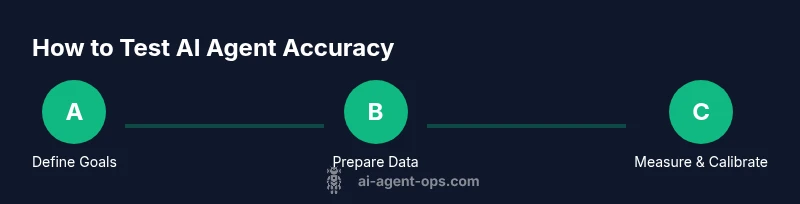
Structure the evaluation as a repeatable workflow: prepare data, run inference, calculate metrics, visualize results, and generate actionable insights. Use a versioned evaluation harness to ensure reproducibility and traceability across model iterations and deployment contexts. Apply cross-validation or hold-out testing where appropriate to estimate generalization, and consider stratified sampling to preserve class balance when relevant. Document failures by category (e.g., boundary cases, mislabeled data, ambiguous prompts) and assign ownership for remediation. Finally, translate metrics into concrete product actions such as retraining, feature engineering, or adjustment of confidence thresholds. The outcome should be a clear, auditable record of agent accuracy and the steps needed to improve it.
Calibration, drift detection, and ongoing maintenance
Calibration ensures that the agent’s confidence aligns with actual outcomes, a critical property for agentic systems that must justify decisions to users. Regularly monitor calibration curves and compute drift metrics to detect performance changes as data distributions shift. Establish a maintenance plan that includes periodic re-evaluation on updated datasets, automated alerts for degrading accuracy, and a governance process for retraining decisions. Effective maintenance ties testing to real-world usage patterns, enabling proactive updates rather than reactive fixes. Ai Agent Ops highlights that ongoing evaluation is essential to sustain trust in autonomous or semi-autonomous agents over time.
Practical pitfalls and how to avoid them
Even a well-designed test can mislead if not implemented carefully. Common pitfalls include data leakage from future information, overfitting to a static test set, label noise masking true performance, and evaluating in an artificial vacuum detached from user behavior. Mitigate these risks with strict data handling policies, diverse and fresh test data, and continuous monitoring in production. Use blind evaluation and independent audits where possible, and keep the evaluation framework modular so you can replace inputs or metrics without destabilizing other parts of your pipeline. Finally, maintain transparency with stakeholders by sharing the evaluation design and results openly.
A practical testing blueprint: putting it all together
Create a phased plan that converts theory into action. Start with a scoping workshop to define success criteria and data requirements. Build a labeled test set and an evaluation harness, then run baseline measurements to establish current accuracy. Expand into scenario testing, edge-case validation, and calibration checks. Use the insights to drive targeted improvements—such as data enrichment, prompt engineering, or model retraining—and re-run the evaluation cycle. A repeatable blueprint helps teams compare iterations objectively and demonstrates progress to product and leadership teams. AI agents thrive on disciplined testing, and a clearly defined plan accelerates reliable delivery.
Summary of the testing journey (note for readers)
The path to robust AI agent accuracy combines clear goals, high-quality ground-truth data, a well-chosen metric mix, comprehensive scenario testing, and disciplined maintenance. It’s not about chasing one perfect score but about proving the agent behaves as intended across real-world tasks and over time. By following a rigorous process, teams reduce risk, build user trust, and unlock more capable agentic systems. The final measure is not a number alone but a reproducible story of measurement, improvement, and governance.
Tools & Materials
- Test dataset (ground-truth labels)(Represent diverse tasks and inputs; include edge cases)
- Annotation tool(Supports versioning and audit trails)
- Labeling guidelines(Clear decision rules and examples for consistency)
- Metrics computation library(Python-based (NumPy/Pandas) or equivalent)
- Evaluation harness(Reproducible scripts to compute metrics and visuals)
- Compute environment(Supported hardware and software versions; containerized if possible)
- Versioned model artifacts(Track model IDs, prompts, and configurations)
- Experiment tracking(Logs experiments, results, and decisions for auditability)
Steps
Estimated time: 4-8 hours
- 1
Define success criteria
Articulate what constitutes acceptable accuracy for each task the agent performs. Map business outcomes to measurable targets and determine tolerance for errors in different contexts.
Tip: Get product owners to agree on objective thresholds and success metrics up front. - 2
Assemble ground-truth data
Gather labeled inputs that reflect real user scenarios, including edge cases. Establish labeling guidelines and ensure data quality with inter-annotator agreement checks.
Tip: Use multiple annotators and a reconciliation process to reduce label noise. - 3
Choose and document metrics
Select a balanced mix of metrics (e.g., accuracy, precision, recall, F1, calibration) that align with task goals. Predefine how you will compute confidence intervals.
Tip: Avoid relying on a single metric; metrics should tell a complete story. - 4
Run evaluation harness
Execute the evaluation pipeline against the test set and capture results, visualizations, and failure modes. Ensure reproducibility with versioned artifacts.
Tip: Automate the run and store results with clear provenance. - 5
Analyze failures and calibrate
Investigate misclassifications, low-confidence predictions, and drift indicators. Apply calibration techniques and, if needed, adjust thresholds or prompts.
Tip: Categorize failures to guide targeted improvements (data, model, or prompts). - 6
Plan monitoring and retraining
Define a cadence for re-evaluation, threshold-based alerts, and a governance process for model updates in production.
Tip: Automate drift detection and notification to reduce response time.
Questions & Answers
What is AI agent accuracy and why does it matter?
AI agent accuracy measures how often the agent produces correct or trusted results across tasks. It matters because users rely on consistent, reliable decisions, and poor accuracy can erode trust and increase risk in production.
AI agent accuracy is how often the agent gets it right. It matters because reliable decisions build user trust and reduce risk in real-world use.
Which metrics should I start with for evaluation?
Start with accuracy for overall correctness, then add precision and recall for error patterns. Include calibration metrics to ensure confidence aligns with outcomes, and consider AUC or log loss for probabilistic tasks.
Begin with accuracy, then add precision, recall, and calibration to get a full picture of performance.
How large should the test set be?
Aim for a representative sample that covers typical usage and edge cases. The exact size depends on task complexity and data diversity; ensure it’s large enough to yield stable metric estimates and meaningful confidence intervals.
Choose a test set that represents usual and edge cases, large enough to give stable metrics.
How can I prevent data leakage in evaluation?
Keep data separate by source and time, avoid using future information, and isolate testing data from any elements used during training. Use automated checks to enforce boundaries between datasets.
Separate data sources and times, and keep testing data distinct from training data to avoid leakage.
How often should accuracy be re-evaluated?
Re-evaluate on a defined schedule or when significant data shift or product changes occur. Implement drift alerts and triggers for retraining to maintain trustworthy performance.
Re-evaluate at a defined cadence or when major changes happen, with drift alerts.
Watch Video
Key Takeaways
- Define success criteria tied to business outcomes
- Use a diverse, labeled test set with clear guidelines
- Combine multiple metrics to assess accuracy and calibration
- Test under real-world scenarios and monitor drift over time
- Establish a repeatable evaluation loop for continuous improvement