Test AI Agent: Practical Verification Guide
A comprehensive, step-by-step guide to testing AI agents for reliability, safety, and performance across real tasks, with practical workflows and tooling recommendations for developers and leaders.


Learn how to test an AI agent effectively by defining clear objectives, building a safe test harness, and validating behavior across planning, tool use, and task execution. This quick guide introduces a repeatable workflow to catch failures early and improve reliability.
What is a test ai agent and why it's important\n\nIn modern automation, a test ai agent is a software construct designed to validate the behavior, robustness, and safety of an autonomous agent before it runs in production. It focuses on evaluating decision-making, tool use, and long-running tasks under controlled conditions. According to Ai Agent Ops, testing an AI agent ensures dependable automation, reduces unexpected outcomes, and helps teams ship smarter, faster workflows. The Ai Agent Ops team found that many teams underestimate the scope of tests for agentic AI workflows, often treating them like traditional software tests. A robust test strategy defines objectives, boundaries, and observability from the outset. It also creates repeatable test cases that cover core capabilities such as goal decomposition, plan generation, action execution, and outcome validation. The difference between a mere demo and a reliable test is not just the data, but the repeatability of results. By building a test harness that simulates real tasks, you can observe how the agent negotiates uncertainty, handles failures, and adapts to new prompts or tools. This is especially important for agents that orchestrate other systems or interact with live data feeds. In short, a disciplined testing mindset makes AI agents predictable allies rather than black-box risks.
Key principles of testing AI agents\n\nTesting AI agents requires a shift from traditional software tests to tests that evaluate behavior, safety, and adaptability. Core principles include: Observability - capture prompts, decisions, tool selections, and final outcomes with traceable logs. Reproducibility - ensure tests can be repeated with the same seeds and data. Robustness - verify performance under variation, noise, and partial failures. Safety and ethics - check for unsafe prompts, biased decisions, and leakage of sensitive data. Determinism vs stochasticity - decide when stochastic behavior is expected and when it must be constrained. End-to-end coverage - test across the full workflow, from user intent to final action, and back to user feedback. When designing tests, consider both unit-level checks (are the agent components calling the right tools?) and scenario-level tests (does the agent achieve the objective given a task and constraints?). Also consider evaluation metrics that reflect real-world impact, such as task success rate, time to completion, fairness indicators, and resource usage. The Ai Agent Ops approach emphasizes traceability, versioned prompts, and modular test cases that map to agent capabilities, so teams can pinpoint failures quickly and iterate efficiently.
Common testing scenarios and examples\n\nTesting a test ai agent involves various scenarios that stress planning, tool use, and interaction with users or other systems. Example 1: a tool-using planner that must fetch data from an API, process it, and present a recommended action. Example 2: a multi-turn assistant that answers complex questions while maintaining context and avoiding leakage of sensitive data. Example 3: a fault-tolerant workflow where the agent encounters partial failures and must retry, switch tools, or escalate to a human. For each scenario, design starter prompts, failure cases, and success criteria. Finally, create end-to-end tasks that mirror real jobs in your domain—whether ticket triage, code deployment, or customer support automation. Testing such scenarios reveals edge cases such as prompt injection, tool unavailability, and latency spikes that can derail plans. Real-world examples help teams communicate results clearly to stakeholders and establish a shared baseline for improvements. The process should be repeatable, with deterministic seeds where possible and documented test intents that map to expected outcomes.
Tools, environments, and data you need\n\nA reliable test of a test ai agent requires a mix of tools, environments, and data to reproduce real-world conditions. Core items include: - Test harness or framework that can simulate prompts, tool calls, and environment responses. - Sandbox or simulated environment that gracefully models tool latency, failures, and network issues. - Data generator to create diverse scenarios, seed values, and edge cases. - Logging and tracing system to capture prompts, decisions, tool selections, and results. - Version control for prompts, tools, and test cases to track changes over time. - Metrics dashboard to visualize success rates, latency, and resource usage. Optional but beneficial: synthetic data for safety testing, unit tests for individual components, and alerting rules for failures. When choosing tools, favor modular architectures that allow swapping components without rewriting tests. All data used in tests should be scrubbed of sensitive information where possible.
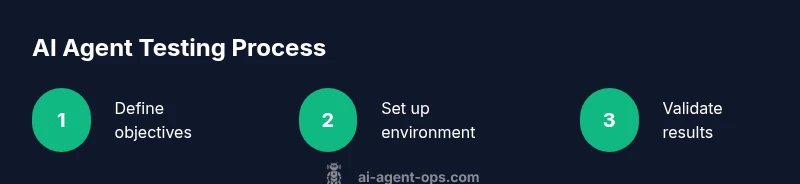
A practical testing workflow: from setup to validation\n\nA practical workflow for test ai agent testing progresses from scope to verification. Start by clearly defining the agent's objective, constraints, and success criteria. Then build a controlled environment that resembles production and assemble a diverse test corpus. Next, implement a lightweight test harness that can replay prompts and log decisions. Run baseline tests to verify the agent's behavior against known good outcomes. After that, stress test with edge cases, latency variations, and tool outages. Finally, analyze results, fix issues, and re-run tests to confirm improvements. This workflow should be repeatable and versioned, allowing you to scale coverage as your agent evolves. The next section provides step-by-step actions you can implement now.
Common pitfalls and how to avoid them\n\nCommon mistakes include assuming tests reflect production conditions, neglecting latency or tool outage scenarios, mixing evaluation of individual components with end-to-end tests, and ignoring safety constraints. To avoid these, design tests to isolate components, simulate external dependencies, and include safety-focused checks (prompt safety, data handling, and output verification). Another pitfall is overfitting tests to the initial dataset; keep tests diverse and update them as the agent's capabilities grow. Finally, maintain comprehensive test documentation and versioning to prevent drift across releases.
How to measure success and scale testing\n\nMeasuring success means defining meaningful metrics and tracking progress over time. Key measures include task success rate, average time to complete tasks, failure rate, and safety/compliance indicators. For scalability, adopt a modular test suite with reusable scenarios, seeds, and scripted prompts; use continuous integration to run tests on every update. Automate data generation for edge cases and rotate prompts to avoid overfitting. The Ai Agent Ops analysis shows that mature programs emphasize coverage breadth, traceability, and fast feedback loops, enabling teams to ship safer agents faster. Building test environments that mirror production reduces surprises and supports governance.
Ai Agent Ops approach to test ai agent\n\nThe Ai Agent Ops team recommends adopting a disciplined, repeatable testing program as a foundation for any AI agent project. Start with clear objectives, invest in a robust harness, and build observability into every decision. By treating prompts as code, versioning test cases, and integrating tests into your development lifecycle, teams can achieve safer, more reliable agentic workflows. Following these practices helps organizations improve reliability, safety, and overall value from AI agents.
Tools & Materials
- Test harness/framework(A lightweight harness to replay prompts and log decisions)
- Simulation environment(Models latency, tool outages, and data feeds)
- Data generator(Seeded, diverse prompts and edge cases)
- Logging/Observability stack(Capture prompts, decisions, and outcomes)
- Version control for prompts/tests(Track changes across iterations)
- Metrics dashboard(Visualize success rates, latency, resources)
- Safety/privacy tooling(Data scrubbers and prompt safety checks)
Steps
Estimated time: 2-3 hours
- 1
Define objectives and success criteria
Clarify the task the agent should accomplish, constraints, and how success will be measured. Document seeds and expected outcomes to enable reproducibility.
Tip: Start with a concrete, measurable objective and a minimum viable test set. - 2
Set up the test environment
Create an isolated sandbox that mimics production conditions, including latency, failures, and data flows. Establish clear boundaries to prevent live data interactions during testing.
Tip: Isolate external calls to reduce flakiness and improve test reliability. - 3
Implement the test harness
Develop scripts that replay prompts, monitor tool calls, and log decisions and outcomes. Keep prompts and tools modular for reuse across scenarios.
Tip: Version control prompts and tool configurations to track changes. - 4
Run baseline tests
Execute initial scenarios to establish a reference behavior. Capture deviations from expected results and categorize by severity.
Tip: Annotate any unexpected behavior with the exact input and environment state. - 5
Stress test and edge cases
Introduce latency spikes, partial failures, and abnormal data to test resilience. Verify recovery paths and escalation rules.
Tip: Use randomized seeds to reveal nondeterministic behavior. - 6
Analyze results and iterate
Review failures, implement fixes, and re-run tests to confirm improvements. Document changes and update test coverage as needed.
Tip: Automate a feedback cycle to close the loop quickly.
Questions & Answers
What is a test ai agent?
A test ai agent is a framework to validate the behavior, safety, and reliability of an autonomous agent before deploying it.
A test ai agent validates behavior, safety, and reliability before deployment.
How do you measure agent performance?
Measure performance with task success rate, time to completion, error rate, and safety indicators; ensure tests reflect real-world goals.
Use success rate and efficiency as core metrics.
What tools are recommended for testing?
Use a modular test harness, simulated environment, logging, data generation, and a metrics dashboard.
A modular harness and simulator are essential.
How often should tests run in a project?
Run tests on every change affecting agent behavior and on a regular schedule to catch regressions.
Test with every update to catch regressions.
How do you ensure safety during testing?
Incorporate prompt safety checks, privacy safeguards, and bias monitoring; isolate tests from live data.
Prioritize safety and privacy in tests.
Watch Video
Key Takeaways
- Define objective-driven tests for AI agents.
- Ensure observability and reproducibility in every test.
- Use modular harnesses and reusable scenarios.
- Address safety and ethics from day one.
- Iterate tests continuously as capabilities evolve.