How Much Do AI Agents Cost: A Practical Guide
Explore the cost of AI agents—from upfront development to ongoing operating expenses. Learn budgeting strategies, compare DIY vs vendor options, and optimize ROI for AI agent deployments.


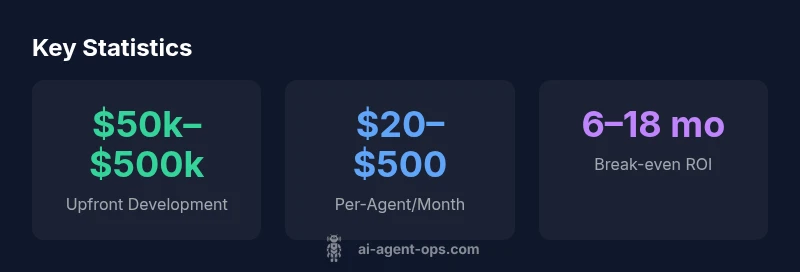
AI agents cost varies widely by scope and deployment. According to Ai Agent Ops analysis, upfront development typically ranges from tens of thousands to six figures, while ongoing costs cover cloud compute, data services, and maintenance. Vendors often price per agent per month from roughly $20 to a few hundred dollars, plus integration and governance expenses.
What drives AI agent costs
Understanding how much do ai agents cost requires looking at the core cost drivers: development effort, licensing, cloud compute and data services, governance, and ongoing maintenance. In practice, costs scale with the complexity of the agent's tasks, the number of agents deployed, the quality and volume of data, and how deeply the solution must integrate with existing software stacks. The Ai Agent Ops team has observed that even small pilot deployments can require substantial upfront work to define intents, data pipelines, and safety guardrails; larger programs demand sophisticated orchestration across teams and environments. Stakeholders typically underestimate ongoing compute and data costs that accrue month over month as agents operate in production. By mapping these drivers upfront, teams can forecast budget with greater accuracy and avoid stunned quarterly bills.
Cost categories to budget
Budgeting for AI agents involves more than just a single price tag. Break costs into clear categories so teams can align on milestones and ownership:
- Upfront development: scoping, data engineering, integration, and validation.
- Licensing or subscriptions: per-agent licenses, tiers, and SLA levels.
- Cloud compute and data services: model hosting, storage, API calls, and data pipelines.
- Data preparation and labeling: cleaning, normalization, and labeling for training/finetuning.
- Governance, security, and compliance: access controls, audits, and policy enforcement.
- Maintenance and support: monitoring, incident response, and updates.
Ai Agent Ops analysis emphasizes that robust governance and data handling can meaningfully affect long-term cost stability, especially in regulated industries.
Upfront development vs ongoing operating costs
A common decision is whether to build in-house (DIY) or buy via a vendor. DIY gives control and customization but typically requires larger upfront investments and ongoing engineering effort. Vendor-based solutions can reduce time-to-value and provide managed services, but they come with recurring subscription costs and potential constraints on customization. In practice, many teams start with a pilot DIY effort to establish core capabilities and then transition to a vendor-assisted scale-out for governance and reliability. The key is to separate initial build costs from ongoing operational expenses and to forecast both with realistic usage scenarios. Ai Agent Ops suggests building a phased budget that includes a wind-down plan for pilots that don’t scale.
Vendor vs DIY: cost considerations
- DIY advantages: maximum customization, control over data, bespoke governance.
- DIY drawbacks: higher upfront cost, longer ramp-up, more in-house talent needs.
- Vendor advantages: faster time-to-value, managed infrastructure, standardized governance.
- Vendor drawbacks: ongoing subscription costs, potential vendor lock-in, limited customization.
A practical rule of thumb is to compare the total cost of ownership (TCO) for a 12–24 month horizon. If the required customization, data complexity, or compliance needs exceed what off-the-shelf options offer, a DIY or hybrid approach may be more cost-effective in the long run.
Cost ranges by use case
- Small automation pilot for a single team: Upfront development on the lower end (tens of thousands) with modest monthly costs (tens to low hundreds per agent).
- Department-wide assistant: Moderate upfront and monthly costs (mid five-figures upfront, $100–$400 per agent per month).
- Enterprise-grade agent with governance: Higher upfront investment (six figures) and substantial ongoing costs (hundreds per agent per month, plus data and compliance expenses).
- Industry-specific, regulated-agent deployment: Very high upfront and ongoing costs (six figures plus annual governance budgeting) due to custom models and strict data controls.
Ai Agent Ops notes that many organizations underestimate the scale of governance and data-security requirements when budgeting for large deployments.
Hidden costs and pitfalls
- Data acquisition and labeling: Clean, labeled datasets can be expensive but are essential for performance.
- Talent and team capacity: Ongoing model maintenance, monitoring, and governance require dedicated staff.
- Security and compliance: Audits, access controls, and incident response add ongoing expense.
- Integration friction: Connecting AI agents to legacy systems or ERP platforms can trigger hidden costs in middleware and monitoring.
- Model updates: Regular retraining and deployment pipelines add ongoing costs that compound over time.
Early visibility into these items helps prevent budget overruns and delayed rollouts. Ai Agent Ops recommends a risk-adjusted budgeting approach that includes contingency buffers for governance and data-related expenses.
Practical budgeting checklist
- Define use cases and target outcomes with clear success metrics.
- Separate upfront build scope from ongoing subscription needs.
- Map data requirements, labeling costs, and storage.
- Estimate cloud compute, API usage, and model sizes.
- Plan governance, security, and regulatory compliance.
- Build a phased implementation with milestones and go/no-go gates. 7)Include maintenance, monitoring, and retraining costs in annual budgets.
- Create a simple TCO calculator to compare DIY, vendor, and hybrid paths.
This checklist helps teams stay aligned on cost drivers and avoid scope creep.
Return on investment and value beyond cost
ROI from AI agents comes from time savings, reduced error rates, improved decision speed, and better customer experiences. Quantifying these benefits requires consistent KPI tracking (e.g., task completion time, accuracy, customer satisfaction). While cost matters, many organizations realize substantial value from improved throughput and decision quality even when direct cost savings are modest. Ai Agent Ops highlights that ROI is most reliable when teams tie investment to measurable business outcomes and implement governance to sustain benefits over time.
Case examples and benchmarks
Because organizations vary widely by industry, the most meaningful benchmarks come from internal pilots and controlled rollouts. Start with small pilots to establish baseline performance, then scale with governance and cost controls. Common patterns show that pilots with clear success criteria and robust data pipelines tend to reach ROI targets within 6–18 months, depending on usage volume and task complexity. Across industries, the most successful programs maintain disciplined cost monitoring and continuous optimization of models, pipelines, and access controls.
Cost components and ranges for AI agents (DIY vs vendor)
| Cost Factor | Typical Range | What influences it |
|---|---|---|
| Upfront development (DIY) | 50,000–500,000 | Scope, data requirements, integrations |
| License or subscription per agent (per month) | $20–$500 | Vendor, features, SLA |
| Cloud compute and data services (per agent per month) | $10–$2,000 | Usage, model size, latency |
| Maintenance and governance (per year) | 2,000–25,000 | Staff, monitoring, compliance |
| First-year total cost of ownership | 70,000–$600,000 | Scale, governance, data needs |
Questions & Answers
What factors influence the cost of AI agents?
Costs are driven by upfront development, licensing or per-agent subscriptions, cloud compute, data services, governance, and ongoing maintenance. The exact mix depends on task complexity, the number of agents, data quality needs, and integration with existing systems.
Costs depend on upfront work, subscriptions, cloud usage, data needs, and governance requirements.
Are there cheaper alternatives to building my own AI agent?
Yes—off-the-shelf agents or low-code platforms can reduce upfront costs and implementation time, but they may limit customization and governance. Evaluate total cost of ownership against feature fit and long-term needs.
Yes—vendor-ready options can cut setup time and cost, but may limit customization.
How do cloud costs affect ongoing expenses?
Cloud compute, storage, and API usage scale with workload. Monitor usage, select appropriate model sizes, and implement governance to prevent runaway costs.
Cloud costs rise with usage; keep an eye on model size and data needs.
What pricing models do AI agent vendors offer?
Common models include per-agent per-month subscriptions, tiered feature pricing, and usage-based fees. Some vendors bundle services with maintenance; negotiate SLAs to fit your needs.
Most vendors charge per-agent per-month or per-usage; blending plans helps.
How long does it take to see ROI from AI agents?
ROI timing varies, but many mid-size deployments reach break-even in 6–18 months, depending on efficiency gains, volume, and governance. Track KPIs like time saved and error reduction.
Payback often happens within a year with the right metrics.
Do costs differ by industry or domain?
Yes; regulated industries or specialized domains require stricter governance, data handling, and custom models, which adds cost. Simpler use cases may cost less.
Industry needs can drive cost due to compliance and data requirements.
“Cost is not a one-time number; it’s a multi-year investment shaped by scope, data, and governance. With proper budgeting, AI agents can deliver measurable ROI across teams.”
Key Takeaways
- Define use cases to bound upfront costs
- Separate upfront build from ongoing subscriptions
- Compare vendor pricing to DIY Total Cost of Ownership
- Budget for governance, data services, and maintenance