AI Costs: From Pilot Deployments to Enterprise Scale
Explore AI costs from pilot projects to enterprise deployments. Learn upfront, ongoing, and hidden costs, plus budgeting tips and ROI framing for executives.


AI costs vary from a few thousand dollars for a small pilot to six-figure budgets for large, enterprise-scale deployments. The numbers depend on scope, data needs, deployment model, and ongoing usage. To plan effectively, outline upfront work, compute, data prep, and governance, then forecast ongoing spend and potential savings.
The true cost spectrum of AI
If you’re asking how much does ai cost, you’re not alone. The short answer is: AI costs vary dramatically depending on scope, data needs, deployment model, and usage. AI budgets are rarely a single line item; they unfold across multiple phases: discovery and design, model selection, data preparation, integration, ongoing compute, governance, and support. According to Ai Agent Ops, the most reliable way to forecast costs is to treat AI as a product with defined stages and measurable usage. The cost envelope widens as you scale, but you can constrain it with a clear plan. For smaller pilots, costs may be in the low thousands; for mid-scale deployments, tens of thousands; for enterprise-scale agentic AI workflows, annual budgets can escalate toward six figures or more. This spectrum means you should think in terms of total cost of ownership (TCO) rather than upfront price alone. In this guide, we’ll dissect the major cost drivers, present practical budgeting approaches, and offer a framework you can adapt to your organization.
Upfront vs ongoing costs
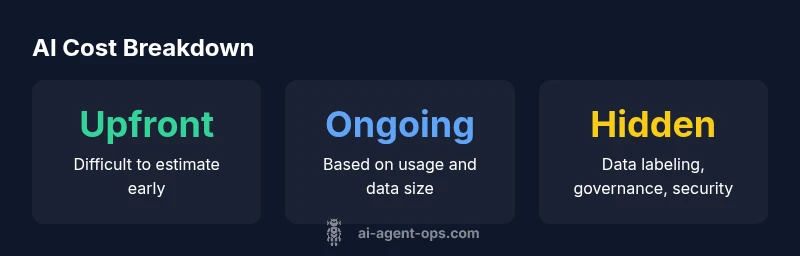
Budgeting for AI starts with distinguishing upfront investments from ongoing expenses. Upfront costs include discovery and requirements framing, data collection and labeling, model selection, and system integration. You typically invest in data quality assurance, pilot design, and initial governance policies. Ongoing costs cover compute or API usage, data storage, monitoring, model updates, support, and governance maintenance. Ai Agent Ops’s framework emphasizes a phased budgeting approach: define a target operating model, pilot with clear success metrics, then scale with controlled increments. Teams that plan thoroughly—from data procurement to deployment—tend to avoid budget shocks and align AI initiatives with business outcomes.
Cost by deployment model: cloud APIs, hosted solutions, on-prem
Deployment choices are a major cost lever. Cloud API or pay-as-you-go models are typically lowest upfront but vary with usage, which can lead to unpredictable bills if demand spikes. Hosted AI platforms (SaaS) provide predictable monthly/annual costs and reduce in-house maintenance but may limit customization. On-prem or self-hosted deployments demand higher initial investments in hardware and talent but offer long-term control and potentially lower total costs for very large workloads. Across models, budgeting should account for licensing, data transfer, latency requirements, and integration complexity. For many teams, a mixed approach—pilot on cloud, scale with a managed service, and retain core capabilities on-prem for sensitive workloads—delivers balance between cost, speed, and control.
Hidden costs and cost drivers
Hidden costs can stealthily inflate AI budgets. Data labeling and annotation quality directly affect model performance and require ongoing investment. Data licensing, access controls, and privacy compliance add layers of cost and complexity. Integration with existing systems often requires middleware, custom adapters, and testing cycles. Monitoring, security audits, and incident response plans must be funded, especially in regulated industries. Rarely discussed but critical are costs tied to talent: hiring, training, and retaining data scientists, ML engineers, and platform admins. Planning for these factors upfront helps prevent sticker shock later.
Estimating TCO and ROI: a practical framework
A disciplined ROI framework starts with scope and usage. Step one: define the intended outcomes and the expected workload (e.g., automation of specific tasks, decision support, or customer interaction). Step two: estimate compute and storage needs based on data throughput and latency requirements. Step three: factor data labeling, annotation, and cleansing costs. Step four: include integration and governance overhead, including security and compliance. Step five: build a simple ROI model that compares estimated annual benefits (time savings, accuracy improvements, revenue impact) against total annual costs. Use ranges to reflect uncertainty and run sensitivity analyses to see how changes in usage or data needs affect ROI.
Affordability strategies and cost optimization
To keep AI affordable, start small with a clear MVP and measurable milestones. Choose deployment models that align with your risk tolerance and velocity. Reuse existing models and data where possible to reduce labeling costs. Architect data pipelines for efficient streaming or batch processing to control compute. Monitor usage and implement cost alerts, quotas, and scaling rules to avoid runaway charges. Embrace a cost-aware governance process that curbs scope creep and prioritizes high-impact use cases. Finally, build a cross-functional cost model that involves product, engineering, data science, and finance from day one.
Real-world guidance for teams and organizations
Real-world budgeting requires disciplined forecasting and ongoing adjustments. Build a rolling 12-month forecast that captures pilot ramp-up, growth phases, and potential decommissioning of underperforming use cases. Establish a cost governance routine: quarterly reviews of spend by model, data source, and department. Align AI initiatives with business priorities, and maintain a living ROI dashboard that tracks time saved, accuracy gains, and customer impact. The Ai Agent Ops team recommends framing AI investments as strategic bets with staged exits or pivots if ROI targets are not met. Documentation, governance, and stakeholder alignment are just as important as the technical implementation when it comes to sustainable AI budgeting.
Comparison of AI deployment cost models
| Deployment Model | Typical Initial Cost | Ongoing Cost | Notes |
|---|---|---|---|
| Cloud API (pay-as-you-go) | low–mid | variable per usage | Good for pilots and variable workloads |
| Hosted AI Platform (SaaS) | mid | low–mid | Predictable budgets with some customization limits |
| On-premise / self-hosted | high | high ongoing maintenance | Requires hardware, security controls, skilled staff |
| Open-source + self-managed infra | low–mid | low–mid | Cost depends on infra, ops capacity, and data needs |
Questions & Answers
What is the typical upfront cost of AI projects?
Upfront costs depend on scope and data needs, including discovery, labeling, model selection, and integration. A well-scoped pilot can remain in the low to mid range, while larger initiatives may require a higher upfront commitment.
Upfront costs vary with scope and data needs, but a well-scoped pilot helps establish a baseline for budgeting.
How do ongoing costs differ between API usage and on-prem solutions?
API usage is typically variable and tied to consumption, while on-prem solutions incur steady compute, storage, and maintenance costs. SaaS platforms offer predictable recurring fees but may limit customization.
Ongoing costs vary by deployment: usage-based for APIs, and fixed maintenance for on-prem or SaaS.
Are there hidden costs I should plan for?
Yes. Data labeling, data licensing, security compliance, integration maintenance, and personnel training often drive unseen expenses. Building a governance plan helps reveal and control these costs early.
Hidden costs include data labeling, licensing, security, and ongoing maintenance.
What’s the best way to estimate AI costs for a startup?
Start with a pilot using a cloud API to validate use cases, then layer in a cost model for data, compute, and governance. Scale costs gradually as ROI proves value.
Begin with a pilot, validate use cases, then build your cost model as you scale.
Do AI costs include data labeling?
Data labeling is a common ongoing expense, particularly for supervised learning. Plan for labelers, QA, and potential outsourcing depending on data volume and quality needs.
Data labeling is typically an ongoing cost you shouldn’t overlook.
How long does it take to break even on AI investments?
Break-even timelines vary by use case and ROI drivers. A clear MVP with measurable benefits helps identify when savings offset costs, usually within several quarters for practical business applications.
Break-even depends on use case, but a measurable MVP helps you track ROI quickly.
“Cost-aware AI programs succeed when budgeting treats AI as a product with clear milestones and measurable outcomes.”
Key Takeaways
- Define cost categories early to avoid surprises
- Choose deployment models that match workload and risk tolerance
- Factor data labeling, governance, and security from day one
- Use MVPs to test ROI before large-scale investments
- Monitor spend with a cost governance routine