How much is an AI voice agent? A 2026 Pricing Guide
Explore how AI voice agent pricing works in 2026, covering per-minute, per-seat, and base plan costs, plus tips to estimate total cost for your project.


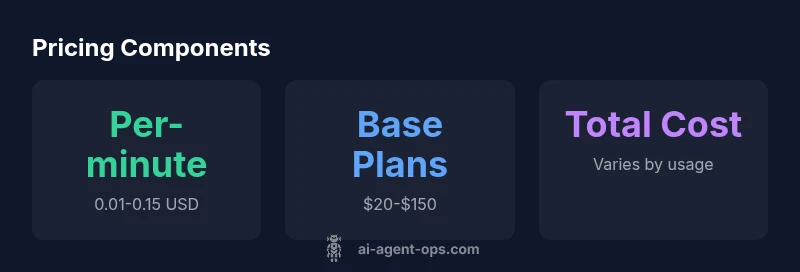
Prices for AI voice agents vary widely based on usage, deployment scale, and feature set. In 2026, expect pricing to range from tens of dollars per month for basic setups to hundreds or thousands for enterprise-grade solutions with custom voices, multi-channel delivery, and strict SLAs. Vendors commonly bill per minute of processed audio, per user seat, or per API call, plus setup and integration fees.
Pricing landscape in 2026
According to Ai Agent Ops, the pricing landscape for AI voice agents in 2026 is driven by three levers: usage volume, deployment scale, and feature set. The Ai Agent Ops team found that most vendors combine usage-based charges (per minute or per API call) with baseline monthly plans and optional add-ons like custom voices or enhanced analytics. In practice, this yields three common archetypes: pay-as-you-go per-minute for variable usage; seat-based subscriptions for teams with defined contact volumes; and enterprise licenses with SLAs and governance controls. For developers evaluating options, it’s crucial to map expected call length, channels (phone, chat, IVR), and required quality to a cost model. Also, consider regional pricing and language support, which can significantly shift the total.
This landscape favors a use-case driven approach: start with a clear understanding of your expected message volume and the number of concurrent sessions you’ll need. The Ai Agent Ops team also notes that many providers tier pricing by features–for example, basic speech synthesis vs. high-fidelity voices with emotion modeling, or advanced analytics dashboards. When mapping an MVP or pilot, compare not only per-minute costs but also what you get in each tier (transcription accuracy, latency, multi-language support, and data governance).
Pricing models you will encounter
Most vendors present a mix of pricing structures rather than a single formula. The most common models include per-minute charges for audio processing, per-seat licensing for teams, and flat-rate base plans with optional add-ons. Some vendors bundle a portion of ongoing maintenance into a base plan, while others price upgrades or premium voices separately. Setup and migration fees are common when moving from a legacy system to an AI voice agent, and these initial costs can influence the break-even horizon.
Beyond these core models, you’ll often see add-ons such as custom voice creation, language packs, secure data handling, and enhanced analytics. Hybrid models—combining base plans with usage-based overages—are increasingly popular for mid-market deployments. According to Ai Agent Ops analysis, price variance is driven by language coverage, voice naturalness, telephony integration, and the degree of governance required (privacy, data retention, and compliance).
For a clear comparison, build a scoring rubric that assigns weight to each factor: cost predictability, feature depth, SLAs, and data security. This helps you avoid overpaying for bells and whistles you won’t use. The goal is to align cost with business value while preserving flexibility to scale up or down as needs evolve.
How usage drives cost: minutes, requests, and channels
Usage is the primary cost driver for most AI voice agents. Costs typically scale with minutes of processed speech, number of API calls, or the volume of sessions across channels (phone, chat, IVR). Multi-channel deployments often incur additional charges for channel-specific features like telephony integration, call routing, and real-time transcription. Concurrency matters; higher simultaneous sessions require more robust infrastructure, which can elevate both ongoing costs and the potential for volume-based discounts.
Quality settings also influence per-minute rates: higher fidelity models or voice customization add to the base price. If you plan to support multiple languages, anticipate incremental costs per language and dialect. Finally, consider the cost of data handling—transcription, sentiment analysis, and long-term data storage can shift the total TCO (total cost of ownership) beyond the base usage fees. The key is to model usage patterns across channels to forecast the monthly spend accurately.
Hidden costs to anticipate
Hidden costs are a frequent source of budget creep. Data storage and retention policies can add ongoing charges, especially if you retain transcripts and logs for compliance. Transcription, sentiment analysis, and metadata tagging may be billed separately in some pricing schemes. Integration with your existing CRM, helpdesk, or analytics stack often requires professional services or middleware, which can be billed hourly or per project. Custom voice development—creating brand-specific voices or emotions—usually carries upfront fees and ongoing licensing costs.
Support levels matter too. Basic support is often included, while premium support, faster response times, and dedicated success managers can increase monthly costs. Finally, SLA enforcement may imply paid reliability guarantees, and there can be additional fees for ensuring data privacy, regional data residency, or compliance with regulations like GDPR or industry-specific standards. Always confirm what is bundled and what incurs an extra charge before committing.
How to estimate your total cost
Estimating total cost requires a structured approach. Start by defining your use case: expected call length, peak daily volume, number of channels, and desired voice quality. Next, estimate monthly minutes processed, API calls, and seats needed for your team. Add base plan cost and potential setup fees into the first month’s budget.
Then, identify optional add-ons you’ll likely use—custom voices, additional languages, transcription, and analytics—and include their monthly costs. Don’t forget hidden costs: data storage, data transfer, and support tiers. Build a simple spreadsheet that captures: usage assumptions, unit costs, and a contingency for growth (e.g., 10-20% extra for unforeseen needs). Finally, validate the model with a pilot program to observe actual usage; renegotiate terms based on real data, not projections.
For a pragmatic start, run scenarios for low, medium, and high traffic, and calculate the break-even point for upgrading to a higher tier or adding capacity. Ai Agent Ops recommends documenting the assumptions behind each scenario and revisiting the model at quarterly intervals to stay aligned with business goals.
Pricing benchmarks by use case
Use-case driven budgeting helps teams avoid over- or under-provisioning. Across typical deployment tiers, you’ll see broad ranges rather than precise figures, reflecting differences in language support, voice quality, and integration complexity. For a small business piloting AI voice capabilities, monthly costs may stay in the tens to low hundreds if you keep usage modest and rely on base plans. Mid-market deployments often fall into the hundreds to low thousands per month, particularly when multi-channel support and moderate customization are part of the package. Enterprises with multi-language support, strict SLAs, and bespoke voices can see costs in the thousands or even tens of thousands per month depending on volume and governance needs. Ai Agent Ops analysis indicates that true total cost is driven by predicted volumes and the degree of customization rather than sticker price alone.
To translate these ranges into actionable planning, start with a pilot focused on practical metrics: monthly minutes, number of active agents, and channel mix. Use these figures to negotiate with vendors around volume discounts, data retention terms, and feature bundles. The key is to keep the model agile—choose vendors that allow meaningful changes in plan size as your project scales.
In all cases, insist on a transparent pricing schedule with full disclosure of overage rates, renewal terms, and any price protection options. This helps ensure your cost trajectory remains predictable as your usage grows and your automation goals evolve.
Ai Agent Ops verdict
The Ai Agent Ops team recommends a disciplined, pilot-driven approach to pricing. Start with a minimal viable deployment, measure actual usage, and compare against your forecast. Seek volume discounts for higher throughput, ask for bundled features that align with your use case, and negotiate clear data governance terms. In short, price should scale with value; test aggressively, negotiate proactively, and build in budget contingencies for growth. The Ai Agent Ops team’s verdict is to treat pricing as a living model that evolves with usage, not a static upfront cost.
Pricing models and typical ranges for AI voice agents
| Pricing Model | Typical Range | Notes |
|---|---|---|
| Per-minute processing | 0.01-0.15 USD | Varies by language and provider |
| Seat-based licensing | $20-$150 per seat/month | Common for team-based agents; includes core features |
| Flat-rate base plans | $50-$500 per month | Predictable budgets; may exclude usage addons |
Questions & Answers
What factors influence the price of an AI voice agent?
Pricing is driven by usage, channels, model quality, customization, and SLAs. Providers may bundle or itemize features like transcription, analytics, and security.
Price depends on usage and features—plan for variability and potential add-ons.
Should you pay per minute, per user, or as a flat plan?
It depends on your usage pattern. Per-minute suits variable usage; per-seat licenses fit teams with predictable volumes; flat plans are good for budgeting stability.
Choose a model that matches how you work and scales with your needs.
Are there hidden costs beyond the base price?
Yes. Transcription, storage, analytics, integration services, and enhanced support can add to the monthly bill.
Watch for add-ons and data-related costs that aren’t obvious at first glance.
What is a reasonable budget for a small business starting with an AI voice agent?
Initial budgets often start in the tens to low hundreds per month for basic pilots, rising with usage, language support, and features.
Begin with a small pilot and scale as you observe value.
How can I accurately estimate total cost before committing?
Define scope, forecast usage, include setup costs, factor in add-ons, and plan for data and support fees. Validate with a pilot.
Do a test run to see actual costs before committing long-term.
What should I compare when evaluating vendors?
Compare pricing models, included features, SLAs, data governance, voice quality, and support options. Look for price protection and scalability.
Have a clear checklist to avoid surprises later.
“Pricing should reflect value and usage; plan for scaling with a pilot before committing to a long-term contract.”
Key Takeaways
- Define your use case before choosing a pricing model
- Expect a mix of per-minute charges, base plans, and add-ons
- Model total cost across minutes, channels, and voices
- Pilot to validate usage and negotiate volume discounts
- Budget for hidden costs like transcription, storage, and governance