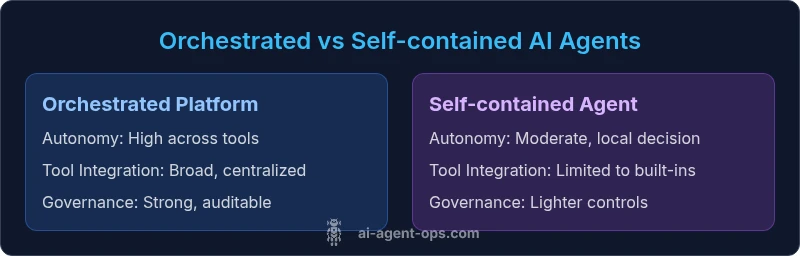
What Makes AI Agents Difference: A Comprehensive Comparison
A rigorous, analytics-driven comparison of AI agent architectures, focusing on autonomy, orchestration, governance, and integration to help teams choose the right design for scalable automation.


What makes ai agents difference comes down to architecture: autonomy, context handling, and tool orchestration across environments. The Ai Agent Ops team notes that effective designs offer strong governance and observable decision-making, not just clever models. This TL;DR highlights how orchestration versus self-contained agents shapes throughput, risk, and flexibility, helping teams decide where to start and how to scale.
What Makes AI Agents Difference: A Framework
A robust way to compare AI agents is to break them into architecture, governance, and integration dimensions. When teams ask what makes ai agents difference, the initial focus should be on architecture: autonomy, tool orchestration, and memory. According to Ai Agent Ops, the most meaningful differences come from how agents decide, act, and coordinate across tools, data sources, and environments. This article provides a framework to assess both established platforms and emerging designs, then maps practical implications for developers, product teams, and leaders who want faster automation without sacrificing safety. The goal is not a single winner but a clear lens to judge trade-offs in autonomy, control, and observability. Throughout, expect a steady emphasis on agentic workflows and governance to align with real business needs.
Autonomy and Control: Where decision power lives
Autonomy is the core differentiator between simple scripting and intelligent agents. Some designs push decision-making outward to the agent, letting it plan steps, choose tools, and adjust course as new data arrives. Others centralize control in an orchestrator or human-in-the-loop gate. The former tends to produce faster throughput and more scalable automation, but requires strong governance, safety rails, and transparent evaluation metrics. The latter offers tight oversight and easier debugging but can bottleneck workflows and limit flexibility. When evaluating options, ask: who sets goals, what constraints exist, and how easily can the system recover from partial failures? This balance between autonomy and governance often dictates long-term success in production environments. As Ai Agent Ops highlights, organizations that design for observable decision-making typically outperform those that optimize only for speed.
Context, Memory, and Continuity: How agents remember and adapt
A major difference across AI agent designs is how memory is modeled and how context persists. Some systems cache short-term state within a session, while others persist multi-session history in external stores or knowledge graphs. Persistent context improves continuity across tasks, enabling agents to re-use past decisions and avoid repeating costly reasoning. However, it also creates privacy, security, and data-management challenges. Effective agents implement principled memory management: defined lifecycles for cached data, clear provenance trails, and selective forgetting. The trade-off is between faster real-time responsiveness and richer long-term reasoning, and the right choice depends on domain demands, data sensitivity, and regulatory requirements.
Tooling, Orchestration, and Delegation: The plumbing of agents
Orchestrated agents tie together a broad set of tools, APIs, and services through a central coordination layer. This layer handles task delegation, retries, fallbacks, and cross-tool data passing, enabling complex workflows that span several domains. Self-contained agents rely on embedded capabilities, internal models, and limited external calls. The advantages and risks are straightforward: orchestration expands capability and resilience but introduces integration complexity and potential latency; self-contained designs simplify debugging but may lose reach and adaptability. For teams, the decision often hinges on required scale, governance needs, and how rapidly you want to experiment across toolchains.
Sensing, Data Access, and Environment Interaction
Effective agents must sense what matters, access relevant data, and act in the right environment. Agent capabilities vary widely in the breadth of data sources they can access (structured databases, streaming feeds, file systems, or web services) and in how they interact with external systems (read-only vs. write-enabled, real-time vs. batch). A key distinction is whether the agent operates in a sandbox with synthetic data or in production with real users and data. Security, data minimization, and traceability are essential regardless of approach. Selecting this dimension helps teams avoid scenarios where an agent can act without adequate data context or robust auditing.
Planning, Reasoning, and Evaluation loops
The heart of agent intelligence often sits in the planning and reasoning loop. Some architectures implement explicit planning stages—decompose goals into tasks, sequence actions, and simulate outcomes before execution. Others lean on reactive policy-based decisions, adjusting behavior as events unfold. Evaluation loops, such as post-action audits and feedback signals, determine continuous improvement. Differences in latency tolerance, explainability, and failure handling drive the choice between proactive planning and reactive control. In production, linking these loops to monitoring dashboards and alerting ensures operators understand why an agent chose a given path.
Governance, Safety, and Compliance: Guardrails that scale
Governance is a primary differentiator for enterprise-grade AI agents. Strong guardrails include role-based access, data retention rules, and auditable decision logs. Safety considerations cover error handling, risk signaling, and the ability to escalate when tasks hit ambiguity or potential harm. Compliance demands vary by domain (healthcare, finance, or critical infrastructure) and geography, but a consistent pattern is to embed policy checks, red-teaming practices, and independent reviews. The most successful architectures balance autonomy with observability, enabling rapid iteration while preserving trust and accountability. The Ai Agent Ops team emphasizes governance as a design constraint, not an afterthought.
Data Governance, Privacy, and Security in Agent Architectures
Data governance underpins both performance and trust. Agents that ingest or transform data must align with privacy laws, data classification, and least-privilege access. Encryption, secure telemetry, and robust authentication are table stakes, but so are data lineage and access provenance. In orchestrated environments, cross-service data handoffs should be governed by strict contracts and schemas to prevent leakage or misinterpretation. Teams should implement data retention policies and automated compliance checks, ensuring that agents do not retain sensitive data beyond required windows. Privacy-by-design reduces risk and builds user confidence.
Deployment Contexts: Cloud, Edge, and Hybrid
The deployment context shapes how agents perform, scale, and cost. Cloud-based agents benefit from elastic compute and centralized governance, but may incur network latency and data transfer costs. Edge deployments reduce latency and protect sensitive data, yet impose resource constraints and distributed management challenges. Hybrid approaches attempt to balance these trade-offs, placing control logic where it matters most. The choice depends on latency requirements, data sovereignty, and organizational capabilities. In practice, most teams start with a cloud-first approach and progressively add edge capabilities as needs evolve.
Cost, ROI, and Total Cost of Ownership
Costs of AI agents are distributed across development, integration, operation, and governance. Upfront investments include architecture design, tooling licenses, and skills development. Ongoing costs cover compute, data storage, monitoring, and security. ROI varies with task complexity, automation depth, and governance overhead. Ai Agent Ops analysis shows that architectures enabling modularity and reusability tend to reduce incremental costs over time by enabling faster iteration and safer experimentation. The exact ROI curve depends on domain, but a clear pattern is that the most scalable solutions separate concerns and support continuous learning. The trade-off is upfront effort for long-term resilience and speed.
Industry Patterns: Where orchestrated agents shine
Across industries, orchestrated agent platforms excel for multi-step workflows, regulated environments, and needs for strong observability. Sectors such as finance, healthcare, and enterprise software benefit from centralized policy enforcement and auditable decision logs. In contrast, small teams or pilot projects often succeed with self-contained agents that deliver quick wins with minimal setup. The best path often blends both approaches: a core orchestrated framework with surface-level, domain-specific agents that can be deployed rapidly.
Practical Guidelines for Teams: Design, Evaluate, and Adopt
Start with a clear set of goals and measurable indicators for success. Map goals to agent capabilities (autonomy, memory, tool access) and to governance requirements (auditability, privacy, safety). Build or select an orchestration layer that aligns with your existing toolchain, data platforms, and deployment environments. Practice iterative experiments, with guardrails and rollback plans. Finally, measure impact across four axes: speed, accuracy, reliability, and compliance. The Ai Agent Ops team recommends a staged approach: prototype quickly, scale thoughtfully, and maintain rigorous governance throughout the lifecycle.
Comparison
| Feature | Orchestrated Platform | Self-contained Agent |
|---|---|---|
| Autonomy | High: multi-step planning across tools | Moderate: task-focused execution |
| Tool Integration | Broad tool access with centralized orchestration | Limited, built-in capabilities |
| Context Memory | External state stores / knowledge graphs | Ephemeral or session-bound memory |
| Governance | Strong policy, auditing, rollback | Weaker controls, faster setup |
| Latency & Throughput | Potentially higher due to orchestration | Lower with local execution |
| Cost Profile | Higher upfront, scalable long-term | Lower upfront, limited reach |
| Best For | Complex workflows, regulated environments | Quick wins, small teams, low overhead |
Positives
- Greater automation throughput across multi-tool workflows
- Improved resilience through modular, reusable components
- Enhanced governance with auditable decisions and policy enforcement
- Easier scaling and reuse across teams and domains
- Better observability and accountability for complex tasks
What's Bad
- Higher upfront complexity and implementation effort
- Requires specialized skills to design and maintain
- Potential latency from cross-service orchestration
- Increased operational overhead for governance and monitoring
Orchestrated platforms generally win for scale and governance; self-contained agents win for speed and simplicity
Choose orchestration when multi-tool workflows and compliance matter most. Opt for self-contained when you need fast deployment with minimal setup and clear, early wins.
Questions & Answers
What is the main difference between orchestrated AI agents and self-contained ones?
Orchestrated agents coordinate across multiple tools and services via a central controller, enabling complex workflows and governance. Self-contained agents rely on built-in capabilities with limited external calls, offering simplicity and faster initial deployment. The trade-off is reach and control versus speed and ease of iteration.
Orchestrated agents coordinate many tools, while self-contained agents keep things in one package. The choice affects complexity, speed, and governance.
How do AI agents handle memory and context over time?
Memory strategies vary: some persist long-term context externally (knowledge graphs, databases), others rely on short-term session state. Persistent context improves continuity but raises privacy considerations. A disciplined memory policy with data lifecycle management is essential for safety and compliance.
Memory can be short-term or long-term. Long-term memory helps continuity but needs careful privacy controls.
What governance and safety considerations apply to AI agents?
Governance includes access controls, auditable logs, and data retention policies. Safety involves error handling, escalation paths, and risk signaling. Compliance varies by domain but should be baked in from the start, not added later.
Governance and safety should be built-in from day one, not after deployment.
When should a team choose an orchestrated platform over a smaller solution?
Choose an orchestrated platform when you need multi-tool workflows, consistent governance, and scalable reuse. Start with a small core and expand, ensuring you have guardrails and a clear pathway for compliance.
Pick orchestration for scale and governance; start small and grow with guardrails.
What is the cost impact of adopting AI agents at scale?
Costs accrue from development, integration, and ongoing governance. Scalable, modular architectures tend to reduce incremental costs over time by enabling faster iteration and safer experimentation. Exact numbers depend on domain, data needs, and compliance requirements.
Costs grow with scale, but modular designs save time and reduce risk over time.
What are practical steps to start building AI agents?
Start with a concrete automation goal, map required capabilities, and choose a minimal orchestration layer or a small, self-contained agent to validate assumptions. Iterate with guardrails, collect feedback, and measure impact on speed, accuracy, and reliability.
Begin with a clear goal, validate quickly, and iterate with guardrails.
Key Takeaways
- Define automation goals before selecting architecture
- Prioritize governance when scaling across teams
- Prefer orchestration for complex, multi-tool workflows
- Invest in memory, provenance, and privacy controls
- Prototype, then scale with guardrails