ServiceNow AI Agent vs Virtual Agent: A Practical 2026 Comparison
Compare ServiceNow AI Agent and generic Virtual Agent in 2026: use cases, integration, governance, deployment, and ROI considerations for developers, product teams, and business leaders evaluating AI agent workflows.


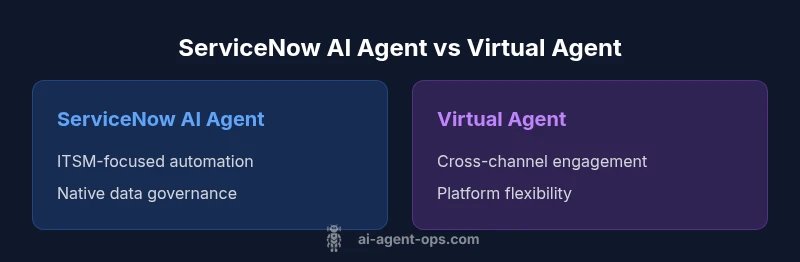
In the ServiceNow AI Agent vs Virtual Agent comparison, the ServiceNow AI Agent excels for ITSM-centric workflows within the ServiceNow platform, offering deeper integration, governance, and faster time-to-value. A generic Virtual Agent, by contrast, provides broader channel reach and platform-agnostic deployment for multi-channel customer interactions. For organizations already on ServiceNow, prioritize the AI Agent for core operations; for broader customer experience needs, pair a flexible Virtual Agent with ITSM automation.
What is ServiceNow AI Agent?
ServiceNow AI Agent is an AI-enhanced capability built within the Now Platform to automate routine IT Service Management (ITSM) tasks, orchestrate multi-step workflows, and provide context-aware assistance to agents and end users. It taps into the ServiceNow data fabric—including incident records, knowledge articles, change requests, and CMDB items—to surface relevant results and drive actions directly inside approved ServiceNow apps. According to Ai Agent Ops, this in-platform AI agent benefits organizations that require strong data locality, policy-driven execution, and enterprise-grade governance. The architecture emphasizes intent understanding, task-focused reasoning, and tight integration with native workflows, ensuring actions like ticket creation, status updates, or knowledge article recommendations stay within controlled boundaries. For developers, the upside is predictable security constraints, consistent user experiences, and simplified integration through existing Now Platform APIs and workflows. As the AI agent landscape evolves in 2026, Ai Agent Ops analysis shows ServiceNow-driven AI adoption rising among large enterprises that prioritize ITSM alignment and auditable AI actions, reinforcing the platform’s role in agent orchestration and operational resilience.
What is a Virtual Agent?
A Virtual Agent, in contrast, is a chat or voice-based AI assistant designed to engage users across channels—web chat, mobile apps, messaging apps, or voice interfaces. It is typically built to handle customer service, HR inquiries, sales support, or product guidance, and can be deployed across multiple systems and data sources beyond a single platform. Virtual Agents often leverage large language models (LLMs) or hybrid approaches to interpret user intent, manage conversations, and trigger downstream actions via APIs. They excel when the goal is channel-agnostic reach, rapid prototyping, and cross-domain automation. In the broader comparison of servicenow ai agent vs virtual agent, Virtual Agents offer flexibility, including multi-brand support and cross-department workflows, but may require more extensive integration work to maintain governance and data consistency across platforms. In 2026, enterprises increasingly adopt Virtual Agents to extend digital first strategies and support non-IT touchpoints, while balancing data security with cross-channel responsiveness.
Key functional distinctions: capabilities, data access, and context handling
The two AI agents differ in scope and data access. ServiceNow AI Agent operates inside the Now Platform, leveraging native data models and secured access to ITSM, CMDB, and knowledge bases. This yields strong context continuity for IT operations and streamlined ticketing, with policy-driven execution that limits actions to approved workflows. Virtual Agents, meanwhile, connect to diverse data sources across CRM, ERP, HR systems, and external APIs. They offer broader channel reach and more flexible deployment but may require additional governance overlays to ensure data consistency and privacy across environments. Context retention also varies: ServiceNow AI Agent tends to maintain session memory within a defined ITSM task, while Virtual Agents can maintain broader, multi-session context across channels but demand careful data-handling to avoid leakage between customers or departments. Both approaches benefit from structured prompts, continuous learning loops, and ongoing evaluation to mitigate drift and ensure alignment with business objectives. When deciding servicenow ai agent vs virtual agent, map required data surfaces, governance needs, and channel strategy to determine which solution delivers measurable business value.
Integration, governance, and security considerations
Governance is a central differentiator. ServiceNow AI Agent inherits the platform’s RBAC, audit trails, and data policies, making it easier to enforce compliance and governance for ITSM workflows. It leverages Now Platform security controls, including role-based access, data segregation, and audit-ready activity logs, which is critical for regulated industries. Virtual Agents must be wired to governance controls across each connected system, often requiring separate data handling policies, encryption keys, and privacy safeguards across multiple vendors. The choice between servicenow ai agent vs virtual agent should consider how your organization enforces data ownership, access controls, and privacy across channels. For both options, plan a governance framework that includes regular model evaluation, performance monitoring, and incident response playbooks to handle AI missteps or data exposure. In 2026, enterprise teams increasingly demand integrated governance capabilities that unify AI usage across platforms, reducing risk while enabling scale.
Deployment models and total cost of ownership
Deployment choices hinge on where the data lives and how much control you need. ServiceNow AI Agent typically runs within the Now Platform’s cloud environment, benefiting from a consolidated data surface and simplified operations for ITSM-centric use cases. This often translates to lower integration overhead and faster onboarding for teams already inside the ServiceNow ecosystem, but it may tie you to ServiceNow’s licensing model and ecosystem constraints. Virtual Agents offer greater flexibility to operate across multiple platforms and channels, but can incur ongoing costs from multiple vendor licenses, API usage, and hosting. Total cost of ownership for either approach depends on workload size, number of channels, required data integrations, and governance requirements. A blended approach—starting with ServiceNow AI Agent for core ITSM tasks and adding a Virtual Agent for customer-facing channels—can deliver both depth and breadth while balancing cost and risk.
Migration strategies and coexistence patterns
Many enterprises adopt a phased approach when transitioning to AI-enabled operation. Start with a single ITSM use case inside ServiceNow to prove value, then gradually broaden to additional IT domains. Introduce a Virtual Agent for non-IT channels to preserve consistent brand experiences while preserving governance boundaries. Coexistence patterns include handoff protocols between agents and humans, orchestration layers that route requests to the most appropriate agent, and standardized intents mapped to both platforms. Data synchronization points, such as customer profiles or knowledge articles, should be centralized where possible to avoid duplicates and drift. In 2026, best practices emphasize clear ownership, robust telemetry, and a staged rollout that minimizes risk while preserving user experience and security. The Servicenow ai agent vs virtual agent decision should align with your digital transformation roadmap and cross-functional collaboration goals.
Practical decision framework and decision checklist
To choose servicenow ai agent vs virtual agent, start by listing critical use cases and data surfaces for ITSM versus customer engagement. Create a decision rubric that weighs platform affinity, data governance, channel strategy, and total cost of ownership. Include a 90-day pilot plan with measurable outcomes such as incident resolution time, first contact resolution, and user satisfaction. Evaluate integration complexity, change management requirements, and required skills. Ensure you have executive sponsorship, a cross-functional steering committee, and a clear roadmap for data privacy and security controls. By anchoring your decision to specific business objectives and risk tolerance, you can choose the solution that best supports your organization’s AI agent ambitions and agentic AI workflows.
Real-world scenarios: ITSM, customer service, HR, and product support
In ITSM, ServiceNow AI Agent can automate ticket routing, self-service, and knowledge article recommendations within the Now Platform, delivering fast incident resolution and standardized processes. For customer service, a Virtual Agent can handle multi-channel interactions across web chat, social media, and messaging apps, providing 24/7 support and freeing human agents for complex inquiries. HR service delivery benefits from Virtual Agent by guiding employees through policy questions and form submissions across platforms, while IT teams may still rely on ServiceNow AI Agent for workflow orchestration and governance. Product support scenarios can combine both approaches: ServiceNow AI Agent streamlines internal operations like change management, while Virtual Agent handles external user inquiries across channels. In all cases, set clear success metrics and design your architecture to minimize data silos and maximize user experience.
Implementation roadmap: steps to evaluate, pilot, scale
Begin with a discovery phase to map target use cases, data sources, and current pain points. Define success metrics (e.g., time-to-resolution, handoff accuracy, customer satisfaction). Build a small cross-functional pilot, starting in ITSM with ServiceNow AI Agent and a parallel pilot for a high-visibility customer channel using a Virtual Agent. Establish governance, security, and privacy controls before scaling. Collect telemetry, monitor performance, and iterate on intents, prompts, and workflows. When you see tangible improvements, expand to additional domains, optimize channel coverage, and explore orchestration between the two agents to maximize value. This structured approach aligns with the broader goal of accelerating agentic AI workflows while maintaining control and compliance.
Comparison
| Feature | ServiceNow AI Agent | Virtual Agent (generic) |
|---|---|---|
| Primary use case | ITSM automation and workflow orchestration inside the Now Platform | Customer-facing and cross-channel automation across multiple systems |
| Data access and control | Native data models within ServiceNow with policy-driven actions | Connections to diverse data sources with centralized governance required |
| Platform integration depth | Deep, native integration with ITSM, CMDB, knowledge, and change processes | Platform-agnostic integration across CRM/ERP and other systems |
| Context retention and memory | Context scoped to ITSM tasks and workflows inside Now Platform | Cross-channel, session-spanning context across connected systems |
| Customization and training | Prompts and intents aligned with ServiceNow data and workflows | Flexible prompts, multi-domain intents, and cross-vendor training |
| Deployment model | Cloud-based within ServiceNow Now Platform | Cloud or on-prem options depending on vendor and architecture |
| Security and compliance | RBAC, audit logs, and policy controls from ServiceNow | Cross-platform security controls and data privacy governance across systems |
| Cost considerations | License and ecosystem alignment with ServiceNow | License costs across multiple platforms and channels; variable API usage |
| Best For | ITSM-centric enterprises seeking deep integration and governance | Organizations needing broad channel reach and platform versatility |
Positives
- Deep integration with ServiceNow platform and data model
- Unified governance and security across ITSM workflows
- Faster time-to-value for IT service automation
- Consistent user experience within the ServiceNow ecosystem
What's Bad
- Higher dependency on the ServiceNow environment
- Potentially narrower in non-IT use cases
- License and tenancy considerations in large enterprises
- Requires careful data mapping to avoid silos when combining with Virtual Agent
The Ai Agent Ops team recommends starting with ServiceNow AI Agent for ITSM-centric workflows, while maintaining a flexible virtual agent for multi-channel interactions.
ServiceNow AI Agent offers depth and governance for IT operations; Virtual Agent provides breadth and cross-channel reach. Use both strategically to cover core ITSM tasks and outside-IT touchpoints.
Questions & Answers
What is the main difference between ServiceNow AI Agent and a Virtual Agent?
ServiceNow AI Agent is embedded in the Now Platform, leveraging native ITSM data and workflows with strong governance. Virtual Agents are platform-agnostic and suited for multi-channel customer engagement across systems. The choice depends on data locality, channel strategy, and governance needs.
ServiceNow AI Agent works best inside Now for IT tasks, while Virtual Agents reach across channels in other systems. Your decision should hinge on data locality and channel strategy.
Which use cases suit the ServiceNow AI Agent best?
ITSM automation, incident response, knowledge article recommendations, and policy-driven ticket orchestration are natural fits for the ServiceNow AI Agent. It shines when data security, governance, and deep platform integration matter most.
Best for ITSM tasks like ticketing and knowledge searches inside ServiceNow.
Can I deploy both in parallel?
Yes. A common pattern is to deploy ServiceNow AI Agent for internal IT workflows and a Virtual Agent for customer-facing channels. Ensure orchestration rules and data governance prevent conflicts and maintain a unified user experience.
Yes—use ServiceNow for IT tasks and a Virtual Agent for customer channels, with a clear handoff plan.
What about data governance and security?
Both approaches require a governance framework, but ServiceNow AI Agent inherits built-in RBAC and audit capabilities. A Virtual Agent setup demands cross-system policy controls, data access reviews, and encryption practices across connected services.
Governance matters in both; leverage built-in RBAC for ServiceNow and enforce cross-system controls for Virtual Agents.
How do costs compare between the two options?
Costs depend on licensing, scale, and channel requirements. ServiceNow AI Agent typically aligns with the Now Platform licensing, while a Virtual Agent may incur multi-vendor licenses and API usage charges. Plan for ongoing maintenance and data integration efforts.
Costs vary; expect platform licensing for ServiceNow and potential multi-vendor costs for a Virtual Agent.
How should I measure ROI for AI agents?
Track metrics such as time-to-resolution, first contact resolution, reduction in manual work, user satisfaction scores, and incident volume. A paired approach—ITSM improvements with ServiceNow and customer-channel outcomes with a Virtual Agent—often yields the clearest ROI.
Use ITSM efficiency metrics and customer satisfaction to quantify ROI, plus channel-specific impact for the Virtual Agent.
Key Takeaways
- Choose ServiceNow AI Agent for ITSM-focused automation
- Add a Virtual Agent to extend multi-channel capabilities
- Prioritize governance and data privacy from day one
- Pilot with clear success metrics before scaling