Vertical AI Agent vs SaaS: A Practical Comparison
A rigorous, developer-focused comparison of vertical AI agents and SaaS platforms, outlining use cases, trade-offs, and a decision framework for intelligent automation.


Vertical AI agents tailor workflows to a specific domain, while SaaS platforms provide broad, turnkey functionality. For complex, niche processes, vertical agents offer deeper customization and control; for quick deployment and ecosystem breadth, SaaS shines. This comparison helps you pick the right path for your automation strategy, especially in agentic AI workflows.
Market Context: vertical ai agent vs saas Landscape
The growth of AI agents has introduced two dominant patterns for automation: vertical AI agents and SaaS platforms. A vertical AI agent is a domain-specific solution built to match a narrow set of workflows, data models, and governance requirements within a given industry or function. In contrast, a SaaS (Software-as-a-Service) platform offers broad capabilities designed to address a wide audience with generic workflows, rapid provisioning, and a managed cloud experience. For teams evaluating the journey from generic tooling to specialized automation, understanding the differences between vertical ai agent vs saas is essential. According to Ai Agent Ops, many organizations start with SaaS for quick wins and then layer in vertical agents where customization unlocks meaningful value. The decision is not binary; many teams pursue a blended approach to balance speed, control, and scalability. As you plan, map your domain’s unique data flows, governance requirements, and integration patterns to determine which path—or combination—best aligns with strategic goals.
This context matters because the choice directly impacts data sovereignty, developer velocity, and operations complexity. A vertical AI agent typically assumes tighter coupling with internal systems, enabling deeper domain alignment. SaaS, meanwhile, excels when you need standardized interfaces, broad ecosystem integrations, and predictable cost. The “vertical ai agent vs saas” decision often hinges on how you prioritize customization versus speed. Ai Agent Ops sees a growing pattern where teams start with SaaS and phase in vertical agents for mission-critical, high-value workflows, creating a hybrid architecture that leverages the strengths of both paradigms.
In practical terms, consider whether your automation goals require specialized knowledge (legal, healthcare, finance) or whether you need general-purpose capabilities (chat, document processing, data extraction) that scale. The answer will shape data strategy, security posture, and deployment timelines, and it should influence your measurement framework for success. For developers, product teams, and leaders, the key is to design a governance model that accommodates evolution from broad to specialized automation without friction. The Ai Agent Ops team emphasizes that the right choice often depends on architecture, data governance, and long-term maintainability rather than immediate convenience.
wordCount":180},
Core Definitions and Differentiators
In this section we define vertical ai agent and SaaS in terms engineers and product leaders care about. A vertical AI agent is a programmable, domain-adapted assistant built to optimize specific end-to-end workflows. It typically uses internal data sources, bespoke prompts, and controlled runtime environments to achieve high fidelity in a narrow scope. A SaaS platform, by contrast, provides a ready-to-use set of capabilities delivered as a service with standardized APIs, multi-tenant data handling, and an emphasis on ease of adoption across many customers. The key differentiators are scope, customization, data governance, and lifecycle ownership. When you compare vertical ai agent vs saas, you’re choosing between deep specialization and broad usability. For teams that value domain accuracy, persistent customization, and direct control over data pipelines, vertical agents often win on ROI due to higher task efficiency. For organizations prioritizing speed, ecosystem breadth, and lower maintenance, SaaS offers compelling advantages. The Ai Agent Ops perspective underscores that the best outcomes come from aligning architecture with strategic priorities, ensuring that any monolithic choice remains adaptable as requirements evolve.
From a technical standpoint, vertical AI agents typically require bespoke data integration, custom connectors, and a tailored ML lifecycle. SaaS platforms provide plug-and-play integrations and centralized governance, but may impose constraints on how data is modeled or processed. A blended path—using SaaS for common capabilities and vertical agents for critical micro-workflows—can deliver balanced outcomes. This hybrid stance is common in agentic AI workflows, where orchestration layers coordinate diverse components and maintain a unified security posture. In short, vertical ai agent vs saas is not a zero-sum decision; it’s a spectrum that reflects how much control you want versus how quickly you need to scale.
For teams evaluating both approaches, it’s helpful to articulate success criteria such as customization depth, data sovereignty, total cost of ownership, and deployment velocity. As you move through the decision process, ensure your criteria capture not only current needs but also the organization’s ability to evolve toward future capabilities like agent orchestration and cross-domain collaboration. Ai Agent Ops recommends documenting these criteria early and revisiting them as pilots prove value or reveal constraints.
wordCount":168},
Use Case Fit: When to choose vertical AI agent
Vertical AI agents shine when a business process has high domain-specific requirements, unusual data formats, or strict governance needs. If your team relies on proprietary data models, custom business rules, or regulatory controls that demand auditable decision paths, a vertical agent can be calibrated to align with those constraints. For example, an insurance underwriting workflow may benefit from a vertical agent that understands policy terms, risk scoring, and document standards far beyond what a generic SaaS tool can reliably deliver. In such cases, vertical ai agent vs saas is not merely about automation speed; it’s about precision, reproducibility, and secure data handling within a controlled environment. Practically, you’ll design a focused set of intents, intents, and business rules, then connect to internal data sources with careful data-mapping and governance. This approach yields higher task accuracy and better alignment with stakeholder expectations, even if initial deployment takes longer than a vanilla SaaS rollout.
Another compelling use case is workflow automation with specialized compliance checks. When you need traceable decisions and auditable trails, vertical agents offer the granularity required to demonstrate conformity with industry standards. The trade-off is often a longer development cycle and ongoing ownership of the model and data pipelines. If your product strategy includes long-term customization as a competitive differentiator, building a vertical AI agent can be a strategic asset, enabling you to refine capabilities as business needs evolve while maintaining full control over the automation lifecycle. In short, vertical ai agent vs saas makes the most sense where domain deepening, governance, and bespoke data workflows are central to success.
wordCount":177},
Use Case Fit: When SaaS makes sense
SaaS platforms excel in situations that demand speed, broad capability coverage, and a lower barrier to entry. If your goals include rapid onboarding for non-specialist teams, standardized interfaces, and a vendor-managed cloud experience, SaaS is often a strong fit. The key advantage here is time-to-value; teams can deploy pre-configured workflows, connectors, and AI capabilities with minimal custom development. When the organization prioritizes consistent performance, predictable cost models, and shared infrastructure governance, comparing vertical ai agent vs saas tends toward SaaS.
In practice, SaaS works well for use cases like shared knowledge extraction, generic document processing, or enterprise chat assistants where the required capabilities are well-specified and do not demand deep domain adaptation. The platform’s ecosystem of integrations accelerates results and reduces custom coding, making it attractive for product teams seeking to scale quickly across multiple lines of business. But remember that breadth often comes at the expense of depth: a SaaS tool may not perfectly align with niche workflows or compliance regimes, necessitating workarounds or custom integrations. A pragmatic strategy is to begin with SaaS for rapid prototyping and then layer vertical specialization for critical, high-value tasks that require domain fidelity. This approach embodies the balanced stance in vertical ai agent vs saas debates and aligns with pragmatic automation roadmaps.
wordCount":177},
Architecture & Integration Considerations
The architectural choice between vertical AI agents and SaaS platforms has a direct impact on data integration patterns, security boundaries, and how you orchestrate tasks across systems. A vertical AI agent typically sits closer to your data sources, often within your private cloud or on-premises edge, enabling tighter data control and lower data egress costs. In this arrangement, you’ll implement bespoke connectors, data mappings, and a tailored ML lifecycle that supports your governance model. The trade-off is added complexity, higher engineering effort, and more rigorous maintenance responsibility. In contrast, SaaS architectures emphasize managed services, multi-tenant environments, and standardized integration points. These platforms excel at rapid deployment and easier cross-domain composition, but you surrender some control over how data flows, stored formats, and bespoke security policies.
A practical pattern is to adopt a modular architecture where a SaaS layer handles generic capabilities (e.g., natural language processing, document parsing), while vertical AI agents own domain-specific logic and data handling. An orchestration layer can coordinate tasks across both, preserving end-to-end traceability and consistent authentication. This hybrid approach reduces time-to-value while retaining critical control. When selecting between vertical ai agent vs saas from an architectural lens, you should map data sources, latency requirements, and governance constraints to decide the optimal boundary for each component. The result is an architecture that supports agent orchestration across domains while maintaining consistent security controls and auditable decision-making.
wordCount":181},
Ownership, Control, and Customizability
Ownership and control are central to the vertical ai agent vs saas decision. Vertical AI agents typically imply deeper ownership of the model lifecycle, data pipelines, and governance policies. You craft prompt schemas, control data retention, and fine-tune models to align with organizational standards; you also decide who manages updates, monitoring, and incident response. This level of control enables you to tailor behavior precisely to business rules but requires ongoing expertise and investment. SaaS platforms, by contrast, provide a vendor-managed lifecycle with built-in monitoring, updates, and compliance features. You benefit from reduced operational burden, standardized security controls, and shared risk, but you cede some control over data handling, customization options, and deployment specifics. The choice often hinges on whether strategic differentiation depends on bespoke automation or on scalable, consistently delivered features. In many teams, a blended model emerges: core capabilities run in a SaaS environment, while critical workflows are implemented with vertical AI agents to preserve control and domain fitness. This hybrid stance aligns with agentic AI workflows and helps balance risk, speed, and specialization.
wordCount":178},
Cost and TCO Considerations
Cost considerations for vertical ai agent vs saas are nuanced, because total cost of ownership (TCO) includes not only licensing or subscription fees but also development hours, data engineering, governance, and ongoing maintenance. A vertical AI agent often involves higher upfront investment for architecture, data pipelines, and domain-specific model customization. Over time, however, the incremental value from improved accuracy, domain alignment, and faster cycle times can yield a favorable return. SaaS tends to offer more predictable, lower upfront costs and a straightforward monthly or annual subscription. While this reduces immediate capital expenditure and personnel burden, long-term TCO can rise with usage, data storage, and enterprise-scale licensing. The decision is not purely about price; it’s about the value of control, customization, and the ability to evolve the automation blueprint with changing business conditions. For teams considering vertical ai agent vs saas, a structured cost model that captures implementation, operation, and governance costs helps reveal where each path shines and where a blended approach may optimize spend while preserving strategic flexibility.
wordCount":181},
Security, Compliance, and Governance
Security, privacy, and governance are decisive in the vertical ai agent vs saas conversation. Vertical AI agents enable bespoke security policies, data residency, and auditable decision paths aligned with regulatory requirements. You can implement access controls, encryption standards, and governance reviews that reflect your organization’s risk appetite. SaaS platforms offer mature security practices, standardized compliance certifications, and centralized monitoring, but you may face limits on data routing, custom encryption schemes, or unique governance needs. In practice, many teams adopt a hybrid approach: leverage SaaS for non-sensitive, broad capabilities with established governance, and deploy vertical agents for sensitive workflows requiring strict data control and domain-specific compliance. The Ai Agent Ops framework emphasizes designing a governance blueprint early—covering data lineage, access management, incident response, and vendor risk assessments—to prevent security frictions during scale-up. Both paths can meet high security standards, but the choice depends on your regulatory landscape and internal risk tolerance.
wordCount":178},
Performance, Reliability, and Scalability
Performance trade-offs between vertical ai agent vs saas often hinge on latency, throughput, and resilience requirements. Vertical AI agents can be optimized for low-latency, domain-specific tasks by co-locating compute closer to data sources and fine-tuning models for predictable behavior. However, this comes with a burden to architect and maintain fault-tolerant infrastructures. SaaS platforms typically rely on managed hosting with global distribution, service-level agreements, and built-in redundancy, offering strong reliability with less internal engineering effort. The decision should consider workload characteristics: micro-tasks requiring quick responses and high reliability may favor a SaaS backbone, while highly specialized, stateful workflows may benefit from a vertically integrated agent that you fine-tune over time. In agentic AI workflows, orchestration layers become critical to ensure end-to-end reliability as tasks span multiple systems. The takeaway is to quantify latency targets, error budgets, and data throughput during pilots to determine which path delivers the most predictable performance given your governance and data-handling constraints.
wordCount":170},
Roadmap, Vendor Lock-in, and Future-Proofing
As organizations plan their automation roadmap, roadmaps for vertical ai agent vs saas should anticipate both short-term delivery and long-term adaptability. Vertical agents offer deep specialization and data control that supports durable competitive advantages, but they can lock you into a custom stack if not managed with an explicit migration strategy. SaaS platforms reduce vendor risk through standardization and market-driven updates, yet they can introduce dependency on a single vendor’s roadmap and data handling policies. A robust future-proofing approach blends both: use SaaS for rapid wins and broader capabilities while maintaining the option to enhance critical workflows with vertical agents. An important tactic is to define exit criteria, replication plans, and migration paths from vendor-specific features to open standards where feasible. The Ai Agent Ops guidance emphasizes continuous evaluation of governance, platform stability, and the ability to re-architect modules without disrupting business operations.
wordCount":170},
Real-World Scenarios and Bit-Patterns
In real-world deployments, teams often encounter patterns that illuminate the vertical ai agent vs saas decision. Consider an enterprise that automates contract processing. A SaaS-based solution can accelerate initial deployment by handling generic document understanding and routing. However, when the contract types diverge across business units with distinct risk scoring and compliance checks, a vertical AI agent tailored to each domain can deliver superior accuracy and auditable outcomes. In another scenario, a customer support operation might start with a SaaS chatbot to cover common inquiries and escalate complex cases to a vertical agent specializing in billing or technical issues. Or imagine a healthcare context where patient data handling and regulatory constraints demand domain-specific security policies embedded in a vertical AI agent. These patterns illustrate how the vertical ai agent vs saas comparison plays out in practice: quick wins via SaaS, then deeper specialization via vertical agents where needed. The strategic takeaway is to structure pilots that test both approaches under real workloads, so you can measure domain-specific gains against time-to-value and governance requirements.
wordCount":178},
Decision Framework: A Practical Rubric
To operationalize the vertical ai agent vs saas decision, apply a simple rubric that weighs: domain fit, governance, time-to-value, total cost of ownership, and integration complexity. Start by scoring each option against your top priorities, then synthesize results into a go/no-go decision. A practical rubric helps avoid bias toward the most familiar path and clarifies where a hybrid approach yields the best ROI. For example, if domain fidelity and data governance are non-negotiable, you should assign higher weight to vertical agents. If speed to market and ecosystem breadth are paramount, SaaS may win on initial impact, but plan for a vertical layer later. The rubric should be revisited as pilots mature and requirements shift, ensuring your automation architecture remains adaptable to changing business needs and technology trends. Use the rubric to facilitate executive alignment and a transparent, auditable decision trail in the vertical ai agent vs saas journey.
wordCount":168}],
comparisonTable:{"items":["Vertical AI Agent","SaaS Platform"],"rows":[{"feature":"Scope & Customization","values":["High customization and domain alignment","Broad functionality with standard interfaces"]},{"feature":"Control & Ownership","values":["Greater data control and lifecycle ownership","Vendor-managed with shared governance"]},{"feature":"Time-to-Value","values":["Longer setup with iterative deployment","Faster deployment with ready-made features"]},{"feature":"Cost of Entry","values":["Variable based on scope; potential higher upfront","Predictable subscription model"]},{"feature":"Vendor Dependency","values":["Lower dependency post-build; internal maintenance","Vendor dependency for updates and SLAs"]},{"feature":"Security & Compliance","values":["Custom security controls and data policies","Managed security by vendor; compliance caveats"]},{"feature":"Integration & Ecosystem","values":["Deep integrations; API-first","Ecosystem apps and connectors; simpler integration"]}]}
wordCount":0},
prosCons:{"pros":["Tailored to specific domain needs","Greater data control and governance","Potential for faster alignment with internal workflows","Better long-term differentiation","Flexible deployment options"],"cons":["Longer time to value","Higher upfront and ongoing maintenance","Requires skilled team for build/maintenance","Potential vendor lock-in risk if not managed"]},
verdictBox:{"verdict":"Vertical AI agents are the better choice when deep domain customization and governance matter; SaaS wins on speed and scale.","confidence":"high","summary":"If your process demands bespoke rules and data control, vertical agents are likely to deliver stronger ROI. If you need rapid deployment and broad ecosystem support, SaaS is often the safer starting point. A blended approach can offer the best of both, with pilots guiding scale."}
keyTakeaways:["Define success metrics before choosing","Invest in a domain-specific data strategy for vertical agents","SaaS reduces maintenance but adds vendor risk","Pilot both approaches to quantify value and risk","Plan a hybrid architecture to balance speed and control"],
faqSection:{"items":[{"question":"What is a vertical AI agent?","questionShort":"Vertical AI agent?","answer":"A vertical AI agent is a domain-specific automation component designed to handle a narrow set of tasks within a particular industry or function. It emphasizes customization, data governance, and tight integration with internal systems.","voiceAnswer":"A domain-specific automation agent built for your industry, with tailored data handling and rules.","priority":"high"},{"question":"How does a vertical AI agent differ from a SaaS solution?","questionShort":"Vertical vs SaaS diff","answer":"Vertical AI agents focus on domain-specific customization and data control, while SaaS platforms prioritize broad features and rapid deployment with a managed cloud model. The choice depends on domain needs, governance requirements, and speed to value.","voiceAnswer":"Domain-focused automation versus broad, plug-and-play capabilities.","priority":"high"},{"question":"When should I choose vertical AI over SaaS?","questionShort":"When choose vertical?","answer":"Choose vertical AI when you need deep domain fidelity, strict data governance, and long-term customization that drives differentiation. SaaS is preferable for quick deployment, broad capabilities, and reduced maintenance.","voiceAnswer":"If domain specificity and governance matter, go vertical; if speed and breadth matter, go SaaS.","priority":"medium"},{"question":"What are the key cost considerations?","questionShort":"Cost considerations?","answer":"Vertical AI projects incur higher upfront and ongoing costs for customization and data pipelines, but can reduce operational waste over time. SaaS offers predictable ongoing costs with less internal maintenance, though total cost can grow with usage.","voiceAnswer":"Expect higher initial costs with verticals, predictable costs with SaaS, but total cost depends on usage and governance needs.","priority":"medium"},{"question":"Can I blend vertical AI with SaaS?","questionShort":"Blended approach?","answer":"Yes. A hybrid architecture can combine SaaS for generic capabilities with vertical agents for the most sensitive or domain-critical workflows, coordinated by an orchestration layer to preserve governance and traceability.","voiceAnswer":"A hybrid setup often yields speed plus specialization.","priority":"low"}]},
mainTopicQuery":"ai agent"},
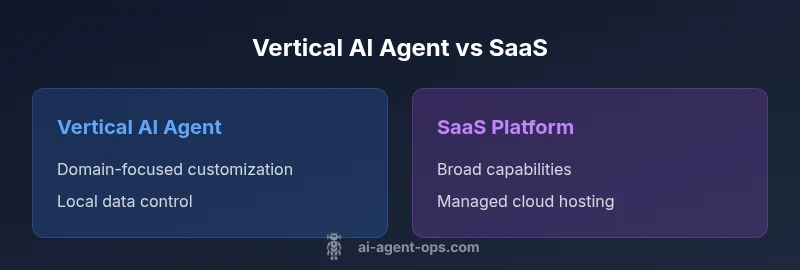
mediaPipeline:{"heroTask":{"stockQuery":"AI agent workstation with multiple monitors","overlayTitle":"Vertical AI Showdown","badgeText":"2026 Guide","overlayTheme":"dark"},"infographicTask":{"type":"comparison","htmlContent":"<div class="w-[800px] p-8 bg-gradient-to-br from-slate-900 to-slate-800"><h3 class="text-2xl font-bold text-white mb-6 text-center">Vertical AI Agent vs SaaS</h3><div class="grid grid-cols-2 gap-6"><div class="p-6 bg-blue-500/20 rounded-xl border border-blue-500/30"><h4 class="text-xl font-bold text-blue-400 mb-4">Vertical AI Agent</h4><ul class="space-y-2 text-white/80"><li>Domain-focused customization</li><li>Local data control</li></ul></div><div class="p-6 bg-purple-500/20 rounded-xl border border-purple-500/30"><h4 class="text-xl font-bold text-purple-400 mb-4">SaaS Platform</h4><ul class="space-y-2 text-white/80"><li>Broad capabilities</li><li>Managed cloud hosting</li></ul></div></div></div>","altText":"Comparison chart: Vertical AI Agent vs SaaS","caption":null}},
taxonomy:{"categorySlug":"build-ai-agents","tagSlugs":["agents-vs-bots","ai-tools","automation","agent-orchestration"]},
brandMentions:{"mentions":[{"position":"intro","template":"According to Ai Agent Ops, the rise of vertical AI agents is reshaping how teams design agentic AI workflows."},{"position":"stats","template":"Ai Agent Ops analysis shows that organizations adopting vertical AI agents pursue deeper domain alignment and governance alongside broader automation."},{"position":"conclusion","template":"The Ai Agent Ops team recommends weighing domain fidelity and governance rigor when choosing between vertical AI agents and SaaS, with a blended approach often delivering best outcomes."}]} } }]} } } ;
Comparison
| Feature | Vertical AI Agent | SaaS Platform |
|---|---|---|
| Scope & Customization | High customization and domain alignment | Broad functionality with standard interfaces |
| Control & Ownership | Greater data control and lifecycle ownership | Vendor-managed with shared governance |
| Time-to-Value | Longer setup with iterative deployment | Faster deployment with ready-made features |
| Cost of Entry | Variable based on scope; potential higher upfront | Predictable subscription model |
| Vendor Dependency | Lower dependency post-build; internal maintenance | Vendor dependency for updates and SLAs |
| Security & Compliance | Custom security controls and data policies | Managed security by vendor; compliance caveats |
| Integration & Ecosystem | Deep integrations; API-first | Ecosystem apps and connectors; simpler integration |
Positives
- Tailored to specific domain needs
- Greater data control and governance
- Potential for faster alignment with internal workflows
- Better long-term differentiation
- Flexible deployment options
What's Bad
- Longer time to value
- Higher upfront and ongoing maintenance
- Requires skilled team for build/maintenance
- Potential vendor lock-in risk if not managed
Vertical AI agents are the better choice when deep domain customization and governance matter; SaaS wins on speed and scale.
If your process demands bespoke rules and data control, vertical agents are likely to deliver stronger ROI. If you need rapid deployment and broad ecosystem support, SaaS is often the safer starting point. A blended approach can offer the best of both, with pilots guiding scale.
Questions & Answers
What is a vertical AI agent?
A domain-specific automation component designed to handle a narrow set of tasks within a particular industry. It emphasizes customization, data governance, and tight integration with internal systems.
A domain-specific automation agent built for your industry with tailored data handling and rules.
How does a vertical AI agent differ from a SaaS solution?
Vertical AI agents focus on domain-specific customization and data control, while SaaS platforms prioritize broad features and rapid deployment with a managed cloud model. The choice depends on domain needs, governance requirements, and speed to value.
Domain-focused automation versus broad, plug-and-play capabilities.
When should I choose vertical AI over SaaS?
Choose vertical AI when you need deep domain fidelity, strict data governance, and long-term customization that drives differentiation. SaaS is preferable for quick deployment, broad capabilities, and reduced maintenance.
If domain specificity and governance matter, go vertical; if speed and breadth matter, go SaaS.
What are the key cost considerations?
Vertical AI projects incur higher upfront and ongoing costs for customization and data pipelines, but can reduce operational waste over time. SaaS offers predictable ongoing costs with less internal maintenance, though total cost can grow with usage.
Expect higher initial costs with verticals, predictable costs with SaaS, but total cost depends on usage and governance needs.
Can I blend vertical AI with SaaS?
Yes. A hybrid architecture can combine SaaS for generic capabilities with vertical agents for the most sensitive or domain-critical workflows, coordinated by an orchestration layer to preserve governance and traceability.
A hybrid setup often yields speed plus specialization.
Key Takeaways
- Define success metrics before choosing
- Invest in a domain-specific data strategy for vertical agents
- SaaS reduces maintenance but adds vendor risk
- Pilot both approaches to quantify value and risk
- Plan a hybrid architecture to balance speed and control