Servicenow AI Agent vs Agentic Workflow: An Analytical Comparison
A rigorous, objective comparison of Servicenow AI Agent and agentic workflow, focusing on scope, integration, governance, and implementation for ITSM versus cross-system automation.


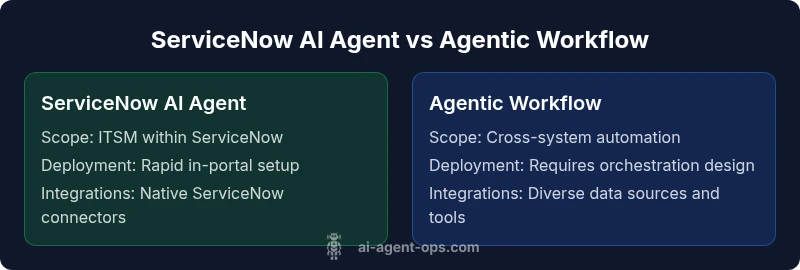
In the Servicenow AI Agent vs Agentic Workflow comparison, ServiceNow AI Agent is an inside-platform automation assistant designed for ITSM workflows, while agentic workflow describes a broader pattern of cross-tool orchestration using autonomous agents. ServiceNow offers rapid ROI within its ecosystem, whereas agentic workflow enables broader, system-wide automation across tools and data sources.
Context and Definitions
The Servicenow AI Agent is a built-in automation assistant embedded in the ServiceNow platform. It leverages native ITSM data, workflow templates, and connectors to accelerate routine tasks, ticketing, and knowledge management within IT operations. In the Servicenow AI Agent vs Agentic Workflow comparison, the distinction between a platform-native agent and a cross-platform orchestration pattern matters for long-term scalability. This article treats both as viable strategies with different scope, governance needs, and return-on-investment profiles. We frame the discussion around a practical decision lens that product teams and IT leaders can use to map automation ambitions to architecture choices, data flows, and governance rules.
Scope and Integration Boundaries
The Servicenow AI Agent shines when the automation scope is tightly coupled to ITSM within ServiceNow. It provides native intents, catalog actions, and incident/request workflows that align with CMDB data and ITIL-aligned processes. Its integration footprint is strongest inside the ServiceNow ecosystem, reducing integration friction for operators who already rely on the platform. Agentic workflow, by contrast, emphasizes cross-system orchestration: it coordinates tasks across multiple tools, SaaS services, ERP systems, data lakes, and custom APIs. This broader scope unlocks end-to-end automation but requires careful governance, versioning, and security policy alignment across tools. In practice, teams may start with ServiceNow for rapid wins and then layer agentic workflows to expand automation reach across the enterprise.
Key Differences by Dimension
- Definition and Scope: ServiceNow AI Agent is a platform-native automation assistant focused on ITSM; agentic workflow is a design pattern for orchestrating autonomous agents across heterogeneous systems.
- Deployment Footprint: ServiceNow gains speed with in-platform deployability; agentic workflow requires cross-tool connectivity and middleware.
- Data and Governance: ServiceNow centralizes data governance within ITSM; agentic workflow requires distributed data governance with standardized policies across tools.
- Integrations: ServiceNow connectors are deep within the ServiceNow stack; agentic workflow relies on APIs, adapters, and potential middleware to reach diverse systems.
- ROI and Time to Value: ServiceNow often delivers quick wins for IT operations; agentic workflow may yield longer implementation cycles but broader business impact.
Implementation Patterns and Roadmaps
A practical path often begins with a ServiceNow-first approach to capture quick wins in ITSM, incident management, and knowledge management. Define clear success criteria for IT tasks and ensure data quality within CMDB. Once core ITSM automation is stable, plan a staged expansion to agentic workflows by identifying top cross-tool processes (e.g., onboarding, service provisioning, cross-department approvals). Key activities include establishing governance committees, defining data contracts, and selecting a middleware or integration platform that can translate intents into reliable actions across systems. A phased roadmap reduces risk and ensures measurable milestones.
Data, Governance, and Security Considerations
Governance is critical when moving beyond a single platform. For ServiceNow AI Agent use cases, you can leverage existing IT governance, role-based access, and CMDB hygiene to minimize risk. When architecting agentic workflows, you must implement cross-tool data contracts, standardized security policies, and auditable action trails. Consider adopting an architecture that supports centralized policy enforcement, such as a control plane or orchestration layer, and ensure that sensitive data remains compliant with regulatory requirements. In both paths, maintain clear ownership for data lineage, version control for automation scripts, and robust monitoring to detect drift or failures.
Migration Path: From Single-Platform to Agentic AI
If your organization starts with ServiceNow AI Agent and later pursues an agentic workflow, use a staged migration plan. Begin by mapping end-to-end processes that touch multiple systems and identify integration touchpoints. Create a common data model and adapters to translate between ServiceNow data structures and external tools. Establish governance workflows to manage changes across platforms, including testing pipelines, rollback plans, and security reviews. A well-planned migration reduces disruption and enables progressive maturation of automation capabilities.
Authority Sources
Reading list for deeper, trusted context includes foundational standards and research:
- https://www.nist.gov
- https://dl.acm.org
- https://www.nature.com
Comparison
| Feature | ServiceNow AI Agent | Agentic Workflow |
|---|---|---|
| Definition & Scope | Embedded within ServiceNow for ITSM and workflow automation | Cross-tool orchestration across multiple systems and tools |
| Deployment Model | Platform-native setup with guided templates | Orchestrated across tools with custom connectors |
| Integration Footprint | Best-in-class within ServiceNow connectors | Broad integrations across SaaS, ERP, and data sources |
| Governance & Compliance | ServiceNow-centric governance and data policies | Cross-tool governance requiring policy alignment |
| Data Ownership | Data resides primarily in ServiceNow records | Data distributed across sources requiring harmonization |
| ROI & Time to Value | Faster time-to-value within ITSM scope | Longer setup but larger enterprise impact |
Positives
- Faster ROI for ITSM automation within the ServiceNow ecosystem
- Clear governance within a single platform
- Reduced setup friction for teams already on ServiceNow
- Predictable maintenance due to native tooling
- Strong alignment with ITIL-centric processes
What's Bad
- Limited cross-system reach without additional tooling
- Potential vendor lock-in within the ServiceNow stack
- Requires cross-tool governance for multi-system automation
- Less flexibility for highly customized workflows that span multiple platforms
ServiceNow AI Agent is the pragmatic choice for ITSM automation; agentic workflow excels in cross-tool orchestration.
Choose ServiceNow AI Agent for rapid, ITSM-focused gains. If your automation needs extend beyond ServiceNow, plan an incremental shift toward agentic workflows to achieve enterprise-wide orchestration.
Questions & Answers
What is the functional difference between ServiceNow AI Agent and Agentic Workflow?
ServiceNow AI Agent provides platform-native automation for ITSM tasks inside ServiceNow, with ready-made intents and workflows. Agentic workflow is a broader pattern for coordinating autonomous agents across multiple tools and data sources, enabling end-to-end processes that span the enterprise.
ServiceNow AI Agent automates ITSM tasks within ServiceNow, while agentic workflow coordinates multiple tools to automate broader business processes.
Can I deploy both approaches in parallel?
Yes. Many teams start with the ServiceNow AI Agent to address core ITSM tasks, then layer agentic workflows to extend automation across other tools and data sources as governance and integration capabilities mature.
Yes, you can run both in parallel—start with ServiceNow for ITSM, then expand to cross-tool orchestration as needed.
Which approach is more cost-effective for a typical enterprise?
Cost-effects depend on scope. A ServiceNow-first approach can deliver quicker, lower-risk ROI within ITSM. Agentic workflows may incur higher upfront integration costs but offer broader business impact over time.
It depends on scope: ServiceNow for quick ITSM wins, or agentic workflows for broader automation with longer payoff.
What are common integration considerations when adopting agentic workflow?
Plan for middleware or adapters to connect diverse tools, establish data contracts, and align security policies across platforms. Ensure there is a clear data ownership model and an auditable change management process.
You’ll need middleware or adapters, data contracts, and shared security policies when orchestrating across tools.
How do I measure success for these approaches?
Define measurable outcomes such as cycle time reduction, incident resolution improvements, or automation coverage. Use governance dashboards and post-implementation reviews to track drift, compliance, and ROI.
Track cycle time, resolution improvements, and automation coverage with dashboards and regular reviews.
Key Takeaways
- Assess your automation scope before choosing a path
- Map integration needs across tools and data sources
- Prioritize governance and data ownership from day one
- Plan a staged migration from single-platform to cross-system orchestration