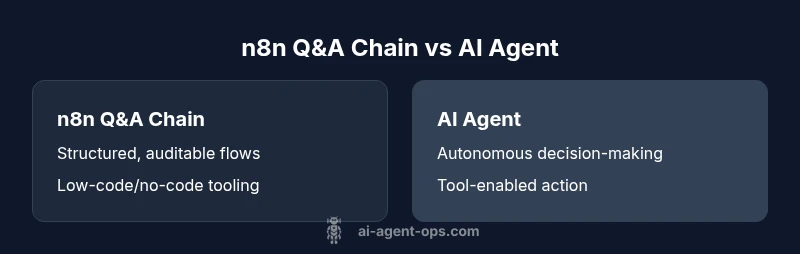
n8n Question and Answer Chain vs AI Agent: A Practical Side-by-Side Analysis
Explore a technical, analytical comparison between n8n Q&A chains and autonomous AI agents. Learn architectures, use cases, trade-offs, and integration patterns for developers and product teams evaluating agentic automation.


The quick answer is a side-by-side comparison between a no-code n8n Q&A chain and an autonomous AI agent. n8n chains excel at transparent data flows and auditable execution, while AI agents offer dynamic decision-making and tool use. This guide analyzes architectures, use cases, trade-offs, and practical integration patterns for developers and teams.
What is an n8n Q&A chain?
n8n is a low-code/no-code automation platform that lets you stitch together services, databases, and APIs into visual workflows. A Q&A chain within n8n is a patterned sequence where a user question is parsed, routed through a series of nodes for validation, enrichment, and response generation, and then returned as an answer. The chain emphasizes determinism, traceability, and replayability: each node's input, transformation, and output can be logged and audited. For teams building customer-facing bots or internal assistants, an n8n Q&A chain provides a transparent, auditable path from question to response. However, such chains typically rely on external AI models for natural language understanding or generation, and they may struggle to adapt to uncertain queries without additional orchestration. According to Ai Agent Ops, this pattern shines when the goal is to control data flows and ensure compliance while remaining agnostic about the underlying AI internals.
Practical takeaway: use n8n to enforce governance, data provenance, and repeatable execution in a no-code environment.
What is an AI agent?
An AI agent is a software construct capable of perceiving its environment, reasoning, planning, and acting through a set of integrated capabilities. AI agents can autonomously pursue goals by using tools, querying data sources, and maintaining short- and long-term memory. They combine planning with action loops, often invoking external APIs, databases, or other agents, and they adapt their behavior based on feedback. Agentic AI emphasizes autonomy, tool-use, and goal-directed behavior, enabling complex tasks such as dynamic data gathering, decision-making under uncertainty, and multi-step problem solving. For teams exploring agent-based automation, AI agents unlock a level of self-directed execution that often outpaces strictly scripted workflows. Ai Agent Ops notes that agentic architectures enable more adaptive automation in real-world scenarios, provided governance and safety rails are in place.
Key architectural differences: data flow, state, and control
n8n Q&A chains map a deterministic path: input enters a node, is transformed or enriched, and passes to the next node until a final answer is produced. State is local to the workflow run, with explicit checkpoints and logs supporting auditing. AI agents, by contrast, operate as loop-driven systems that plan, decide, and act across a broader toolset. They maintain internal memory, use prompts or tool schemas, and adjust strategy based on outcomes. Governance is achieved via strict prompts, tool permissions, and observability, but the architecture tends to be more complex and less predictable than a fixed node graph. According to Ai Agent Ops Analysis, 2026, agent-centric designs excel in dynamic contexts but require careful control of prompts, memory management, and tool access to prevent drift.
Typical use cases and scenarios: where each shines
n8n Q&A chains are ideal for structured, auditable interactions: live customer support scripts, data extraction with validation, rule-based risk checks, and compliance-heavy workflows where every decision step must be traceable. AI agents are better suited for autonomous operations in uncertain environments: proactive monitoring, decision-making with tool use (APIs, databases, and services), and end-to-end task execution that can adapt to changing inputs. A pragmatic approach often blends both: use n8n to orchestrate and guardrail AI agent actions, pre- and post-process results, and ensure reproducibility. This balance is increasingly common in enterprise automation landscapes.
Integration patterns and trade-offs: orchestrating between worlds
A common pattern is to use n8n as the orchestrator that configures, triggers, and logs AI-agent tasks. The Q&A chain handles input normalization, validation, and final presentation, while the AI agent handles planning and execution against toolsets. Trade-offs include latency introduced by multiple hops, governance overhead, and the need for robust observability. For high-stakes domains, start with transparent, auditable chains and incrementally introduce autonomous agents with strict guardrails, testing extensively in sandbox environments before production.
Performance, cost, and maintenance considerations
n8n chains tend to offer predictable performance and cost structures based on node counts and hosting. They are easier to maintain for teams familiar with visual workflows and can leverage existing auditing and versioning practices. AI agents introduce variability tied to model usage, tool integrations, and the complexity of prompts and memory management. Ongoing maintenance includes prompt refinements, tool permissions auditing, and monitoring for drift or undesired behavior. A hybrid approach—n8n for orchestration and AI agents for autonomous actions—often yields a favorable balance of reliability and capability.
Security, governance, and compliance concerns
Both approaches demand strong data governance. With n8n chains, enforce data minimization, access controls, and comprehensive audit logs. When enabling AI agents, ensure strict control over tool usage, memory handling, and external API access. Data separation, encryption, and compliance mapping (e.g., privacy regulations and data residency) are essential regardless of the architecture. Establish incident response plans and clear ownership for model updates, prompts, and tool integrations to mitigate risk.
Practical implementation checklist: step-by-step guidance
- Define the objective and success criteria for the automation task. 2) Map data flows and identify decision points that benefit from human oversight. 3) Choose the architectural pattern (n8n Q&A chain, AI agent, or hybrid). 4) Design governance, prompts, and tool access controls. 5) Build a POC with a constrained scope and observability. 6) Measure latency, accuracy, and reliability; iterate. 7) Plan a phased rollout with rollback and monitoring. 8) Document decisions, logging, and provenance to support audits.
How to decide: when to choose which approach
If your priority is transparency, strict data control, and auditable decision steps, start with an n8n Q&A chain. If you need autonomous action, adaptability to changing inputs, and complex task execution with tool-use, consider an AI agent. A hybrid strategy often delivers the best of both worlds: structure where it matters, autonomy where it adds value.
mainTopicQuery
Comparison
| Feature | n8n Q&A Chain | AI Agent |
|---|---|---|
| Architecture style | Visual workflow with nodes | Autonomous agent with planning and tool-use |
| Decision making | Deterministic routing & rules | Dynamic reasoning with prompts and tools |
| Latency | Predictable latency through nodes | Variable latency tied to AI calls and reasoning |
| Maintenance | Lower cognitive overhead; strong auditing | Higher complexity; requires governance and monitoring |
| Use cases | Structured Q&A, data routing, validation | Autonomous decision-making in dynamic contexts |
| Cost drivers | API calls, hosting, and node count | Model usage, compute, tool integrations |
Positives
- No-code integration enables rapid prototyping
- Clear audit trails and reproducible runs
- Strong data governance and compliance alignment
- Predictable performance in well-defined flows
- Easier collaboration for non-developers
What's Bad
- Limited autonomous reasoning without extra tooling
- Can become bulky if many conditional branches
- Dependent on external AI models for language tasks
- Hybrid patterns increase configuration complexity
n8n Q&A chains excel in transparency and governance; AI agents excel in autonomy and dynamic task execution
Choose n8n for auditable, rule-driven automation. Choose an AI agent for adaptive, goal-directed tasks. A hybrid approach often yields robust, scalable automation.
Questions & Answers
What is the main difference between an n8n Q&A chain and an AI agent?
An n8n Q&A chain is a deterministic sequence of nodes that processes input and produces an auditable output. An AI agent operates with autonomy, planning, and tool use to achieve goals, adapting its behavior based on feedback.
The main difference is that n8n chains are fixed and auditable, while AI agents are autonomous and adaptive.
When should I choose n8n Q&A chain over an AI agent?
Choose an n8n Q&A chain when transparency, data provenance, and strict governance are priorities. Opt for an AI agent when you need autonomous action, complex decision-making, and dynamic tool integration.
Pick n8n for auditability; pick an AI agent for autonomy and adaptability.
Can I combine both approaches in a single workflow?
Yes. A practical pattern is to orchestrate AI-agent actions through an n8n workflow, using the chain to validate inputs and post-process results, while the agent handles planning and execution behind guarded interfaces.
Absolutely—use n8n to guard and post-process AI-agent actions.
How do latency and cost compare between the two options?
n8n chains typically offer predictable latency with linear costs tied to hosting and node usage. AI agents introduce variability due to model usage and tool calls, which can affect both latency and ongoing costs depending on scale.
Expect predictable performance with n8n; expect variability with AI agents due to models and tools.
What are common pitfalls to avoid?
Avoid over-engineering, unclear ownership of prompts and tools, and gaps in observability. Ensure data governance, guardrails for model behavior, and a clear rollback plan during rollout.
Watch for drift, poor prompts, and weak observability.
Key Takeaways
- Define your objective before choosing architecture
- Use n8n for auditability and control where possible
- Leverage AI agents when autonomy adds value
- Hybrid patterns often deliver balanced outcomes
- Invest in observability and governance from day one