OpenAI Agent Builder vs N8N: Side-by-Side AI Agent Comparison
Ai Agent Ops analyzes OpenAI Agent Builder against N8N, comparing architecture, connectors, hosting, security, and cost to help teams choose the best path for AI-powered automation.


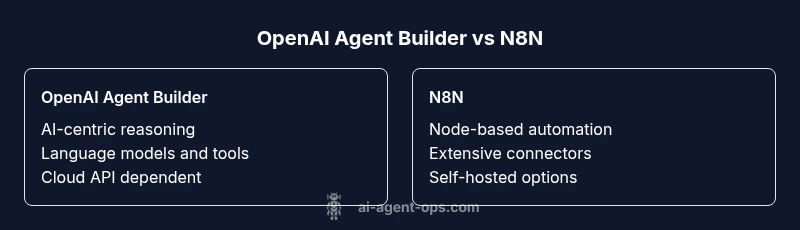
OpenAI agent builder vs N8N is a trade-off between AI-centric reasoning and broad automation orchestration. The OpenAI path emphasizes language-driven agents with conversational capabilities, while N8N prioritizes flexible connectors and node-based automation. Choose OpenAI if you need advanced AI reasoning; choose N8N if you value broad integrations and self-hosted options.
What the comparison covers
This article examines the practical distinction between an open AI agent builder and a workflow platform like N8N. For teams evaluating tools to automate decision-making, the phrase open ai agent builder vs n8n often surfaces, because it frames a choice between AI-first agent behavior and general-purpose automation. According to Ai Agent Ops, the core question is not simply which tool is 'better'—it's which tool matches your team's goals for intelligence, governance, and speed.
We start from a common mental model: agent builders embed language models, tools, and memory into agents that can reason about tasks and choose actions. N8N, by contrast, centers on visual programming, connectors, and orchestrations that can automate processes across multiple services with predictable reliability. In practice, you may mix both approaches: use an AI agent as the brain and N8N as the orchestrator for durable, rule-based workflows. The goal is to align capability with governance, latency tolerance, and cost constraints.
hostHeadingIgnorePunctuationBlocksOnlyStartWithHeadingsRemoved
Comparison
| Feature | OpenAI Agent Builder | N8N |
|---|---|---|
| Hosting & deployment | Cloud API-based (OpenAI) | Self-hosted or cloud options (N8N) |
| Connector ecosystem | AI-centric connectors and API access | Extensive node-based connectors to many services |
| Execution model | Agent-driven decision making with tool use | Workflow-based orchestration with triggers and actions |
| Data governance | AI-centered data handling with memory and privacy controls | On-premise options, role-based access, auditing |
| Pricing approach | Usage-based API costs plus platform fees | Tiered pricing with self-hosted option |
| Best for | AI-focused tasks with language understanding | Broad automation and integration heavy teams |
| Learning curve | Steep for prompts and agent design | Moderate for nodes and flows |
Positives
- Accelerates AI-driven decision making across complex tasks
- Rich AI capabilities with natural language understanding and reasoning
- Flexible orchestration with connectors for diverse services
- Supports rapid prototyping and experimentation with AI agents
What's Bad
- Costs can scale with API usage and data egress
- Governance and compliance can be complex at scale
- Self-hosting requires operational overhead and careful maintenance
- Hybrid setups can introduce integration frictions
Hybrid approach often provides the best balance, leveraging AI-driven agents for decision-making and N8N for orchestration across systems.
OpenAI agent builder shines where language understanding and AI reasoning are needed. N8N excels at broad connectivity and reliable automation. Your choice should reflect governance, latency, and cost considerations, or you can adopt a hybrid pattern to get the best of both worlds.
Questions & Answers
What is the main difference between OpenAI agent builder and N8N?
The OpenAI agent builder centers AI reasoning and language-driven actions, while N8N focuses on visual automation and service orchestration. The choice hinges on whether your priority is intelligent decision-making or broad integration across tools.
OpenAI focuses on AI reasoning, N8N on automation orchestration.
Can both tools be used together in a hybrid approach?
Yes. A common pattern is to use OpenAI agents for decision-making and N8N to orchestrate tasks across services, providing a practical balance between AI capabilities and reliable workflows.
Yes, you can combine them.
Is self-hosting possible with these tools?
N8N offers self-hosted deployment, enabling on-premise or private cloud setups. OpenAI agent builder generally operates as a cloud API, with hosting controlled by the provider.
N8N can be self-hosted; OpenAI is cloud-based.
How should I approach cost estimation?
Estimate based on API usage for AI calls and the number of workflows or runs in N8N. Consider data transfer, storage, and governance costs in your total cost of ownership.
Think about AI API usage plus workflow volumes.
What governance features matter most?
Audit trails, access controls, data privacy, and policy-driven execution are key. Ensure you can trace actions, enforce approvals, and protect sensitive data in both AI and automation layers.
Prioritize audit trails and access controls.
Which is better for beginners?
N8N tends to be more approachable for beginners due to its visual editor and straightforward automations; OpenAI agent builder requires some familiarity with prompts and AI tool design.
N8N is usually easier to start with.
Key Takeaways
- Define primary need: AI reasoning vs automation breadth
- Plan for hosting and governance early
- Prototype hybrid stacks to test performance and cost
- Invest in observability and secure data handling
- Leverage connectors and agents strategically to avoid vendor lock