vertex ai agent builder vs n8n: An Analytical Comparison
A rigorous, developer-focused comparison of Vertex AI Agent Builder and N8N to help teams decide which tool fits their AI agent workflows, integration needs, and governance requirements.


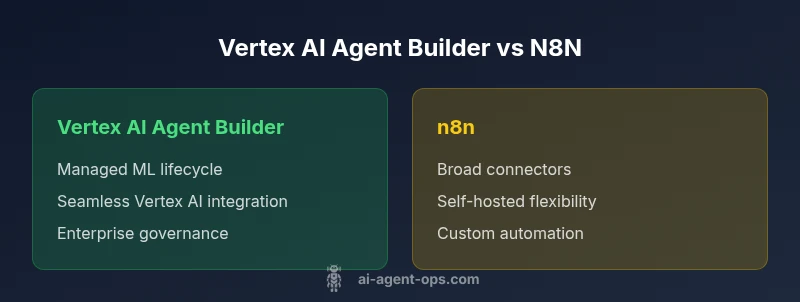
According to Ai Agent Ops, vertex ai agent builder vs n8n boils down to scale and control: Vertex AI Agent Builder offers managed ML pipelines and tightly integrated Vertex AI capabilities, while n8n emphasizes flexibility, broad connectors, and self-hosted control. The Ai Agent Ops team notes that the best choice depends on deployment needs, governance requirements, and team skill sets.
vertex ai agent builder vs n8n: Context in AI agent workflows
In modern AI engineering, teams increasingly employ agent-based patterns to orchestrate data, models, and actions. The phrase vertex ai agent builder vs n8n captures a core decision: should you build on a managed, ML-centric platform that co-exists with your data pipelines, or should you assemble a flexible automation stack with open, community-driven tooling? Vertex AI Agent Builder sits within the Google Cloud Vertex AI ecosystem, offering a streamlined path to deploy, monitor, and scale intelligent agents. N8N, by contrast, is a no-code/low-code automation platform known for its extensible node system and self-hosted options. For developers and product teams, this choice shapes how you structure workflows, manage data provenance, and govern access control across environments. Ai Agent Ops’s experience indicates that many teams start with a specific use case—data ingestion, model inference orchestration, or policy-driven actions—and then expand toward broader agentic AI workflows, which helps frame the vertex ai agent builder vs n8n decision in practical terms.
Architectural Foundations and Deployment Models
Choosing between vertex ai agent builder vs n8n requires understanding where each option sits in your tech stack. Vertex AI Agent Builder is designed to run as a managed service on Google Cloud, leveraging Vertex AI for model deployment, feature stores, and scalable inference. It emphasizes centralized governance, IAM roles, and secure data pathways to support enterprise-scale ML workloads. N8N, meanwhile, is primarily an automation engine with a node-based, extensible architecture. It can be deployed as a cloud service or self-hosted on-premises or in a private cloud, giving teams more control over runtime environments and data residency. The trade-off is often a balance between operational simplicity and the flexibility to customize connectors, nodes, and execution contexts. For teams with stringent data locality or compliance needs, n8n’s self-hosted path may be attractive; for those seeking turnkey ML pipelines and managed services, Vertex AI Agent Builder presents a compelling option.
AI Capabilities and Scope: ML-centric vs Automation-centric
A central differentiator in vertex ai agent builder vs n8n is scope. Vertex AI Agent Builder is built to orchestrate ML-powered agents, integrating seamlessly with Vertex AI components such as model training, evaluation, feature stores, and scalable inference endpoints. This makes it a natural fit for teams applying reinforcement learning, model monitoring, or large-scale inference pipelines where ML models drive decision logic. N8N focuses on automation logic, API orchestration, and workflow execution across services, databases, and SaaS tools. While you can trigger AI-related tasks in n8n, it does not natively provide the same level of ML lifecycle management as Vertex AI. In practice, teams often use n8n to glue together data sources and services, then hand off ML-heavy tasks to Vertex AI or another dedicated ML platform. Ai Agent Ops notes that a hybrid approach—n8n for automation glue and Vertex AI for ML workstreams—is common in complex agent ecosystems.
Integrations and Ecosystem: Connectors, data sources, and extensibility
In the vertex ai agent builder vs n8n comparison, ecosystem reach matters. Vertex AI Agent Builder leverages Google Cloud-native integrations, BigQuery, Dataflow, Cloud Storage, and Vertex AI services, enabling unified data pipelines and policy-driven actions within a single cloud ecosystem. This tight coupling simplifies security, data governance, and auditing for large organizations. N8N offers a broad connector catalog and a vibrant community contributing nodes for popular SaaS services, databases, and custom HTTP endpoints. Its extensibility makes it a versatile choice for teams that rely on diverse tools and want to tailor automation workflows with minimal friction. The trade-off is that deeper, native ML integration often requires more manual configuration in n8n or bridging via external services. The resulting decision should reflect your preferred integration pattern and data strategy.
Security, Governance, and Compliance considerations
Security and governance are central to any AI agent strategy. Vertex AI Agent Builder benefits from Google Cloud’s security model, IAM, VPC Service Controls, and audit logging, which supports enterprise-grade compliance. When your workflows require strict access controls and data residency within a single cloud boundary, the managed nature of Vertex AI can simplify risk management. N8N’s self-hosted deployments allow on-premises data handling and custom security layering, but demand rigorous configuration, patch management, and ongoing monitoring. Both platforms support role-based access, encryption at rest, and encrypted in transit; the difference lies in where that governance sits—within a managed cloud boundary or in your own data center. For teams prioritizing regulatory alignment and centralized control, Vertex AI offers strong defaults; for those needing bespoke security postures, n8n provides customization leverage.
Performance, Reliability, and Scaling: Latency, throughput, and uptime implications
Performance characteristics influence user experience and operational economics in vertex ai agent builder vs n8n. Vertex AI Agent Builder benefits from Google Cloud’s scalable infrastructure, autoscaled model serving, and integrated monitoring dashboards. This tends to yield predictable latency and streamlined incident response for ML workloads. N8N’s performance hinges on your deployment choice—cloud-hosted instances scale with usage, while self-hosted installations depend on your infrastructure capacity and node optimization. For workloads with bursty traffic or variable inference demands, a hybrid stance—Vertex AI for ML inference and n8n for orchestration—can provide resilient performance while preserving agility. Consider also the cost implications of data egress, pipeline complexity, and the need for separate observability tooling when evaluating overall performance.
Pricing, Total Cost of Ownership, and Value Considerations
Many teams evaluate vertex ai agent builder vs n8n through the lens of TCO. Vertex AI Agent Builder typically follows a usage-based pricing model tied to Vertex AI services, data processing, and storage, which can scale with demand but may lead to higher sustained costs for heavy ML workloads. N8N’s cost profile varies with deployment: the open-source core is free, but enterprise features, premium connectors, and hosted options incur fees. A robust cost comparison should account for licensing, cloud compute, data transfer, and maintenance time. In practice, organizations pursuing machine learning dominance may justify Vertex AI costs by improved model performance, faster time-to-value, and stronger governance. Conversely, teams prioritizing flexibility and cost control may lean toward n8n when the automation needs are broad and data locality is critical.
Best Use Cases and Decision Guidelines for Teams
The vertex ai agent builder vs n8n decision is ultimately use-case driven. If your primary objective is to deploy, monitor, and scale ML agents with tight integration to Vertex AI models, datasets, and feature stores, Vertex AI Agent Builder is typically the stronger choice. It shines in data-centric, ML-driven workflows and governance scenarios where cloud-native alignment matters. If your goals center on building flexible automation, integrating many services, and maintaining self-hosted control over environments, egress policies, and data residency, n8n offers a compelling platform with broad connector support and rapid iteration. For many teams, a hybrid approach works best: use Vertex AI for ML workloads and n8n for orchestrating non-ML tasks, triggering models, and routing results to downstream systems. Ai Agent Ops emphasizes aligning your architecture with organizational capabilities and governance maturity, then validating with a small pilot before wider rollout.
Authority Sources, Best Practices, and Next Steps
To ground the vertex ai agent builder vs n8n comparison in credible sources, consult vendor documentation and independent analyses. Vertex AI documentation provides official guidance on ML lifecycle, model deployment, and governance controls, while no-code automation resources from n8n outline workflow design patterns and connectors. Practically, teams should document decision criteria, perform a minimal viable workflow test, and measure time-to-value and governance impact. Ai Agent Ops recommends capturing a 6–8 week pilot plan that evaluates ML reliability, automation coverage, and security posture across both approaches. Following this approach helps ensure the chosen path scales with organizational needs and aligns with your agent-oriented strategy.
Practical Implementation Tips and Next Steps
For teams ready to start, map your current agent workflows to the two platforms. Create a small ML-enabled agent on Vertex AI Agent Builder to validate model deployment, inference latency, and monitoring workflows. In parallel, build a complementary automation flow in n8n to handle data collection, routing, and non-ML decision logic. Measure maintenance effort, time-to-market, and governance overhead for both approaches. Document learnings and set concrete success metrics (e.g., mean time to repair, model accuracy improvements, automation coverage). The end goal is a cohesive agent strategy where ML-enabled agents and automation orchestrations work together seamlessly, with clear ownership and robust security posture.
Comparison
| Feature | vertex ai agent builder | n8n |
|---|---|---|
| Deployment model | Managed cloud service within Google Cloud | Self-hosted or cloud-hosted via hosting options |
| Primary AI capabilities | Integrated ML lifecycle: training, deployment, inference, monitoring | Automation and integration with nodes for diverse services |
| Ease of use | Designed for developers familiar with Google Cloud ML tooling | User-friendly for no-code/low-code enthusiasts; wide connector ecosystem |
| Extensibility and integrations | Tight Vertex AI and Google Cloud integrations (BigQuery, Dataflow, etc.) | Extensive connectors and custom node support; flexible integrations |
| Security and governance | Cloud IAM, VPC, audit logs; centralized governance | Self-hosted security controls; customizable access policies |
| Pricing model | Usage-based for ML services and storage | Open-source core with optional paid cloud hosting and connectors |
| Best for | Teams pursuing scalable ML workflows with cloud governance | Teams needing flexible automation and broad service coverage |
Positives
- Strong ML and data pipeline integration with Vertex AI
- Managed hosting reduces operational overhead
- Scalable ML capabilities and enterprise-grade governance
- Broad ecosystem for ML-augmented workflows
What's Bad
- Less direct control over deployment nuances compared to self-hosted stacks
- Potentially higher ongoing costs for heavy ML workloads
- Requires familiarity with Google Cloud concepts for optimal use
- n8n may require more effort to achieve deep ML lifecycle management
Vertex AI Agent Builder is preferred for ML-centric workflows with cloud governance; n8n excels for flexible automation and self-hosted control.
If ML scale and integrated governance are priorities, Vertex AI wins. If modular automation and data locality matter more, n8n wins. For many teams, a hybrid approach offers the best balance.
Questions & Answers
What is Vertex AI Agent Builder best used for?
Vertex AI Agent Builder is best for teams deploying machine learning agents within a managed cloud environment. It provides ML lifecycle tooling, scalable inference, and integrated governance suitable for enterprise workflows.
Vertex AI is ideal for ML-driven agents in a managed cloud setup, with strong governance and scaling features.
Can I run n8n in a self-hosted environment regularly used for sensitive data?
Yes. n8n supports self-hosted deployments, enabling strict data residency and custom security controls. This is advantageous for teams with strict compliance needs or on-premises requirements.
Yes—self-hosted n8n supports sensitive data environments with configurable security.
Do these tools require cloud expertise to start?
Starting with Vertex AI Agent Builder benefits from familiarity with Google Cloud ML tooling, while n8n is approachable for no-code/low-code users but still benefits from a basic understanding of APIs and workflows.
Vertex AI helps if you know Google Cloud; n8n is accessible to no-code users but API basics help.
Which tool offers better long-term cost control?
Cost control depends on usage patterns. Vertex AI charges for ML services and storage, while n8n can be cost-effective if you leverage open-source deployment and carefully manage connectors.
Costs depend on usage; Vertex AI scales with ML workloads, while n8n can be cheaper if you self-host and cap connectors.
Is a hybrid approach feasible for most teams?
Yes. A hybrid approach—Vertex AI for ML workloads and n8n for automation orchestration—offers a practical path for many organizations seeking scalability and flexibility.
A hybrid approach often makes sense, combining ML prowess with automation flexibility.
What governance considerations should be planned upfront?
Plan identity and access management, data lineage, model monitoring, and audit logging early. Both platforms support governance, but the implementation shape varies by deployment choice.
Set up IAM, data lineage, model monitoring, and audits early to stay compliant.
Key Takeaways
- Evaluate ML workload needs before choosing platform
- Consider data residency and governance requirements
- Hybrid architectures often yield best balance
- Vertex AI excels in ML lifecycle management
- n8n shines with flexible connectors and self-hosted options