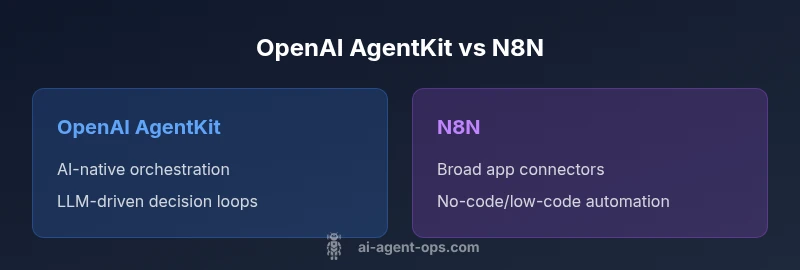
OpenAI AgentKit vs N8N: Side-by-Side Comparison
Analytical side-by-side comparison of OpenAI AgentKit and n8n, focusing on agent orchestration, automation capabilities, hosting options, and integrations for AI-powered workflows.


OpenAI AgentKit excels at AI-driven agent orchestration, while n8n shines in flexible, no-code automation. For teams weighing integration breadth, hosting options, and governance, this guide helps you choose. AgentKit is best for AI-centric, orchestrated workflows; n8n excels for rapid automation across diverse apps and environments.
Framing the OpenAI AgentKit vs N8N Debate
The question of openai agentkit vs n8n has moved beyond a simple feature list. For developers, product teams, and business leaders building AI-powered processes, the choice hinges on how you want to orchestrate agents versus how quickly you can assemble workflows with a no-code tool. According to Ai Agent Ops, the distinction between an AI-native agent kit and a general automation platform often determines two critical dimensions: control over AI-driven decision-making and the speed at which you can prototype workflows. This article digs into those dimensions, balancing architectural differences with practical, real-world considerations to help you decide which path aligns with your AI strategy.
Core Capabilities and Architectural DNA
OpenAI AgentKit is designed around AI-native agent orchestration. It emphasizes LLMS-driven decision points, autonomous task planning, and structured messaging between agents and tools. In contrast, n8n is a no-code/low-code automation platform that enables users to assemble workflows through nodes and connectors. Its core strength lies in breadth of integrations and the ability to compose complex pipelines without deep programming. The architectural tension is clear: AgentKit prioritizes AI-centric control loops; n8n prioritizes connectivity and rapid workflow assembly. In practice, teams often adopt AgentKit when AI agents coordinate multi-step tasks with strategic reasoning, while nudging toward n8n for prototyping and automating across a heterogeneous app landscape.
Hosting, Deployment, and Governance Considerations
Hosting options strongly influence total cost of ownership, security posture, and compliance reach. OpenAI AgentKit typically leans toward a vendor-managed cloud path, offering hosted infrastructure with built-in guarantees around model usage and safety controls. N8n, meanwhile, shines with hosting flexibility: you can opt for self-hosted deployments on your own infrastructure or choose cloud-hosted instances offered by service providers. This split matters for enterprises concerned with data locality, regulatory requirements, and auditability. Governance—policy enforcement, role-based access, and model usage controls—also varies. AgentKit often provides centralized governance features baked into AI workflows, whereas N8n relies on connector-level permissions and broader organizational controls. The trade-off is clear: more centralized AI governance with AgentKit versus flexible, distributed governance in a heterogeneous automation stack.
Extensibility, Integrations, and Ecosystem Mineshaft
The integration story is one of the most consequential differences. OpenAI AgentKit tends to emphasize AI service connectors and native support for LLM-driven patterns, which can simplify building agent-based workflows but may limit breadth outside AI ecosystems. N8n offers an expansive connector catalog and a thriving community of nodes, making it easy to reach dozens if not hundreds of SaaS apps. For teams that must glue CRM, ERP, BI tools, and internal systems, N8n’s ecosystem is a decisive advantage. Conversely, when the goal is to push AI-centric workflows with consistent model behavior and prompt engineering discipline, AgentKit’s focused, AI-first design often yields better out-of-the-box coherence.
Performance, Reliability, and Latency Considerations
Performance in AI-enabled workflows hinges on both AI model latency and the orchestration layer. AgentKit’s architecture prioritizes AI-driven routing and decision-making, which can create predictable patterns for multi-agent coordination but may depend on external model availability and API latency. N8n’s strength is deterministic execution of well-defined sequences across services; latency is primarily a function of each connector and the target service. Reliability stories differ: AgentKit may provide tighter controls for retries and agent coordination semantics, while N8n offers mature error handling across diverse integrations and easier failure isolation in long-running pipelines. If you operate in a latency-sensitive environment, you’ll want to measure how each option handles retries, timeouts, and parallelism in real-world scenarios.
Use-Case Guidance and a Practical Decision Framework
Choosing between OpenAI AgentKit and N8N boils down to use case intensity and AI maturity. If your primary objective is AI agent orchestration—tasks delegated to autonomous agents making decisions with minimal human intervention—AgentKit is often the clearer path. If your focus is rapid automation across many apps with minimal coding, a no-code platform like N8n can accelerate delivery and iteration. A practical framework: map your top 5 workflows, categorize them by AI-centric versus general automation, evaluate data locality and governance needs, then pilot AgentKit for AI-dominant flows and N8n for broad automation. For many teams, a hybrid approach emerges: use AgentKit for AI orchestration where it adds leverage and employ N8n to connect non-AI systems and provide rapid workflow iteration across the business.
Authority sources and External Validation
To triangulate these considerations, several high-quality sources provide guidance on AI governance, automation architecture, and system integration best practices. For governance and security principles related to AI-enabled workflows, see NIST’s AI and cybersecurity resources (nist.gov). For best practices in software automation and workflow reliability, MIT and Stanford offer relevant frameworks in their research and publications (mit.edu, stanford.edu). These references help frame decisions about hosting, data handling, and auditability when comparing agent-centric tooling to broad automation platforms. While not tool-specific, these sources offer foundational guidance that can shape a responsible, scalable adoption strategy for either option.
Real-World Scenarios: Sample Workflows and Demos
Consider a customer-support scenario where AI agents triage tickets, draft responses, and escalate to human agents when confidence is low. AgentKit can orchestrate a team of AI agents that decide the best response path, route complex queries to human agents, and learn from outcomes to refine prompts. In a separate HR onboarding scenario, N8n can connect HRIS, email, calendar, and document systems to automate the entire onboarding flow, with human oversight only when exceptions occur. By pairing these approaches, organizations can leverage AI-driven agent orchestration for decision-intensive tasks while relying on N8n for broad automation across enterprise apps. This hybrid pattern often yields the best mix of control, speed, and governance.
Market Maturity, Roadmap, and Future-Proofing Considerations
Both platforms are maturing, but their trajectories differ. AgentKit’s roadmap is typically oriented toward deeper agent intelligence, better inter-agent communication patterns, and stronger model governance. N8n’s roadmap emphasizes connectors, deployment flexibility, and user experience for non-technical users. From a future-proofing perspective, teams should evaluate how each option handles model updates, API evolution, and evolving data privacy requirements. A practical approach is to implement a small governance spine (policy templates, versioning, and audit logs) that works across both toolchains, enabling a smoother transition if you decide to migrate from one approach to the other or adopt a hybrid architecture that emphasizes AI orchestration where it makes sense and broad automation elsewhere. Ai Agent Ops recommends prioritizing governance and observability in any AI-enabled automation strategy.
Comparison
| Feature | OpenAI AgentKit | n8n |
|---|---|---|
| Agent orchestration capabilities | AI-native, multi-agent coordination and planning | No-code/low-code task automation with connectors |
| Hosting options | Managed cloud hosting by vendor | Self-hosted or cloud-hosted options with flexible deployment |
| Integrations / connectors | Native AI/LLM services focus | Extensive app connectors and community nodes |
| LLM compatibility | Optimized for LLMS-driven workflows | LLMs accessed via API integrations |
| Development effort | Developer involvement for setup and governance | Low/no-code setup with quick prototyping |
| Pricing model | Usage-based or enterprise pricing | Open-core with paid hosting options |
| Best for | AI-centric agent orchestration and governance | Rapid automation across diverse apps |
Positives
- AI-native orchestration reduces manual scripting and enables complex agent coordination
- Flexible hosting options support diverse regulatory and deployment needs
- Rich ecosystem of connectors and community-driven nodes accelerates prototyping
- Clear governance and audit capabilities for AI workflows
What's Bad
- Higher initial complexity for teams new to AI agents and agent orchestration
- Potential vendor lock-in with a specialized AI kit compared to general automation
- Niche focus of AgentKit may require supplementary automation tools for non-AI tasks
- N8N can require more manual curation to manage edge cases in AI-heavy workflows
AgentKit is the stronger choice for AI-centric agent orchestration; N8N excels for broad, no-code automation across apps.
The Ai Agent Ops team recommends prioritizing AI maturity and governance needs when choosing. If AI agents and coordinated AI workflows are your priority, AgentKit offers focused capabilities and governance knobs. If you need rapid, broad automation across many apps with minimal coding, N8N provides speed and flexibility.
Questions & Answers
What is the core difference between OpenAI AgentKit and N8N?
AgentKit centers on AI-native agent orchestration and LLMS-driven decisions. N8N focuses on no-code automation and broad app integration. The best choice depends on whether AI-centric orchestration or broad automation speed is your priority.
AgentKit focuses on AI agents coordinating tasks, while N8N focuses on wiring apps together with no-code workflows.
Can AgentKit run without coding?
AgentKit typically requires some developer involvement to design agent workflows and governance, whereas N8N provides strong no-code capabilities for automation across many apps.
AgentKit needs some setup by developers, but N8N is designed for no-code flows.
Which is better for enterprises with strict data governance?
If governance and AI safety controls are paramount, AgentKit’s centralized orchestration can simplify policy enforcement. N8N can be secure but requires careful configuration across multiple connectors and environments.
For strict governance, AgentKit can be easier to manage; N8N needs careful connector-level controls.
What about hosting options and deployment speed?
N8N offers flexible hosting (self-hosted or cloud). AgentKit generally emphasizes managed cloud hosting with vendor guarantees, which can affect deployment speed and control.
N8N is quicker to deploy when you want to get started, while AgentKit leans on its cloud setup.
Are there any obvious cost implications?
Costs vary by usage, deployment, and hosting choice. AgentKit often uses enterprise or usage-based pricing; N8N may offer open-source options plus paid hosting.
Costs depend on usage and hosting; there isn’t a one-size-fits-all price.
Can I combine both tools in a hybrid workflow?
Yes. Use AgentKit for AI-agent orchestration in AI-first flows and N8N for broad automation tasks that connect non-AI apps, creating a complementary architecture.
A practical approach is to mix both: AI orchestration where it helps, automation across apps elsewhere.
Key Takeaways
- Prioritize AI-maturity and governance for AI-centric needs
- Leverage N8N for broad app integrations and rapid prototyping
- Use AgentKit to orchestrate AI agents and improve coherence of AI decisions
- Pilot both tools on a narrow set of workflows to compare real-world outcomes