How to Implement AI Agent: A Step-by-Step Guide
Learn how to implement an AI agent from goal framing to monitoring. This step-by-step guide covers architecture, data handling, tooling, safety, and governance for effective agentic automation in 2026.


Ai agents enable systems to plan, decide, and act with minimal human input. To implement ai agent, start by defining the task, selecting an orchestration approach, and scoping data sources and safety guards. According to Ai Agent Ops, align goals with measurable outcomes, then assemble architecture and governance as a foundation for scalable automation.
What is an AI agent and what does implementing it entail
An AI agent is a software entity that perceives its environment, reasons about goals, makes decisions, and takes actions to achieve outcomes with limited human intervention. Implementing an ai agent involves more than wiring a model to a task; it requires defining clear objectives, designing data flows, establishing guardrails, and planning governance for reliability, safety, and compliance. In practice, you’ll combine LLM-based reasoning, procedural logic, and orchestration layers to create end-to-end workflows that automate decision-making while remaining auditable. Throughout this journey, you’ll balance autonomy with safety, ensure traceability of actions, and maintain alignment with business goals. As Ai Agent Ops emphasizes, success starts with a coherent problem statement, a measurable target, and a plan to monitor and improve the system over time.
Planning the outcome: defining goals and constraints
Before touching code, articulate the exact outcome you want the agent to produce. Define success criteria, acceptance tests, and key performance indicators (KPIs). Identify constraints such as latency, budget, privacy, and compliance requirements. Create a lightweight model of the agent’s decision loop: inputs, internal reasoning, and the final action. Align the plan with business priorities like speed, accuracy, and auditability. Establish governance rules: who can approve deployments, how to handle errors, and how to rollback if necessary. The more explicit you are about boundaries and expectations, the faster you’ll converge on a robust solution. Ai Agent Ops highlights that early clarity reduces rework and increases stakeholder confidence.
Architecture: agent core components and data flows
The heart of an AI agent is a modular architecture that separates perception, decision, and action while maintaining a coherent memory of past interactions. A typical stack includes: a perception layer to gather inputs from APIs, files, or human prompts; a reasoning layer that plans steps toward the goal; an action/execution layer that calls services or triggers workflows; and a memory module that stores context and outcomes for reuse. An orchestration layer coordinates parallel tasks, retries, and fallback strategies. Safety guardrails—such as rate limits, input sanitization, and audit logs—must be baked in from day one. Data pipelines should emphasize lineage and privacy, ensuring sensitive information never leaks through prompts or logs. To scale, design for stateless services where possible and a centralized state store for long-running tasks. Ai Agent Ops notes that robust agents rely on clear interfaces, well-defined data contracts, and observable metrics to guide improvement.
Data, privacy, and compliance considerations
Data is the lifeblood of an AI agent, but mismanaging it invites risk. Start with a data inventory: where inputs originate, how data is transformed, and where it’s stored. Apply data minimization and encryption, and implement access controls that respect least privilege. For regulated sectors, align with privacy laws (for example, regional data residency requirements) and maintain audit trails of decisions the agent makes. Prefer synthetic or masked data for development environments to reduce exposure. Document decision rationales so reviewers can understand why an action was taken. Regularly review logs, prompts, and outputs to detect drift or misuse. Ai Agent Ops reminds teams that governance and ethics aren’t blockers but enablers of trust and long-term adoption.
Tooling and platforms: choosing frameworks
Selecting frameworks and platforms is about balancing speed, control, and safety. Many teams begin with a modular stack that separates perception, reasoning, and action, using an orchestration layer to coordinate tasks. For language-model workflows, you may prototype with a lightweight library that supports prompt design, memory, and access to external tools. For production, consider a scalable deployment platform with observability, versioned prompts, and safety controls. When evaluating options, prioritize compatibility with your data sources, ease of integration with existing services, and clear governance capabilities. Remember that you don’t need to lock into a single vendor; design for interoperability and future-proofing. Ai Agent Ops stresses that the best choice is the one that fits your team’s skills and risk tolerance, not the loudest marketing claim.
Building the agent: from prototype to production
Begin with a minimal viable agent that can complete a simple task end-to-end. Build a small decision loop, wire in a single data source, and run it in a sandbox to observe behavior. Iterate: add more data, refine prompts, and introduce error handling. As you scale, modularize components so teams can swap parts (for example, swap memory for a faster cache or replace the planner with a more capable module). Instrument traces and metrics to monitor latency, accuracy, and reliability. Establish a deployment pipeline with review gates, automated tests, and rollback plans. Keep security top of mind: secure API keys, rotate credentials, and limit privileges for each service. The goal is repeatable, auditable deployments that improve over time. Ai Agent Ops emphasizes gradual, safe rollout and careful documentation of decisions, assumptions, and results.
Testing, monitoring, and governance
Testing a AI agent goes beyond unit tests—it requires scenario-based evaluation, end-to-end tests, and live monitoring. Create test suites that simulate real-world inputs, edge cases, and failures. Define service-level objectives (SLOs) for response times and success rates, and monitor these in production with alerting. Use shadow testing to compare agent outputs against baseline heuristics before enabling real actions. Maintain governance records: versioned prompts, data contracts, access controls, and incident reports. Schedule regular reviews of prompts and behaviors to prevent drift. Establish a transparent audit trail so stakeholders can trace decisions back to inputs, prompts, and policies. Ai Agent Ops notes that governance is not a gate — it is the engine that sustains trust and scale.
Dealing with safety, reliability, and ethics
Autonomy raises safety concerns, from inadvertent data leakage to biased decisions. Build fail-safes, such as human-in-the-loop verification for high-risk actions, and implement robust input validation. Design for reliability with retries, circuit breakers, and graceful degradation when services fail. Address ethics by auditing for bias, ensuring inclusivity in data, and documenting how the agent handles sensitive topics. Prepare an incident response plan that outlines steps to mitigate harm, preserve logs, and communicate with stakeholders. Adopt a risk-based approach: classify actions by impact and require human oversight for critical decisions. Ai Agent Ops reminds teams that responsible AI is good business and essential for durable adoption.
Roadmap and realistic expectations
Plan a staged rollout: start with a narrowly scoped capability, then expand as you learn. Define milestones, required skills, and resource commitments. Budget time for data preparation, integration, testing, and governance. Expect iterations—especially around prompts, data quality, and latency optimizations. Align with organizational timelines and regulatory deadlines. Ensure you have champions across product, engineering, and security who advocate for the agent’s value while maintaining accountability. Ai Agent Ops recommends setting a 90-day window for initial validation and a 6–12 month view for full-scale deployment, with ongoing governance baked in from day one.
Tools & Materials
- Integrated Development Environment (IDE)(e.g., VS Code or JetBrains IDE)
- Python 3.9+ runtime(or your language of choice for agent services)
- API access for AI services (API keys)(store securely in a secret manager)
- Agent framework / orchestration layer(modular components to connect prompts, tools, and memory)
- Data sources and sample datasets(for testing prompts and tool calls)
- Version control (Git)(for code and prompts versioning)
- Testing sandbox environment(for safe experimentation)
- Security tooling (secret management)(rotate keys, least privilege)
- Documentation templates(for decision logs and governance)
- Preview hardware (CPU/GPU as needed)(depends on workload)
Steps
Estimated time: 6-8 weeks
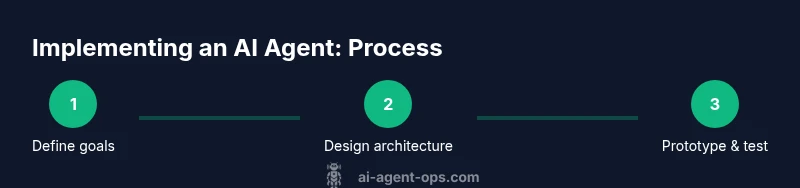
- 1
Define goals and success criteria
Articulate the task, expected outputs, and how success will be measured. Specify KPIs, acceptance tests, and risk tolerance. Include data provenance and privacy requirements from the start.
Tip: Define a narrow initial use-case to limit scope and validate quickly. - 2
Design the agent architecture and interfaces
Outline the perception, reasoning, and action layers, plus a memory store. Define data contracts, tool interfaces, and error-handling paths. Sketch how components communicate and where bottlenecks may occur.
Tip: Keep interfaces minimal and well-documented to ease future swaps. - 3
Select tooling and data sources
Choose frameworks that support modularity, prompts, memory, and tool calls. Map data sources, ensure data quality, and plan privacy controls. Verify that licenses and governance align with your organization.
Tip: Prefer interoperable tools with clear upgrade paths. - 4
Prototype with a minimal workflow
Create a small end-to-end flow that can demonstrate decision-making and action. Use a sandboxed environment to validate behavior and catch obvious failures.
Tip: Document assumptions and collect baseline metrics early. - 5
Test, monitor, and iterate
Develop scenario-based tests and live monitors for latency, accuracy, and safety. Iterate on prompts, data, and governance rules based on results.
Tip: Automate tests and establish alert thresholds for key metrics. - 6
Deploy with governance and maintenance
Move to production with review gates, versioned prompts, and access controls. Plan for ongoing evaluation, updates, and incident response.
Tip: Rotate credentials regularly and enforce least-privilege access.
Questions & Answers
What is an AI agent and how does it differ from traditional automation?
An AI agent perceives, reasons, and acts toward a goal, often using learning and prompts. Traditional automation follows fixed rules without autonomous decision-making. The agent can adapt to new data and tasks, but requires governance to stay aligned with goals.
An AI agent can adapt its actions based on context, unlike fixed-rule automation, but needs governance to stay aligned with goals.
How long does it typically take to implement an AI agent?
Timeline varies by scope, data readiness, and governance requirements. A focused prototype can emerge in weeks, with full production typically spanning months of iteration and monitoring.
A focused prototype can take weeks; full production may take months with ongoing governance.
What skills are essential to implement AI agents?
Essential skills include systems design, data governance, prompt engineering, API integration, and security practices. Cross-functional collaboration with product, security, and legal is important.
You need systems design, data governance, prompts, and strong cross-functional collaboration.
How should success be measured for AI agent deployments?
Measure with KPIs like latency, task success rate, accuracy in decision-making, and governance compliance. Regularly review logs and incident reports to identify drift.
Use KPI-based metrics and governance reviews to measure success and detect drift.
What are common pitfalls when implementing AI agents?
Common pitfalls include unclear goals, data drift, over-autonomy without safeguards, and weak auditability. Addressing these early reduces risk and improves adoption.
Unclear goals and weak governance lead to risk and low adoption; address early.
Do AI agents require continuous governance and updates?
Yes. Ongoing governance is essential for safety, compliance, and performance. Schedule periodic reviews of data, prompts, and decision logs.
Yes—ongoing governance is essential for safety and performance.
Watch Video
Key Takeaways
- Define clear goals and success metrics
- Separate decision from action with modular architecture
- Iterate safely with governance from day one
- Monitor ethics, bias, and data privacy