How to Use AI Agents in 2025
Learn how to design, deploy, and govern AI agents in 2025 with a step-by-step framework, governance tips, and real-world guidance for developers, product teams, and leaders.


This guide explains how to use ai agents in 2025 to design, deploy, and govern agent-powered workflows. You’ll learn practical patterns for orchestration, autonomy levels, and safety controls, plus step-by-step decisions on tooling and governance. By the end, you’ll know how to set up a repeatable process that scales with your data, teams, and business goals.
Why AI Agents Power Modern Businesses
AI agents extend human capabilities by autonomously taking routine decisions and executing tasks across systems. In 2025, teams increasingly rely on agent orchestration to speed up processes, reduce manual toil, and free up experts for higher-value work. According to Ai Agent Ops, AI agents are reshaping automation by enabling repeatable, auditable workflows that scale with data and users. The goal is not to replace humans but to augment decision-making with safe, transparent agentic AI capabilities. In this section, we’ll outline the core reasons to adopt AI agents, common architectures, and governance considerations that matter most for modern teams. The landscape favors modularity—designs that separate decision-making from action execution and emphasize traceability.
Core Concepts: Agentic AI, Autonomy, and Orchestration
Agentic AI combines perception, reasoning, and action through interoperable tools. Autonomy levels range from supervised assistants to self-governing agents with guardrails. Orchestration refers to coordinating multiple agents and tools to complete complex workflows without human micromanagement. In 2025, teams leverage hybrid approaches: planners that set goals, and executors that carry out actions via APIs and services. Understanding these concepts helps you choose the right mix for your domain and risk tolerance. As you design, emphasize transparency, controllable autonomy, and clear handoffs between humans and agents.
Architecture Choices: Planning vs Reactive Agents
Two broad architectures shape AI agent systems: planning-based agents that generate multi-step strategies before acting, and reactive agents that respond to events with fast, rule-driven decisions. Planning-based approaches excel at long-horizon tasks and complex tradeoffs; reactive ones shine in real-time, event-driven scenarios. A practical path often blends both: a planner sets a goal, while reactive components handle urgent decisions. Always pair agents with tool wrappers (APIs, databases, and search) to enable observable, auditable actions and easy rollback if needed. The 2025 standard favors modular, interoperable components rather than monolithic stacks.
Data, Tools, and Integrations
Successful AI agents rely on clean data pipelines and well-defined tool inventories. Map data sources, authentication methods, and rate limits upfront. Choose tool wrappers that are stable, documented, and auditable. Establish data governance: who can access what, how data is stored, and how it is transformed. Security and privacy must be baked in from day one, including secrets management, audit logs, and anomaly detection. Designing a reusable toolkit—prompts, wrappers, and templates—enables scalability across teams while maintaining consistency and safety.
Governance, Security, and Compliance
Governance is not optional in 2025; it’s a required capability for responsible automation. Define guardrails that constrain decisions to safe, permissible actions, and implement monitoring that surfaces deviations quickly. Establish audit trails for actions taken by AI agents and ensure compliance with relevant policies and regulations. Adopt a risk-based approach: classify tasks by impact, assign owners, and implement escalation paths when agents encounter uncertain or harmful scenarios. A robust governance model reduces risk and increases trust in agent-powered workflows.
Case Studies: Real-World Scenarios
Consider a customer-support workflow where AI agents triage tickets, fetch relevant data, and propose responses for human approval. In procurement, agents monitor supplier feeds, compare quotations, and trigger purchase workflows while ensuring compliance checks. Another scenario involves field operations, where agents optimize route planning, schedule maintenance, and alert humans for exceptions. While each domain differs, the pattern remains: define the decision boundaries, connect reliable data sources, and implement governance and monitoring to build trust and resilience.
Measuring Success: Metrics without Misleading Numbers
Success in 2025 is measured by outcomes such as faster issue resolution, higher decision throughput, and better alignment with business objectives—not just algorithmic performance. Define qualitative metrics (trust, explainability) alongside actionable quantitative indicators (time-to-decision, automation coverage). Use dashboards that illuminate agent performance, tool reliability, and escalation rates. Remember that metrics should drive learning and improvement, not create “perfection” fantasies. Ai Agent Ops analysis shows that when teams document goals and monitor outcomes, agent-powered workflows mature faster and deliver meaningful gains.
Common Pitfalls and How to Avoid Them
Common traps include over-automation without human oversight, brittle tool wrappers, and blurred ownership of outcomes. Failing to implement guardrails leads to unexpected actions or data leakage. Inadequate monitoring can hide subtle drift in agent behavior. To avoid these, start with a narrow pilot, enforce strict access controls, and set up clear escalation paths. Maintain documentation for prompts, tool interfaces, and decision logs, so teams can reproduce results and audit decisions when needed.
Getting Started: A Lightweight Pilot Plan
Begin with a well-scoped pilot that targets a single business process and uses a small, representative data set. Define success criteria, secure stakeholder sponsorship, and select a minimal set of tools. Build a reusable framework—prompts, tool wrappers, and guardrails—that can be extended later. Run an iterative loop: test, observe, adjust, and re-test. The goal is to learn quickly while maintaining safety and governance. After a successful pilot, prepare a phased rollout aligned with governance policies and cross-functional milestones.
Scaling AI Agents Across Teams
Scaling requires a centralized capability—an agent library, shared primitives, and governance standards—paired with decentralized execution teams empowered to tailor solutions. Create templates for common workflows, standardized risk assessments, and common tool connectors. Invest in training and upskilling so product teams can design responsibly while preserving consistency. As adoption grows, maintain a feedback loop to refine guardrails, update prompts, and extend the agent ecosystem without sacrificing safety or reliability.
The Human in the Loop: Collaboration Between People and Agents
Humans remain essential for judgment, creativity, and accountability. Design workflows that keep humans in decision loops for ambiguous cases or high-stakes actions. Use human-in-the-loop design to verify agent outputs, provide explanations, and capture lessons learned. This collaboration strengthens trust and resilience, ensuring AI agents support humans rather than replace them. The approach encourages transparency, accountability, and continuous learning across the organization.
Final Preparations for 2025 and Beyond
As you prepare for 2025, prioritize governance, data governance, and risk management alongside technical excellence. Build a roadmap that scales agent capabilities gradually, with guardrails, observability, and escalation policies. Ensure leadership alignment on goals and ethics, and maintain an ongoing dialogue about safety, privacy, and user trust. The Ai Agent Ops team recommends starting small, learning fast, and expanding with disciplined governance to achieve sustainable, impactful automation.
Tools & Materials
- Business goals and success metrics worksheet(Document objectives, success criteria, and stakeholders)
- Data access and API credentials repository(Store securely; use least-privilege access)
- Orchestration platform or framework(Choose one that supports modular adapters)
- AI agent framework with tool-wrapping capabilities(Prompts, tool wrappers, and safety features included)
- Security & compliance policies(Data handling, access control, and auditing rules)
- Monitoring and logging toolkit(Observability for agent decisions and tool activity)
- Test data and sandbox environment(Isolated data for safe experimentation)
- Stakeholder sign-off(Early alignment and ongoing governance)
Steps
Estimated time: 4-6 weeks
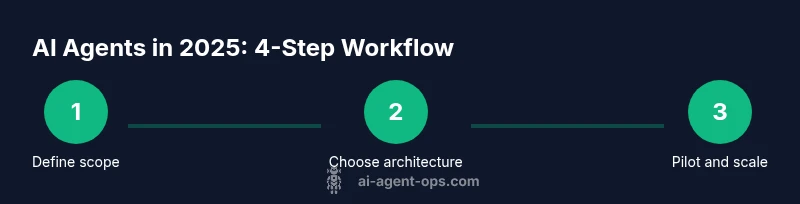
- 1
Define objective and scope
Clarify the problem to solve, the expected outcomes, and any constraints or safety requirements. Document success metrics and boundaries before building.
Tip: Write a one-page scope and review with all stakeholders to ensure alignment. - 2
Choose architecture and scope
Select an agent architecture (planning-based, reactive, or hybrid) that fits the task and risk tolerance. Decide which tasks the agent should handle autonomously and where human oversight is required.
Tip: Start with a narrow pilot to reduce risk and complexity. - 3
Assemble data and tools
Identify data sources, access methods, and required tools or APIs. Ensure data quality, lineage, and security controls are in place before connecting to agents.
Tip: Use versioned connectors to track changes and rollback if needed. - 4
Configure prompts and wrappers
Design prompts, tool wrappers, and action interfaces. Align outputs with guardrails and auditing requirements to maintain safety and predictability.
Tip: Document prompt variants and tool wrapper behavior for reproducibility. - 5
Implement guardrails
Establish safety constraints, escalation paths, and monitoring rules. Ensure that critical actions require human confirmation or automated checks.
Tip: Automate anomaly detection and automatic rollback when safety is breached. - 6
Build a minimal viable agent
Create a lean agent prototype focused on a single end-to-end workflow. Validate behavior in a sandbox before broader use.
Tip: Keep the MVP small to learn quickly and reduce risk. - 7
Test with scenarios
Run representative use cases, including edge cases, to observe decisions and outcomes. Capture logs and explainability traces.
Tip: Add synthetic edge-case data to force the agent to reveal gaps. - 8
Pilot deployment
Launch in a controlled environment with limited users. Monitor performance, guardrails, and user feedback.
Tip: Set up a clear rollback plan in case of unexpected behavior. - 9
Evaluate and iterate
Review outcomes against metrics, adjust prompts and tool wrappers, and revise governance as needed. Prepare for wider rollout.
Tip: Treat the pilot as a learning loop, not a final product.
Questions & Answers
What is an AI agent?
An AI agent perceives its environment, reasons about options, and takes actions using tools and data sources. It operates autonomously within defined guardrails and is designed to be observable and auditable.
An AI agent perceives its environment, reasons about options, and acts through tools within guardrails.
How do AI agents differ from simple bots?
AI agents combine perception, reasoning, and action across multiple tools to achieve goals, whereas simple bots perform scripted, narrow tasks without adaptive decision-making.
AI agents reason and choose actions across tools, unlike basic scripted bots.
What governance is required for AI agents?
Governance should cover guardrails, access controls, auditing, and escalation paths. Establish safety reviews and clear ownership for agent decisions and data usage.
Guardrails and audits ensure safe, responsible agent use.
What skills are needed to build AI agents?
Skills include system design, prompts engineering, data engineering, security practices, and governance planning. Collaboration across product, data, and security teams is essential.
You’ll need prompts design, data handling, and governance skills, plus cross-team collaboration.
What are common pitfalls to avoid?
Avoid over-automation without human oversight, brittle integrations, and vague metrics. Ensure observability and a clear escalation path for uncertain actions.
Watch for over-automation and lack of observation; keep humans in the loop.
Where should I start with AI agents in my organization?
Begin with a tightly scoped pilot in a single domain, establish governance, and build a reusable agent toolkit for future projects.
Start with a small pilot and build a reusable agent toolkit.
Watch Video
Key Takeaways
- Define goals before tool selection.
- Choose governance early and document it.
- Pilot first, then scale with guardrails.
- Measure outcomes, not just AI accuracy.
- Humans remain essential for accountability and quality.