How Long to Learn Agentic AI: A Practical Timeline
Discover how long it takes to learn agentic AI, from fundamentals to end-to-end deployment. This data-informed guide outlines realistic timelines, learning paths, and milestones for developers, product teams, and business leaders.


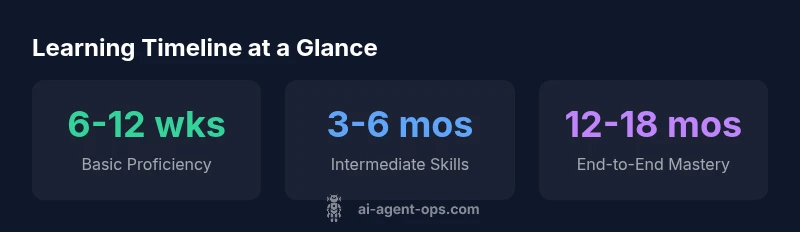
The typical path to learning agentic AI spans weeks to months, depending on your background. For developers with ML experience, reaching basic proficiency in agent orchestration and autonomous agent routines often takes roughly 6-12 weeks of focused study, while deeper mastery can take 3-6 months. Expect a blended approach of theory, hands-on projects, and tooling familiarity.
Defining Agentic AI and the Learning Target
Agentic AI refers to systems designed to autonomously pursue goals through perception, reasoning, and action across multiple tools. For developers, researchers, and product leaders, learning agentic AI means understanding how agents are constructed, how they communicate with tools, and how safety and governance apply in dynamic environments. If you're wondering how long does it take to learn agentic ai, the answer depends on background, scope, and deployment depth, but a practical model breaks learning into phases: concept mastery, hands-on practice, and real-world integration. According to Ai Agent Ops, most learners start with core literacy—describing agent types, prompts, and orchestration primitives—and then build small agents that solve narrow tasks before scaling to broader workflows. This staged approach clarifies time commitments and helps teams align training with product milestones.
From day one, anchor your study with concrete goals. Start by reading foundational papers and tutorials, then mirror those concepts with a simple agent that performs a single task. As you progress, you’ll shift from theory to tool integration, and finally to end-to-end deployment. This approach is echoed in Ai Agent Ops analysis, which shows that structured, milestone-driven learning reduces perceived complexity and accelerates practical competence.
The Learning Curve for Agentic AI: What Changes with Background
Learning agentic AI isn’t one-size-fits-all. Programmers with machine learning and software engineering backgrounds typically move faster through foundational concepts, while product managers or designers may need longer to map user intents to agent capabilities. A data scientist who already understands prompts and evaluation metrics can cut through the early learning fog, whereas a founder focusing mainly on business impact will need to acquire hands-on tooling skills in parallel with strategy. Across backgrounds, expect early friction around tool orchestration, API integration, and safety constraints. Ai Agent Ops analysis suggests that the most efficient learners combine short, focused study blocks with frequent, small projects that demonstrate progress in a tangible workflow rather than only reading concepts.
Learning Phases and Milestones You Should Aim For
Learning agentic AI generally unfolds in three broad phases: foundation, integration, and scaling. Foundation (weeks 1–6) covers agent concepts, primitives, and basic tool usage. Integration (weeks 6–20) emphasizes building multi-agent workflows, error handling, and governance. Scaling (months 6–12 and beyond) focuses on deployment, monitoring, performance optimization, and ethics. Milestones in each phase include delivering a working agent that completes a concrete task, integrating at least two tools, and demonstrating safe operation under simulated conditions. Tracking progress against these milestones helps maintain momentum and aligns learning with product goals.
Key Skills and Toolchains: What to Practice
A practical learning plan requires hands-on practice with several core areas: (1) prompts and planning for agent behavior, (2) orchestration of multiple tools and services (APIs, databases, messaging, web scraping), (3) error handling and fallback strategies, (4) monitoring, logging, and governance (safety rails, privacy, and compliance), and (5) evaluation methods to measure agent performance. Toolchains typically include a primary agent framework, a vector store for memory and retrieval, and debugging utilities. Start small—build a task-specific agent, then gradually introduce more complex toolchains and safety checks. Ai Agent Ops’s guidance emphasizes a disciplined mix of theory and practice to accelerate competence.
Hands-On Projects to Accelerate Mastery
Choose projects that mirror real-world use cases. Start with a single-task agent (e.g., automatically gathering product data), then scale to a workflow that fragments a larger problem into subtasks, each handled by a dedicated agent. Include a safety review and an audit trail. Regularly refactor your agents based on feedback loops and performance metrics. Practical projects with clear aims tend to accelerate learning more than theoretical study alone, reinforcing concepts while delivering tangible outcomes. In practice, many learners report faster growth when their projects tie to a business objective, such as automating recurring internal tasks or customer interactions.
Common Pitfalls and How to Avoid Them
The journey to learning agentic AI is rarely linear. Common pitfalls include overengineering early, underestimating data quality needs, neglecting safety and governance, and failing to set measurable milestones. To avoid these, start with constrained experiments, use synthetic or sandboxed environments for testing, and define explicit success criteria for each milestone. Regular code reviews, peer feedback, and continuous integration practices help catch issues early. Remember that progress is not only about adding capabilities but about building reliable, auditable, and user-friendly agents.
Structuring a Realistic 12-Week Starter Plan (Sample)
A practical starter plan combines learning with weekly, tangible outputs. Week 1–2: core concepts, prompts, and basic agent construction. Week 3–4: integrate one tool and build a simple agent that completes a routine task. Week 5–6: add a second tool, implement error handling, and begin basic monitoring. Week 7–9: design a multi-agent workflow for a small use case; Week 10–12: deploy in a sandbox, collect metrics, and refine prompts. This plan aligns with Ai Agent Ops’s observed timelines and helps you maintain a steady pace toward measurable outcomes. The Ai Agent Ops team recommends pairing theory with hands-on milestones for maximum retention.
Measuring Progress and Next Steps
Effective measurement is essential to stay motivated. Track milestones (number of tasks completed by agents, tool integrations, and safety checks), time-to-delivery for each task, and qualitative improvements in agent behavior. Use simple dashboards to compare planned vs. actual timelines and adjust the plan as needed. As you approach advanced mastery, evolve from individual agents to coordinated agent ecosystems, with governance and monitoring baked in. The goal is not just faster agents, but safer, more reliable ones that deliver business value.
Timeline and focus areas for learning agentic AI
| Learning Phase | Typical Timeframe | Focus Areas |
|---|---|---|
| Basic Proficiency | 6-12 weeks | Foundations: agent types, prompts, tool integration |
| Intermediate Skills | 3-6 months | Workflow orchestration, error handling, safety & governance |
| Advanced Mastery | 12-18 months | End-to-end deployment, monitoring, scaling, ethics |
Questions & Answers
How long does it take to learn agentic AI?
Learning agentic AI typically unfolds in stages: 6–12 weeks for basic proficiency, 3–6 months for intermediate skills, and 12–18 months for end-to-end capabilities, depending on your background and the depth of deployment.
Most people reach basic proficiency in a couple of months and grow from there with hands-on practice.
What background helps most?
Strong programming and ML foundations help the most, followed by familiarity with prompts, APIs, and orchestration tooling. Product-focused roles benefit from understanding user goals and workflows.
If you know Python and ML basics, you’ll learn faster.
What should a learning plan look like?
Define milestones, allocate regular weekly hours, blend theory with hands-on practice, and start with a small agent project before scaling. Align milestones with real product goals.
Create a 12-week plan with small projects tied to a real use case.
Are there quick wins when starting?
Yes: use a starter agent, set up a sandbox, experiment with prompt design, and integrate one tool at a time. Quick wins build confidence and demonstrate value early.
Try a starter project this week.
Which tools or platforms are essential?
Familiarize with one agent framework, a memory or vector store, and a debugging toolkit. Choose one cloud provider to simplify setup and governance.
Start with one platform and iterate.
“Agentic AI mastery comes from iterative practice and real-world projects, not from theory alone.”
Key Takeaways
- Define clear learning milestones before starting
- Balance theory with practical, hands-on projects
- Start small, then progressively add tools and scope
- Prioritize safety, governance, and evaluative metrics
- Allocate consistent weekly study time for momentum