Free AI Agent vs Code: A Practical Comparison
A thorough comparison of free AI agents versus coding from scratch, covering setup, maintenance, cost, control, and real-world use cases for developers and business leaders in 2026.


Free AI agents offer rapid onset and no-code or low-code setup, while coding from scratch delivers maximum control and scalability. For teams seeking speed and low upfront effort, a free AI agent often wins on value in early stages; for long-term projects with strict data governance, custom code typically wins on flexibility and performance. This comparison guides decision-makers.
The Landscape: free ai agent vs code
The term free AI agent often refers to no-code or low-code platforms that provide pre-built agent templates, connectors, and runtime environments. Users can compose behaviors, orchestrate tasks, and deploy agents with minimal or zero programming. In contrast, building an AI agent from scratch—coding from code—gives developers full control over model choice, data flow, latency optimizations, and governance. The phrase free ai agent vs code is a useful shorthand for weighing speed against control in 2026, a year when Ai Agent Ops notes rapid experimentation platforms have proliferated alongside durable, code-driven architectures. The landscape spans hobbyist kits to enterprise-ready stacks, with both paths supporting automation goals, decisioning, and integration with other tools. In practice, teams usually start with a free AI agent to validate concepts and then decide whether to keep it or migrate toward bespoke code as requirements evolve. According to Ai Agent Ops, this spectrum reflects how organizations balance time-to-value with risk management and data stewardship.
Key Differentiators: speed, control, and cost
In any comparison between a free AI agent and custom code, three levers dominate: speed, control, and cost. Speed includes how quickly you can prototype and iterate; control covers predictability, auditability, and the ability to implement complex policies; cost encompasses both upfront expenses and ongoing maintenance. Free AI agents win on speed and low upfront cost, especially for MVPs or internal tooling with straightforward workflows. Custom code wins on long-term adaptability, strict data governance, and integration depth. The best choice often depends on the project’s lifecycle, regulatory constraints, and talent availability. Across teams at scale, a hybrid approach—start with a free AI agent to learn, then migrate critical workflows to code—can provide a pragmatic path forward. Ai Agent Ops’s observations highlight that many teams successfully blend both approaches to maximize learning while preserving governance. The core question remains: what level of control do you require, and how important is rapid experimentation to your roadmap?
When a Free AI Agent Fits Your Team
For many product teams, a free AI agent offers a fast path to value. If your organization prioritizes rapid validation, a no-code or low-code agent can orchestrate data flows, trigger reminders, or manage simple decision pipelines with minimal friction. Non-engineering stakeholders can prototype end-to-end processes, test different prompts, and surface insights without waiting for a full development sprint. The maintenance burden tends to be lower because the vendor handles runtime updates and security patches. The trade-off is reduced visibility into model internals and potential vendor constraints that limit customization. In 2026, successful teams treat free AI agents as a stepping-stone rather than a final architecture, planning a transition when governance needs intensify or when you hit performance ceilings. Ai Agent Ops’s research indicates that those who start with a free AI agent often achieve faster learning cycles, then design migration plans that preserve lineage and traceability of decisions.
When Writing Custom Code Is the Better Path
Custom code excels when projects demand deep customization, strict data control, and scalable performance. If your workflows involve sensitive data, complex multi-agent orchestration, or integration with on-premise systems, coding a tailored agent stack is often necessary. You gain full control over the choice of LLMs, embeddings, vector stores, retrievers, and policy enforcement. You can implement rigorous auditing, access controls, and compliance reporting aligned to standards such as SOC 2 or GDPR. The development journey is longer and requires skilled engineers, robust testing, and ongoing maintenance—yet the payoff is a durable, auditable, and extensible platform. Companies that invest in code-based agents frequently achieve better reliability, predictable performance, and long-term resilience against vendor changes. The Ai Agent Ops team notes that teams evolving from no-code to code often adopt modular architectures and standardized interfaces to minimize disruption during migration.
Architecture and Integration Patterns
Both paths rely on a shared set of architectural primitives: a prompt or policy layer, a data flow or orchestration layer, and an execution layer that interfaces with external systems. Free AI agents typically expose pre-built connectors and event hooks that map to common SaaS services (CRM, help desks, data warehouses). Custom code allows you to design bespoke adapters, custom authentication schemes, and end-to-end encryption tailored to your infrastructure. A hybrid model might use a no-code agent for rapid front-end automation while routing critical decision logic through a centralized code-based service. In either case, you should design with observable telemetry, distributed tracing, and established error-handling to prevent silent failures.
Practical Setup: Getting Started Now
If you’re evaluating the two paths side-by-side, a practical plan is to run parallel experiments for a defined sprint. For a free AI agent, select a handful of business-process flows, connect data sources, and implement clear SLAs for latency and accuracy. Document prompts, rules, and fallback behaviors so you can compare outcomes. For code, establish a lightweight prototype leveraging containerized services, basic monitoring, and a minimal security baseline. Prioritize a clean separation between model, data, and policy logic. When results prove the value of the automation, prepare a migration plan that outlines data mappings, API contracts, and a staged rollout. Across these efforts, maintain alignment with governance requirements and security policies. Ai Agent Ops’s experience suggests keeping a shared glossary of terms and decisions to avoid drift during migration.
Evaluation Framework: A Decision Checklist
Use a consistent rubric to compare options across multiple dimensions: setup time, data governance, customization needs, maintenance burden, integration depth, cost of ownership, and risk. Score each option on a simple scale and plot the results in a two-by-two matrix to visualize the trade-offs. Consider a hybrid strategy that uses free agents for experimentation and then transitions the most valuable workflows to code. Make sure your decision aligns with organizational goals, regulatory constraints, and engineering capacity. According to Ai Agent Ops, this disciplined approach reduces surprises and accelerates adoption by teams across disciplines.
Risks, Pitfalls, and How to Mitigate
Common traps include vendor lock-in, limited portability, and ambiguity around ownership of data and prompts. Free AI agents can obscure model internals, complicating debugging and auditability. Code-based solutions demand robust testing and a clear version control strategy for prompts, policies, and data pipelines. To mitigate risk, define a governance model early, implement strict access controls, log all decisions, and design modular components with clean interfaces. Regularly reassess vendor terms and ensure data residency requirements are satisfied. Remember that the best choice is not always “free” or “code” in absolute terms; it’s the approach that best supports your goals and constraints while remaining adaptable to future needs.
Comparison
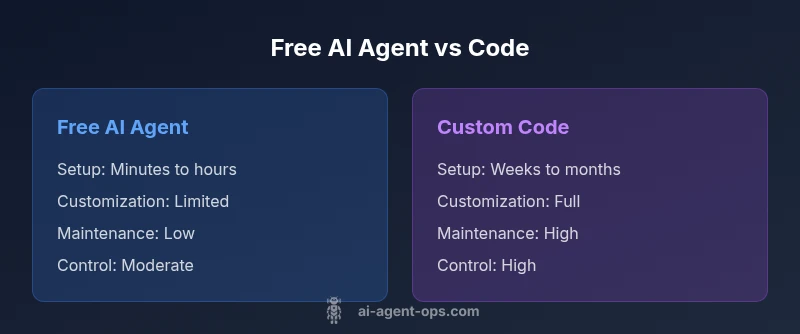
| Feature | Free AI Agent (no-code/low-code) | Custom Code (from scratch) |
|---|---|---|
| Setup Time | Minutes to hours | Weeks to months |
| Customization | Limited to platform capabilities | Unlimited – code-level control |
| Maintenance Burden | Low (platform-managed) | High (devOps and updates) |
| Data Residency & Compliance | Platform-bound, varies by vendor | Full control, regulator-appropriate |
| Speed to Value | Very fast for MVPs | Slower but deeper integration |
| Cost of Ownership | Typically lower upfront | Higher upfront and ongoing costs |
| Scaling & Performance | Limited by platform | Unlimited, but requires own infra |
| Vendor Lock-in | Moderate to high | Low if built-in modularity |
| Security & Compliance | Shared responsibility; depends on vendor | End-to-end control; requires safeguards |
Positives
- Rapid time-to-value and quick MVPs
- Low-code/no-code lowers barrier for non-engineers
- Easy experimentation across multiple configurations
- Lower upfront investment with vendor-managed runtimes
- Faster onboarding for new team members
What's Bad
- Limited customization and advanced policy control
- Vendor dependency and potential data concerns
- Reduced visibility into model internals and decisions
- Migration to code can be disruptive if not planned
Custom coding often wins for long-term projects requiring deep customization and strict data governance.
If you need full control, security, and scalability, invest in code. If speed and low overhead are the priority, free AI agents are a strong starting point, with a path to migration later.
Questions & Answers
What is a free AI agent and how does it differ from coding an agent?
A free AI agent is a no-code or low-code solution that enables you to configure and deploy automated agents with minimal programming. Coding an agent from scratch involves building the logic, data flows, and integrations in code. The choice depends on speed, governance, and the required level of customization.
A free AI agent is a ready-to-use automation tool you configure without full programming; coding an agent means building it yourself for full control.
Can a free AI agent handle enterprise-scale tasks?
Free AI agents can handle many enterprise tasks, especially when processes are well-defined and governance needs are moderate. However, scaling beyond basic workflows often requires custom code or hybrid architectures to meet data security, latency, and integration requirements.
They can handle many tasks, but for large-scale needs, you may eventually need custom code or a hybrid approach.
How do I measure total cost of ownership for each option?
Total cost of ownership includes licenses or platform fees, development time, maintenance, and potential migration costs. Free agents may have lower upfront fees but can incur higher long-term costs if you outgrow capabilities. Code-based solutions often require more initial investment but reduce ongoing vendor dependency.
Look at upfront, maintenance, and migration costs to compare total ownership.
Is security compromised when using free AI agents?
Security depends on the vendor and your data handling practices. Free agents may entrust data to a third party and offer shared responsibility models. For sensitive data, implement strong controls, encryption, access policies, and consider migrating to code when needed for full governance.
Security varies by vendor; use strong data controls and plan for governance when handling sensitive info.
When should I migrate from a free AI agent to custom code?
Migration is prudent when you require deeper data control, custom workflows, or regulatory compliance that is not easily met by a vendor. Start with a hybrid approach for a smooth transition, documenting interfaces and data mappings to minimize disruption.
Move to code when governance or customization needs exceed the free agent's capabilities.
What are common pitfalls when choosing between these approaches?
Common pitfalls include underestimating data governance, over-relying on vendor capabilities, and neglecting a migration plan. Ensure clear ownership of data, maintainable interfaces, and a staged roadmap that aligns with organizational risk tolerance.
Watch for governance gaps and lack of a migration plan when deciding.
Key Takeaways
- Start with a clear decision framework
- Use free AI agents for rapid prototyping
- Plan a migration path to code as needs grow
- Balance speed with governance and data security