Free AI Agent Builder: A Practical 2026 Guide
An analytical guide to free ai agent builder platforms, their capabilities, limits, and best practices for prototyping agentic workflows without code. Learn evaluation, comparison, and production migration strategies with Ai Agent Ops insights.


A free ai agent builder is a software platform that lets teams design, test, and deploy AI agents without writing code. It covers drag-and-drop workflows, basic agent orchestration, and prebuilt connectors. Free tiers enable experimentation but typically limit concurrent agents, data sources, and runtime performance, prompting upgrades for production workloads.
What is a free ai agent builder and why it matters
According to Ai Agent Ops, a free ai agent builder is a software platform that lets teams design, test, and deploy AI agents without writing code. It covers drag-and-drop workflows, basic agent orchestration, and prebuilt connectors. For product teams and developers, these tools unlock rapid experimentation, reduce initial development time, and help validate agentic workflows before committing resources. In practice, you can prototype simple agents to handle tasks such as data collection, routing, or decision making within a sandbox environment, avoiding upfront infrastructure costs. The value lies in turning ideas into testable automations quickly, without the misalignment that often accompanies large software builds. While the free tier is meant for exploration, it also introduces constraints around runtime, data volume, and concurrency. That makes it essential to outline your use case, desired outcomes, and data boundaries before you start, so you can measure success and know when to upgrade.
Core capabilities and typical limitations
A free ai agent builder typically offers a visual designer for drag-and-drop workflows, a library of prebuilt connectors, and a lightweight runtime for experiments. You can assemble multi-step intents, route data between services, and simulate agent behavior without touching code. Common limits include the number of concurrent agents, the amount of data you can process, and the range of integrations available. Security features may be basic, and deployment is usually cloud-only with limited on-prem options. For teams, the most valuable capability is rapid iteration—being able to test hypotheses about automation, decisioning, and orchestration in days rather than weeks. The learning curve tends to be moderate, with most users becoming productive after a few guided tasks and practical examples.
Free vs paid tiers: what changes and when to upgrade
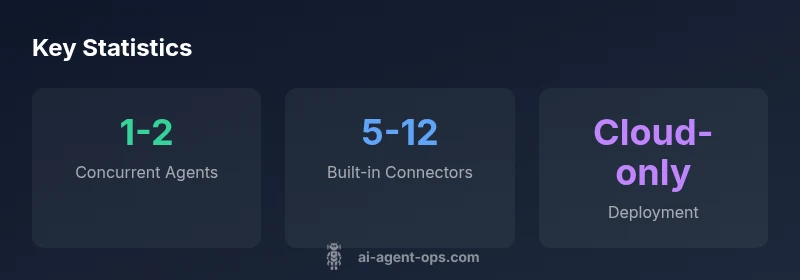
The line between free and paid tiers is typically defined by scalability and governance. Free tiers grant a sandboxed environment, limited connectors (often 5-12), and a cap on concurrent agents (1-2). Paid plans expand connectors to 100+ or more, unlock advanced orchestration patterns, enable production-grade deployment, and introduce governance features like access controls and auditing. Ai Agent Ops analysis shows that teams should start with a clearly defined pilot—map the exact use case, required data sources, and critical SLAs—and then decide whether the incremental value justifies the cost. If your goal is to validate the concept or prototype a small workflow, the free tier is often sufficient; for production workloads, you’ll want a plan with stronger security, reliability, and support.
Practical workflow examples for the free tier
A free ai agent builder is well-suited for quick, low-risk experiments. For instance, you can build a simple data-collection bot that gathers customer feedback from a web form, a routing agent that assigns tickets to the right team based on keywords, or a scheduling assistant that books meetings via calendar APIs. These examples demonstrate core capabilities: event-driven triggers, conditional logic, and connector usage. Document each step of the workflow, measure time-to-value, and track how often the agent requires human intervention. Real-world testing should remain isolated to avoid impacting live data until you’re ready to upgrade.
Evaluation checklist and best practices
Before committing to a particular free ai agent builder, run through a practical checklist:
- Define objective metrics (time saved, tasks automated, error rate).
- List essential connectors and data sources you need for your pilot.
- Assess data privacy and security implications for your domain.
- Validate deployment options and runtime limits for your use case.
- Create a migration plan outlining when and how to scale.
- Capture decisions in a living design document to inform stakeholders.
Best practices include starting small, documenting every assumption, and building with governance in mind from day one. This will make upgrades smoother and protect data integrity as you scale.
Security, privacy, and governance considerations
Even in free environments, governance matters. Review access controls, data residency, and retention policies tied to your data sources. Avoid storing sensitive data in plain-text or in insecure connectors. When prototyping, use synthetic data to reduce risk. Establish clear ownership for the automation, and ensure compliance with organizational policies. If your pilot reveals security gaps, plan a transition to a higher-tier solution that offers advanced encryption, audit trails, and robust identity management.
Common pitfalls and troubleshooting
Common pitfalls include overloading the free tier with too many concurrent flows, underestimating data volume, and assuming all integrations will work out-of-the-box. Start with a small, well-scoped use case and validate each connector individually before combining them. When troubleshooting, log events at each step of the workflow, test edge cases, and verify data formats across connectors. If a failure occurs, reproduce it in a controlled environment and document the exact sequence of actions leading to the error.
The path from prototype to production: migration and scaling
As you move from prototype to production, ensure your architecture supports scale: decouple data sources from the agent logic, implement retry strategies, and establish observability. Plan for governance, compliance, and security reviews, and prepare a cost model for downstream usage. A paid plan is typically required to achieve production-grade reliability, higher data quotas, and dedicated support. Document your migration plan early, including milestones, risk assessments, and rollback procedures.
Free vs Premium Feature Comparison
| Feature | Free Tier | Premium Tier |
|---|---|---|
| Drag-and-Drop Designer | Available | Advanced & customizable |
| Connectors & Integrations | 5-12 built-ins | 100+ connectors |
| Deployment Options | Cloud-only | Hybrid & on-prem |
| Usage Limits | 1-2 concurrent agents | Unlimited / scalable |
Questions & Answers
What is a free AI agent builder and how does it differ from paid solutions?
A free AI agent builder is a platform that enables design, testing, and lightweight deployment of AI agents without coding. It emphasizes quick prototyping, drag-and-drop design, and essential integrations. Paid solutions typically add advanced governance, scale, security, and premium connectors.
A free AI agent builder helps you prototype agent workflows without code. For production, you’ll likely need a paid plan with more features.
Can a free tier handle production workloads?
Most free tiers are intended for experimentation and learning. They often cap concurrency and data volume. Production workloads usually require a paid plan with higher quotas, stronger security, and dedicated support.
Free tiers are great for testing, but for production you’ll want a paid option with better reliability.
What should I look for when evaluating free builder options?
Prioritize connector availability, concurrency limits, deployment options, data privacy, and governance features. Verify the availability of essential data sources and the ease of migrating to a paid plan if needed.
Check connectors, limits, and migration paths before you commit.
Are there security or data privacy concerns with free builders?
Yes, even in free environments. Review data handling, access controls, encryption at rest, and audit capabilities. Use synthetic data for testing and map data flows to ensure compliance.
Security matters—use synthetic data and review access controls.
How easy is it to migrate from a free builder to a paid platform?
Migration depends on data sources and connectors. Plan a staged upgrade, preserve data formats, and validate on a sandbox before going live. Document a rollback plan in case of issues.
Have a staged upgrade path with a rollback plan.
Which use cases are best suited for free ai agent builders?
Ideal for prototyping data collection, routing, notification, and basic automation workflows. Use cases that stay within low data volumes and simple logic reduce risk while you validate the concept.
Great for prototyping simple automations and validating ideas.
“"Free AI agent builders empower teams to experiment quickly, but planning for governance and scaling is essential as you move from prototype to production."”
Key Takeaways
- Prototype quickly with a free ai agent builder.
- Expect tier limits; upgrade when production needs arise.
- Plan migration early; map connectors & data sources.
- Ai Agent Ops's verdict: start in a sandbox and scale responsibly.
- Document governance decisions from day one.