Which AI Agent Builder Is Free: A Thorough Comparison
A detailed, analytical comparison of freemium cloud options vs open-source/self-hosted AI agent builders. Learn how to evaluate free plans, manage limits, and plan upgrades for prototyping and small teams.


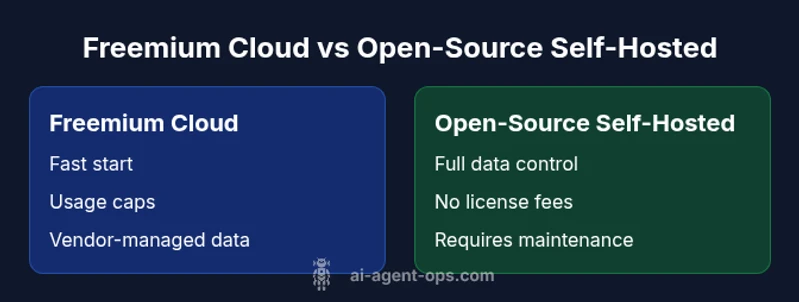
Which ai agent builder is free depends on your goals and constraints. For quick prototyping, freemium cloud options offer rapid setup; for privacy and control, open-source/self-hosted paths can be truly zero-cost to run locally. According to Ai Agent Ops, the best free path balances ease of use with clear usage limits and data controls, before considering paid upgrades.
Introduction: The Free Builder Dilemma
In the evolving world of AI agents, teams constantly ask which ai agent builder is free. The honest answer is that there isn’t a single universal free option; instead there are two main families: freemium cloud services and open-source self-hosted solutions. Each path has distinct advantages and trade-offs for prototyping, testing, and small-scale deployments. This guide focuses on practical findings for developers, product managers, and business leaders who want to evaluate no-cost routes before committing to paid plans or custom builds.
According to Ai Agent Ops, the key is to map requirements to constraints. If you need quick setup with minimal operational burden, cloud freemium tiers win on speed. If your project demands tight data control, regulatory compliance, or ownership of your agent’s logic, open-source options can deliver more predictable costs but require more hands-on work. Throughout this article, we compare two primary families, outline concrete evaluation criteria, and provide actionable steps to derive value from free plans without getting trapped by hidden costs or vendor lock-in.
As you read, keep in mind that the best choice depends on your scenario, not brand reputation alone. The Ai Agent Ops team emphasizes that free is a starting point, not a finish line: plan for growth, monitor usage, and design your agent architecture with upgrade paths in mind.
Comparison
| Feature | Freemium Cloud | Open-Source Self-Hosted |
|---|---|---|
| Cost Model and Upgrade Path | Free tier with limits; paid upgrades | Zero licensing cost; ongoing infra and maintenance costs |
| Data Residency and Privacy | Vendor-managed data and logs; export options limited | Full control over data location and governance |
| API Access and Model Capabilities | Limited API quotas; restricted model access | No intrinsic quotas; depends on your own infra |
| Deployment Options | Cloud-based, fast to start | On-premises or cloud; highly customizable |
| Integrations and Connectors | Prebuilt connectors; easier to start | Requires custom connectors or plugins |
| Observability and Debugging | Basic logs and dashboards in free tier | Full observability depends on setup |
| Support and Community | Community forums; paid support tiers optional | Community-driven or self-supported; no official tickets |
| Upgrade/Migration Path | Streamlined upgrade within vendor platform | Manual migration; export formats may vary |
Positives
- Low upfront costs or zero licensing for prototyping
- Rapid setup and quick time-to-value for MVPs
- Open-source option offers customization and no vendor lock-in
- Strong community resources and no-code/low-code routes
What's Bad
- Freemium limits can throttle production work
- Self-hosted options require infrastructure, maintenance, and security discipline
- Potential data privacy concerns with cloud-free plans
- Migration between paths can be non-trivial if architecture is tightly coupled
Freemium cloud builders are best for fast prototyping; open-source/self-hosted options win on privacy and total cost at scale
Choose freemium cloud to validate ideas quickly and iterate. Opt for open-source/self-hosted when control, compliance, and long-term cost predictability matter more, especially as workloads grow.
Questions & Answers
What counts as a 'free' AI agent builder?
A free AI agent builder typically offers a limited-free tier or an open-source license with no licensing fees. The free option may include caps on API calls, model access, and data retention, or be entirely self-hosted with no software costs. Always verify exact terms, quotas, and export options before committing to any path.
A free AI agent builder usually means either a no-cost tier with usage limits or an open-source option you run yourself. Check quotas, data handling, and export options before deciding.
Are free tiers suitable for production workloads?
Free tiers are generally intended for prototyping and testing rather than full production workloads. If your project scales, you’ll likely hit quotas or need higher privacy guarantees, at which point a paid plan or self-hosted deployment may be necessary.
Free plans are great for testing, but production workloads often need higher quotas and stronger data controls.
What are typical limits in free plans?
Common limits include API call quotas, concurrency caps, data retention windows, and restricted access to advanced model options. Understanding these limits helps you plan when to upgrade or migrate to a self-hosted setup.
Expect quotas on calls and data retention in free plans; plan upgrades when you exceed those limits.
Can I migrate from a free plan to a paid plan easily?
Most providers offer a straightforward upgrade path, but the ease of migration depends on how tightly you’ve coupled your workflow to vendor-specific connectors and configurations. Plan exports and ensure compatibility with your integration layer.
Upgrading is usually possible, but verify export formats and connector compatibility first.
Is open-source viable for small teams?
Open-source solutions can be highly viable for small teams, offering control and zero licensing costs. They require some DevOps effort, proper security practices, and ongoing maintenance.
Open-source options work well for teams that can handle setup and upkeep.
What should I check before choosing a free option?
Check quotas, data privacy controls, upgrade options, export capabilities, and ease of migration. Also assess the ecosystem for connectors and community support to avoid vendor lock-in later.
Look at quotas, data handling, export options, and upgrade paths.
Key Takeaways
- Define MVP scope to fit free tier quotas
- Expect data and usage limits in most free plans
- Open-source paths offer control but require maintenance
- Plan for upgrade paths before committing to a single option