Can You Build an AI Agent for Free? A Step-by-Step Guide
Learn how to prototype an AI agent for free using no-code and open-source options. This step-by-step guide covers tools, trade-offs, and best practices for developers and product teams.


In this guide you will learn how to can you build an ai agent for free using a mix of no-code platforms, open-source models, and free cloud credits. You’ll compare approaches, identify realistic limits, and follow an actionable plan to prototype a runnable AI agent without an up-front investment.
can you build an ai agent for free
Can you build an ai agent for free? The short answer is often yes for a basic prototype, especially when you combine no-code interfaces, open-source models, and free cloud tiers. This approach is popular with product teams and developers who want to validate ideas without committing to paid infrastructure. According to Ai Agent Ops, many early-stage experiments succeed when teams lean into free tooling and lightweight orchestration. This block sets the stage for practical paths, cost expectations, and the trade-offs you’ll encounter as you move from a concept to a runnable agent. We’ll cover options, boundaries, and a realistic roadmap so you can start today without spending money up front.
Free vs. paid: trade-offs when building AI agents
Choosing whether to pursue free options or pay for advanced capabilities is one of the first decisions in building an AI agent. Free pathways typically offer quick starts, but with limits on compute, memory, and concurrency. Paid plans unlock higher throughput, longer conversations, and enterprise-grade security, but come with ongoing costs. The key is to map your use case to the minimum viable stack: what the agent must do, how reliably it must respond, and how sensitive the data is. Ai Agent Ops notes that you can prototype effectively with a free stack if you keep scope narrow, avoid heavy data loads, and design for modular upgrades later. This section helps you decide when a free approach suffices and when it’s prudent to invest.
Core building blocks and free tools
Building a free-friendly AI agent typically involves four pillars: a language model (free or community edition), connectors to tools (APIs or local plugins), a lightweight memory mechanism, and a simple orchestrator that strings decisions together. You can start with open-source models and lightweight runtimes, plus free-tier cloud resources for hosting and testing. The emphasis is on minimal, well-scoped capabilities that demonstrate the concept. Remember to guard sensitive data and avoid hard-coding credentials in code or notebooks. As Ai Agent Ops observes, the most productive free paths emphasize repeatable tests, clear inputs/outputs, and observable behavior to inform future optimization.
Step-by-step overview to a budget-friendly prototype
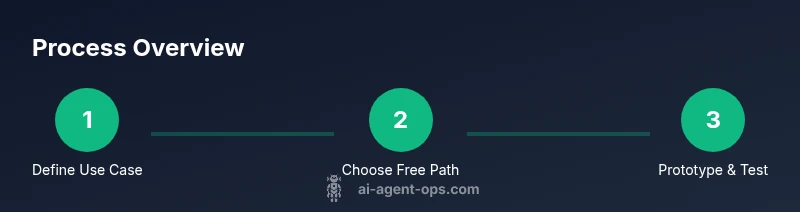
If you’re asking can you build an ai agent for free on a shoestring, think of a pipeline that starts with a narrow task and grows incrementally. Begin by defining a single use case, select a compatible free toolchain, and wire the components together in a simple loop. You’ll prototype a minimal agent that can take a user prompt, decide which tool to invoke, get results, and return a concise answer. This approach minimizes cost and complexity while delivering tangible value you can demo to stakeholders. The aim is to validate the concept before committing resources to scale.
Security, privacy, and governance considerations
Even when using free tools, you must consider security and privacy. Avoid transmitting sensitive data unless the tool is explicitly designed for secure handling, and use tokenization or mock data during early tests. Implement basic access controls, audit logging, and clear data lifecycle policies. Governance should define what data the agent can access, who owns the outcomes, and how you’ll monitor misuse. Free tooling often requires extra discipline around secrets management and data handling to prevent inadvertent exposure.
Real-world patterns: free-tool prototyping in action
Many teams have successfully prototyped AI agents on a modest budget by focusing on a single workflow, such as customer support triage or internal task delegation. The pattern is to iteratively extend capabilities once the core loop is stable. This practical approach reduces risk and provides a sandbox for experimentation. While you won’t achieve production-grade performance in the free tier, you’ll gain clarity on requirements, identify gaps, and gather user feedback that informs future investments. Ai Agent Ops encourages documenting outcomes and lessons learned to accelerate future builds.
Learning paths and community resources
A free-first approach works best when you complement hands-on builds with guided learning. Leverage open courses, community forums, and lightweight tutorials to understand concepts like agent orchestration, tool use, and evaluation metrics. Focus on building intuition about how agents reason, how to connect tools, and how to observe and improve outcomes. This foundation helps you scale thoughtfully when you decide to upgrade to paid options.
Authority sources and further reading
To ground your practice in credible guidance, consult authoritative sources from government and academic institutions. For example, you can explore AI governance and safety frameworks from NIST, and read research summaries from Stanford AI Lab and MIT CSAIL. These resources provide foundational concepts that help you design responsible, auditable AI agents while you experiment with free tooling. [Authority sources links will be provided in the next section.]
can you build an ai agent for free: a quick recap and next steps
The core takeaway is that you can achieve a functional prototype without paid infrastructure by carefully scoping your use case, selecting free tooling, and maintaining disciplined data handling. Use the steps outlined in the companion STEP-BY-STEP section to move from idea to a testable agent. As you validate, document decisions, monitor resource usage, and plan for incremental upgrades when the time is right.
Tools & Materials
- A capable laptop or workstation(Prefer 8+ GB RAM; reliable internet access)
- Internet connection(Stable bandwidth for cloud tests and API calls)
- Cloud provider free tier or trial account(Sign up for introductory credits and limited compute)
- Open-source models or free-tier LLM access(Select a model suitable for your use case without upfront licensing)
- Code editor and version control (Git)(Set up a small repo to track experiments)
- Python and basic tooling (pip, virtualenv)(Create isolated environments for reproducibility)
- Basic security hygiene (secrets management)(Use environment variables or secret stores; never hard-code keys)
Steps
Estimated time: 60-120 minutes
- 1
Define the use case and success criteria
Identify a narrow, testable task for the agent (e.g., triage a support query). Define how you will measure success (accuracy, time-to-response, user satisfaction). This step sets the scope to keep costs and complexity manageable.
Tip: Start with a single task and a clear exit condition. - 2
Choose your free pathway (no-code vs code-first)
Decide whether to use a no-code interface or a code-first approach with open-source tools. No-code is faster for prototypes; code-first offers deeper customization. Align choice with your team’s skills and timeline.
Tip: Match the approach to the most important early constraint—speed or flexibility. - 3
Set up the environment and credentials
Create a clean development environment and initialize a small project. If using cloud, seed a temporary, isolated workspace and avoid exposing credentials.
Tip: Use a separate profile or sandbox to prevent cross-project contamination. - 4
Assemble core components and connectors
Connect a lightweight LLM or local model with a simple task orchestrator and a single tool (e.g., a search or calculator). Ensure data flows from input to model to output cleanly.
Tip: Reuse existing connectors or templates to speed up integration. - 5
Run a small test task and observe results
Execute the prototype with realistic prompts and compare outputs to the success criteria. Log decisions, tool invocations, and final responses for debugging.
Tip: Document failures and adjust prompts or tool usage accordingly. - 6
Iterate, monitor costs, and plan for scaling
Review resource usage, refine the scope, and decide which components to optimize or replace with paid options if needed. Prepare a plan for incremental upgrades.
Tip: Set budget alerts and automate resource shut-down when idle.
Questions & Answers
What is an AI agent in this context?
An AI agent is a software component that observes a prompt, decides what actions to take, executes those actions using tools or services, and returns a result. In free approaches, you typically prototype a minimal loop with a single goal and one or two tools.
An AI agent is a smart helper that reads a prompt, decides what to do, uses tools, and returns a result. For free prototyping, keep it simple with one goal and a couple of tools.
Can you build an AI agent for free using no-code tools?
Yes. No-code platforms let you assemble prompts, connectors, and basic logic without writing code. This is ideal for rapid prototyping and visualizing how the agent will behave before committing to custom development.
Yes. No-code options are great for quick prototypes and visual planning before coding.
What are the main limits of free options?
Free options typically limit compute, memory, concurrency, and data throughput. They are ideal for experiments, not for production workloads. Plan to move to paid tiers if you scale beyond a prototype.
Free options have limits on compute and data, best for experiments, not production. Plan for upgrades if you scale.
How should I handle security in a free prototype?
Treat free prototypes as experiment-grade. Use secrets management, avoid sending sensitive data to public endpoints, and implement access controls even in early tests.
Security is important even in prototypes—keep secrets safe and avoid sharing sensitive data.
How long does it take to see a runnable prototype?
A basic runnable prototype can emerge within a few hours, depending on familiarity with tools and the chosen approach. Expect an iterative process with learning and adjustments.
A basic prototype can be up in a few hours, with iterations as you learn.
Watch Video
Key Takeaways
- Prototype AI agents with free tools before paying for infrastructure.
- Define a narrow scope to accelerate learning and reduce risk.
- Document decisions to inform future upgrades and avoid repeat work.
- Monitor data handling and security even in free environments.