Can You Build an AI Agent Without Coding? A Practical Guide
Discover how to build AI agents without coding using no-code tools. This practical guide covers platforms, design, data governance, testing, and when to venture into code.


You can absolutely build an AI agent without coding using no-code and low-code tools. This quick-start overview shows how to map goals, assemble templates, and configure behavior with visual builders. You’ll prototype, test, and iterate rapidly, understanding when coding is truly necessary. The approach emphasizes scope, governance, and learning by doing.
Can you build an AI agent without coding? A quick reality check
According to Ai Agent Ops, the answer is often yes, especially for early-stage automation and prototyping. When someone asks, can you build an ai agent without coding, the practical answer is that you can leverage no-code and low-code platforms to capture intents, orchestrate actions, and generate responses through visual builders and templates. This approach is particularly attractive for product teams and startups seeking speed and learning feedback without heavy engineering investments. That said, you trade some level of customization for rapid iteration, and you must safeguard data quality, governance, and edge-case handling. The path to success is to frame work as a series of small experiments and escalate to code only when a limitation becomes a bottleneck. The Ai Agent Ops team emphasizes starting with a clear objective, measurable criteria, and a plan for how you’ll validate outcomes at each step.
Practical note: begin with a single measurable task and expand once you’ve demonstrated value.
What you can realistically build today with no-code AI
No-code AI agents today can handle a wide range of practical tasks. Common patterns include chat-based assistants that triage inquiries, workflow automations that route tasks to teammates, and data-pipeline agents that extract, transform, and summarize information. You can assemble these using drag-and-drop blocks, prebuilt connectors, and guided prompts. Templates help you bootstrap behavior, while built-in testing sandboxes let you simulate inputs and observe outputs without touching production data. The focus is on delivering tangible value quickly, then refining as you learn more about user needs and system constraints. While some advanced capabilities—like highly customized decision logic or low-latency real-time control—may require code integration, many teams achieve compelling results with no-code solutions.
Key takeaway: start with a narrow, high-impact use case and scale up.
Platform choices and their impact on outcomes
Different platforms offer varying levels of abstraction and control. No-code platforms excel at rapid prototyping and collaboration, while low-code options provide more advanced integrations and scripting flexibility. When choosing a platform, align capabilities with your goals: if you need fast iteration and human-in-the-loop oversight, a no-code builder with governance features may be best; if you require custom data transforms or domain-specific models, plan for light coding or API hooks. Consider data privacy, security, and compliance requirements as you evaluate vendors. Ai Agent Ops recommends testing multiple platforms against a common set of tasks to reveal where each option shines and where it falls short. This comparative approach helps you avoid vendor lock-in and spot gaps early in the project.
Pro-tip: map platform strengths to your most important metrics (time-to-market, accuracy, user satisfaction).
Designing intents, prompts, and interaction flows
Effective no-code agents rely on well-defined intents, clear prompts, and robust interaction flows. Start by listing the tasks your agent should perform and the questions it should answer. Group related intents to minimize confusion and ensure deterministic behavior for edge cases. Use templates for typical prompts and progressively tailor them as you collect real user data. Visual flow editors help you map user paths, including fallback branches when the agent is uncertain. Always build in guardrails, such as confirmation prompts for irreversible actions or escalation rules to human agents when confidence is low. Ai Agent Ops highlights the importance of documenting decision criteria so future changes remain auditable and understandable by non-technical stakeholders.
Wording matters: precise prompts reduce ambiguity and improve reliability.
Data governance, privacy, and safety in no-code agents
No-code does not absolve you of data governance. Define who can access what data, where it is stored, and how it’s processed. Use anonymized or synthetic data during testing, and implement data minimization to reduce exposure. Establish safety nets like rate limits, abuse detection, and explicit data retention policies. If the platform supports it, enable audit logs and version history to track changes to prompts, intents, and workflows. Be mindful of external APIs and the data you send to them; ensure you have consent and comply with applicable regulations. The Ai Agent Ops team emphasizes starting with a privacy-by-design mindset to prevent leakages and to maintain user trust as you scale.
Security note: configure least-privilege access for collaborators and monitor for anomalous activity.
Testing, monitoring, and iteration without code
Testing is the engine that drives successful no-code AI agents. Create a representative set of test scenarios, including normal flows, error paths, and edge cases. Use synthetic data to simulate real-world inputs without risking production data. Monitor key metrics such as success rate, user satisfaction, and time-to-resolution. Establish a feedback loop that captures user interactions and translates them into concrete improvements, such as refining prompts or expanding intent coverage. Plan periodic reviews to revalidate assumptions and adjust thresholds as your agent encounters new tasks. Ai Agent Ops underscores the habit of rapid iteration over perfection in early stages.
Practical tip: automate a monthly retrospective to review performance dashboards and decide which improvements to implement next.
When to code vs no-code: a pragmatic decision framework
There is a pragmatic decision point: if you repeatedly hit a hard constraint—like custom data transforms, latency requirements, or highly specialized model behavior—coding may be warranted. Start by prototyping with no-code, then incrementally add code where it unlocks measurable value. Maintain a decision log that records the rationale for escalating to code, the expected impact, and the timeline. This framework keeps engineering effort focused on outcomes rather than boilerplate work. Ai Agent Ops’s verdict is to reserve coding for areas where the no-code approach consistently fails to meet your defined success criteria. The goal is to maximize speed and learning while keeping governance intact.
Rule of thumb: code only when you must for performance, fidelity, or compliance outcomes.
Real-world templates and example workflows you can implement today
To illustrate, consider templates for a customer-support bot that triages tickets, a sales-assistant that routes opportunities, and a data-extraction agent that summarizes documents. Start by loading a template relevant to your domain, connect data sources, and tailor prompts to your user scenarios. Mock the user journey, capture failures, and escalate when needed. Reuse and extend templates to reduce friction and keep the experience consistent for users. Ai Agent Ops encourages cataloging templates so your team can quickly assemble new agents from proven building blocks.
The next steps: getting started today
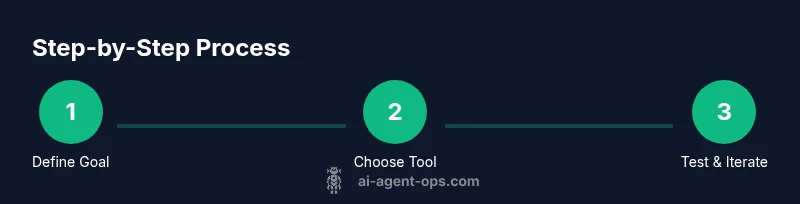
Begin with a single, high-impact use case and a no-code platform that supports templates and safe data handling. Document goals, success metrics, and governance rules before you build. Create a pilot with a limited audience, gather feedback, and iterate on prompts and flows. If you reach a point where customization or performance limits become evident, plan a smooth handoff to code-enabled solutions. The Ai Agent Ops team recommends keeping a living runbook that records decisions and outcomes to guide future improvements.
Tools & Materials
- No-code / low-code AI platform account(Choose a platform with visual workflow builders and AI connectors. Ensure you have admin rights.)
- Web browser(Use the latest version with extensions/plugins enabled for testing.)
- Task templates and sample workflows(Collect examples relevant to your domain to accelerate bootstrapping.)
- Requirements document(List objectives, success criteria, and constraints before building.)
- Data governance and privacy plan(Outline access controls, retention, and compliance considerations.)
- Test data (synthetic or anonymized)(Use safe data to validate flows before production.)
Steps
Estimated time: 1-2 hours
- 1
Define objective and success criteria
Articulate the core task your agent should perform and how you will measure success. Include user impact and constraints. This clarity prevents scope creep and guides prompt design.
Tip: Write a one-sentence success criterion you can validate with a single test. - 2
Map intents and typical user journeys
List the main user questions or actions and group them into intents. Sketch typical flows to reveal decision points and fallbacks.
Tip: Create a fallback path for 20% of uncertain cases to maintain reliability. - 3
Choose platform and set up workspace
Pick a no-code/low-code platform that matches your goals. Create a dedicated project, invite teammates, and configure access controls.
Tip: Enable version history from day one to track changes. - 4
Import templates and configure prompts
Load relevant templates, connect data sources, and tailor prompts to your domain. Test prompts in sandbox mode to refine language and intent routing.
Tip: Keep prompts succinct and outcome-focused to improve reliability. - 5
Run pilot with synthetic data
Execute a controlled pilot using safe data to validate behavior. Observe outputs, measure against success criteria, and log deviations.
Tip: Use synthetic data that covers edge cases and common scenarios. - 6
Review results and plan iteration
Assess performance, gather user feedback, and decide whether to iterate, extend intents, or escalate to code-driven changes.
Tip: Document decisions and update your runbook after each cycle.
Questions & Answers
Can I build a robust AI agent without coding?
Yes, for many standard use cases you can build a robust agent with no-code tools. However, very specialized functions or high-throughput requirements may necessitate custom coding later.
Yes, you can build a robust agent without coding for common tasks; you might need code later for advanced features.
What tasks are best suited for no-code agents?
Tasks like ticket triage, data extraction, scheduling, and basic decision trees are well-suited for no-code agents. Start with templated flows and expand gradually.
Ticket triage, data extraction, and scheduling are great no-code starting points.
Is coding ever necessary with no-code agents?
Coding becomes relevant when you need custom data transforms, low-latency responses, or domain-specific behavior that no-code tools can’t provide.
Coding is often needed when you require custom transforms or domain-tailored behavior.
How secure are no-code agents?
Security depends on the platform and governance practices. Use access controls, data minimization, and audit logs to reduce risk.
Security hinges on platform controls and governance; ensure access and data handling are audited.
How do I test no-code agents effectively?
Test with representative scenarios, use synthetic data, and monitor outcomes against defined metrics. Iterate based on results.
Test with real-world scenarios and synthetic data, then refine prompts and flows.
What are the first steps to deploy no-code agents in production?
Define governance, run a pilot, collect feedback, and establish a rollout plan with rollback options if needed.
Pilot first, collect feedback, and plan a safe rollout with rollback in case of issues.
Watch Video
Key Takeaways
- Start with a focused, high-impact use case.
- No-code agents are great for rapid learning and iteration.
- Code only when required by performance, customization, or compliance.