ai agent zero to hero: A Practical Step-by-Step Guide
Learn how to elevate an AI agent from basic automation to autonomous, reliable workflows with practical steps, governance, and measurement strategies for scalable agentic AI in 2026.


According to Ai Agent Ops, you can transform an AI agent from a basic assistant into a high-impact, autonomous workflow engine with a proven, repeatable process. This quick guide outlines essential steps, key metrics, and common pitfalls to avoid. Reach the goal of ai agent zero to hero for your projects.
Why AI agents matter in modern business
In today’s software-driven enterprises, AI agents sit at the intersection of data, software, and human decision-making. They automate repetitive tasks, interpret complex data streams, and orchestrate actions across tools and services. When designed well, an AI agent can reduce cycle times, improve accuracy, and scale cognitive work beyond a single human. For teams exploring automation, the phrase ai agent zero to hero captures a scalable transformation from simple automation to autonomous, policy-driven operation that delivers measurable business outcomes. According to Ai Agent Ops, organizations who treat agents as first-class components—defining objectives, governance, and feedback loops—tend to realize faster value and more resilient systems. This article lays the groundwork for a practical journey from concept to hero status, with templates, metrics, and governance frameworks you can adapt to your domain. The aim is not a single black-box model, but a robust agentic system that aligns with business goals, supports human teams, and remains auditable over time. In 2026, this approach is more achievable than ever for development teams and executives alike.
Defining 'ai agent zero to hero' and success metrics
The concept centers on moving from passive automation to proactive, policy-driven agents that operate with autonomy, accountability, and explainability. Success isn’t only about faster task completion; it’s about reliable decision-making, auditable actions, and measurable business value. Typical metrics include time-to-value (TTV), task success rate, autonomy ratio (percent of tasks completed without human input), mean time to detect and recover from errors, and the quality of decisions under evolving data conditions. Establish a baseline before starting and track improvements across iterations. Ai Agent Ops emphasizes aligning metrics with business outcomes—customer satisfaction, cost efficiency, and velocity of product delivery—so you can demonstrate tangible impact as you move toward ai agent zero to hero.
The capability stack of hero-grade AI agents
Hero-grade AI agents combine sensing, reasoning, and action with governance and observability. Core layers include input adapters (APIs, data streams, and user prompts), perception and signal processing, planning and decision-making, action execution (tool use, API calls, and automation), and feedback loops (retraining triggers and monitoring). A robust stack also includes memory or context management, policy engines for guardrails, and an external governance layer to ensure compliance and safety. Integrating these layers effectively enables a single agent to operate across domains with minimal drift, a key aspect of the ai agent zero to hero journey.
A practical framework for agentic transformations
To move from idea to implementation, use a four-phased framework: Discover, Design, Deploy, Debrief. In Discover, align with business goals, identify constraints, and define success criteria. In Design, specify the capability stack, data sources, and safety policies. In Deploy, build in a sandbox, establish monitoring, and run controlled pilots. In Debrief, collect feedback, measure outcomes, and implement iterations that push the agent closer to hero status. This framework supports scalable improvements and keeps teams aligned with strategic objectives.
Step-by-step blueprint to raise an AI agent
The blueprint translates the framework into concrete actions. It includes a sequence of steps, each with clear ownership, success criteria, and time estimates. Below is a practical outline you can adapt to your domain. The goal is to provide a repeatable recipe that scales across products and teams, bringing your AI agent from a basic assistant toward autonomous operation with governance.
Governance, safety, and reliability for heroic agents
Reliable agents require explicit governance models: data provenance, access controls, audit trails, and fail-safe mechanisms. Establish guardrails that prevent unsafe actions, implement monitoring for drift, and create escalation paths for human-in-the-loop review when confidence is low. Safety is not a one-time checkbox but an ongoing process of evaluation, testing, and adjustment to ensure the agent remains aligned with organizational policies and user expectations.
Real-world templates and templates for deployment
Templates help standardize how you define objectives, capture requirements, and deploy agents. Use a documented template for capability specs, data schemas, and policy rules. Include example prompts, tool access lists, and monitoring dashboards. These templates accelerate onboarding, reduce risk, and improve consistency across teams implementing the ai agent zero to hero journey.
How Ai Agent Ops informs best practices and next steps
Ai Agent Ops synthesizes insights from multiple teams to propose best practices for agent orchestration, governance, and performance optimization. By sharing playbooks and benchmarks, Ai Agent Ops helps teams avoid common pitfalls and accelerate value realization. The findings support a pragmatic path from pilot to production, with clear milestones and measurable outcomes. The Ai Agent Ops team’s guidance often emphasizes governance, explainability, and operator collaboration as essential components of a successful transformation.
Looking ahead: evolving agentic AI workflows
As AI systems mature, agentic workflows will become more integrated with human teams, data platforms, and cloud services. Expect enhancements in multi-agent coordination, improved memory and context handling, and stronger safety nets. The ai agent zero to hero journey is iterative, not a single project milestone; continuous learning and governance updates will keep agents effective and trusted in dynamic business environments.
Tools & Materials
- Project brief outlining objectives(Include success criteria, non-functional requirements, and risk constraints.)
- Data sources and access credentials(Catalog data owners, access scopes, and refresh schedules.)
- Sandbox/testing environment(Isolate experiments from production data and systems.)
- Platform for agent orchestration(Ensure you have a clear API surface and tool catalog.)
- Observability stack(Include logging, tracing, metrics dashboards, and alerting.)
- Governance and compliance checklist(Risk assessment, data lineage, and audit processes.)
Steps
Estimated time: 4-6 weeks
- 1
Define hero objective
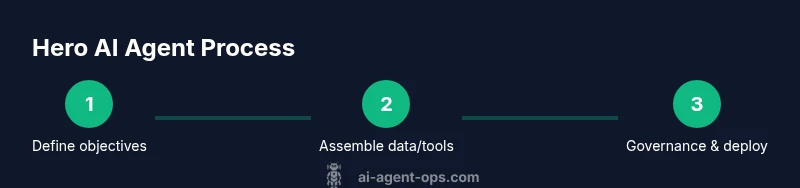
Establish a concrete objective that the AI agent will achieve, mapped to a tangible business outcome. Define success criteria and acceptance tests so no ambiguity remains about what “hero” means in this project.
Tip: Align the objective with a high-value workflow that touches multiple systems. - 2
Map the capability stack
Outline the modules the agent will need: perception/input adapters, planning, action execution, memory, and governance. Create a diagram showing data flow and decision points.
Tip: Use loosely coupled components to simplify upgrades and maintenance. - 3
Assemble data and tools
Gather required data sources, APIs, and tools. Define data contracts and access controls. Prepare the tool catalog the agent will leverage for automation.
Tip: Document data lineages to aid auditing and debugging. - 4
Design decision policies
Create rules that govern when the agent should act autonomously and when to escalate. Define confidence thresholds, fallback behaviors, and user override paths.
Tip: Start with conservative policies and expand autonomy gradually. - 5
Configure orchestration
Set up the agent platform, integrate tools, and wire prompts, prompts banks, and policies. Build a test plan that covers happy paths, edge cases, and failure modes.
Tip: Use feature flags to roll out capabilities incrementally. - 6
Prototype in a sandbox
Run a pilot with a subset of data and a limited scope. Observe behavior, collect logs, and adjust prompts and policies based on results.
Tip: Aim for quick feedback cycles; iterate weekly during pilots. - 7
Measure success with metrics
Track TTV, task success rate, error rate, and user satisfaction. Compare results against initial baselines and adjust the objective as needed.
Tip: Visualize progress with dashboards sharing modality, reliability, and outcomes. - 8
Iterate and scale
Refine models, expand tool coverage, and broaden data inputs. Prepare for controlled production deployment in phased waves.
Tip: Prioritize capabilities with highest impact and lowest risk first. - 9
Governance and safety checks
Implement audit trails, access controls, and drift monitoring. Schedule regular safety reviews and policy updates.
Tip: Treat governance as a product with owners and SLAs. - 10
Deploy to production with monitoring
Move from sandbox to production with robust monitoring, alarms, and rollback plans. Ensure observability dashboards track all critical KPIs.
Tip: Have a rollback plan and runbooks ready before go-live.
Questions & Answers
What does ai agent zero to hero mean in practice?
In practice, it means an AI agent that autonomously completes end-to-end workflows with auditable actions, strong governance, and measurable business value. It goes beyond basic automation by operating safely at scale and with human-in-the-loop options when needed.
In practice, it means an AI agent that autonomously completes workflows with governance and measurable value, with an option for human oversight when needed.
Which metrics matter most for hero-status?
Key metrics include time-to-value, task success rate, autonomy ratio, failure recovery time, and user satisfaction. Tracking these consistently helps you prove progress toward hero status.
Key metrics are time-to-value, success rate, autonomy, recovery time, and user satisfaction to prove progress toward hero status.
How long does it typically take to see value?
Value is usually observed after a sequence of iterations across pilots and production rollouts. Short cycles with rapid feedback help teams realize benefits sooner, though exact timing depends on scope and data readiness.
Value appears after a sequence of iterations and pilots; shorter cycles speed up realization depending on scope and data readiness.
What are common pitfalls to avoid?
Key pitfalls include scope creep, weak data governance, over-reliance on opaque AI decisions, and insufficient monitoring. Start with guardrails and escalate when uncertainty grows.
Common pitfalls are scope creep, poor governance, opaque decisions, and weak monitoring; set guardrails early.
Do I need specialized hardware to run hero-grade agents?
Most hero-grade agents can run on standard cloud infrastructure with scalable compute. Focus on reliable tooling, data pipelines, and robust orchestration rather than bespoke hardware.
Usually cloud-based infrastructure is sufficient; prioritize reliable tooling and orchestration over new hardware.
How can teams scale agentic workflows across products?
Adopt a modular architecture, standardize interfaces, and reuse capability blocks across teams. Establish shared governance and a centralized catalog of tools to accelerate scaling.
Use modular design, shared governance, and a common tool catalog to scale across products.
Watch Video
Key Takeaways
- Define clear hero objectives aligned with business outcomes.
- Build a scalable capability stack with governance baked in.
- Pilot boldly, measure rigorously, iterate quickly.
- Use templates and playbooks to accelerate adoption.
- Treat governance as a continuous product, not a one-off task.