AI Agent Go-to-Market: Practical Launch Playbook for 2026
A practical, step-by-step guide to bringing an AI agent to market. Learn GTM strategy, pricing, channels, and governance for agentic AI with Ai Agent Ops insights.


This guide helps you design and execute a go-to-market plan for an AI agent, from value framing to channels, pricing, and governance. According to Ai Agent Ops, success hinges on early validation, ethical risk controls, and measurable KPIs that align product and business goals. Follow the steps to launch responsibly in 2026.
Understanding the AI Agent Go-To-Market Landscape
Launching an AI agent is not just shipping software; it's orchestrating a living capability that interacts with people, data, and other systems. In 2026, successful GTM for agentic AI blends product readiness with market education and governance. According to Ai Agent Ops, the market expects transparent capabilities, measurable outcomes, and responsible use of AI. Start by defining the problem your agent solves and the value it delivers in clear, quantifiable terms that non-technical decision-makers can grasp. Then map these outcomes to specific use cases, such as task automation, decision support, or autonomous orchestration of workflows. This foundation guides every subsequent GTM decision, from pricing to channel strategy and compliance requirements.
Defining Value Proposition for Agentic AI
Your value proposition for an AI agent should do more than promise speed or cost savings. It must articulate the unique capability of the agent, such as end-to-end workflow orchestration, data-driven decision support, or adaptive automation that learns from user behavior. Frame the benefit in terms of outcomes that matter to the buyer: time saved per task, accuracy improvements, reduced cognitive load, or improved compliance. Create a simple customer story: a line-of-business leader deploys an agent to triage tickets, frees analysts for higher-value work, and delivers measurable improvements in throughput. Use this narrative to test messaging across landing pages, onboarding flows, and sales decks. The goal is to align technical feasibility with business impact, so your claims are credible and verifiable.
Market Validation: Rapid Experiments that Matter
Move quickly to validate demand without building a fully fledged product. Run small pilots with constrained data and a clear success metric agreed with stakeholders. Use lightweight experiments such as concierge tests, where humans simulate the agent’s behavior, and smoke tests on a landing page to gauge interest. Ai Agent Ops notes that the fastest go-to-market paths for AI agents leverage a tight feedback loop between product, marketing, and sales, ensuring the offering evolves with user needs. Capture learnings in a shared dashboard and adjust messaging, pricing, and scope accordingly.
Target Users, Use Cases, and Personas
Develop distinct personas for decision-makers, end users, and operators who will interact with the AI agent. For each persona, map a handful of high-value use cases—ranging from automated triage to decision-support coaching. Visualize the buyer’s journey: discovery, evaluation, purchase, and utilization. Craft messaging that speaks to pain points in each stage, such as time-to-value, risk reduction, and governance controls. Shareable buyer profiles help sales and partners tailor demos and content, and they anchor your go-to-market calendar around quarterly business priorities.
Channel Strategy: Direct, Marketplace, and Partnerships
AI agents thrive in ecosystems. Design a three-pronged channel strategy: direct outreach to product teams and IT stakeholders; marketplace listings on relevant platform ecosystems; and partner programs with system integrators, consulting firms, and data providers. Create playbooks for each channel, including partner enablement kits, contract templates, and co-branded marketing assets. Establish service level expectations for onboarding, data handling, and ongoing support. A well-choreographed channel plan reduces time-to-value and expands reach beyond a single org.
Pricing and Packaging for AI Agents
Pricing for AI agents should reflect value, risk, and usage patterns. Consider a tiered model: a no-risk entry tier for pilots, a usage-driven tier for ongoing tasks, and an enterprise tier with governance controls, SLAs, and advanced support. Bundle features such as analytics dashboards, audit logs, and governance controls to justify higher price points. Validate willingness to pay through experiments with landing pages, offer codes, and limited-time discounts. Keep pricing consistent with your buyer’s budget cycles and procurement processes.
Ethics, Compliance, and Risk Management
Agentic AI introduces new governance concerns: data privacy, model bias, risk of misinterpretation, and potential violations of policy or law. Build a risk management plan early: define data handling rules, consent workflows, and audit trails. Use guardrails and monitoring to detect failures and anomalies, and establish a rapid rollback procedure. Align with regulatory guidance and academic best practices for AI governance, and communicate your stance clearly to customers and partners. Transparency and accountability are essential to sustain trust in agent-based solutions.
Readiness: MVPs, Demos, and Feedback Loops
An MVP for an AI agent should demonstrate core value with minimal risk. Include a live demo that showcases the agent’s decision steps, data inputs, and end-user controls. Create safe test data environments and sandboxed scenarios to avoid exposing real data in marketing assets. Solicit feedback from early users, customer advisory boards, and technical evaluators, then translate insights into product and GTM iterations. Establish a transparent feedback loop across product, marketing, and customer success to accelerate learning.
Metrics and a Learning Loop: From CAC to Net Retention
Define a compact set of metrics that track both product performance and business outcomes. Typical product metrics include time-to-value, task completion rate, error rate, and user satisfaction. Business metrics should cover customer acquisition cost, average contract value, gross margin, and net expansion. Establish baselines, set ambitious but credible targets, and review them quarterly. Use a learning loop to refine product messaging, pricing, and features based on data rather than intuition. This discipline is what separates tactical launches from scalable, repeatable growth.
Tools & Materials
- Market research data access(Industry reports, competitor analysis, and customer interviews)
- Persona templates(Templates for buyer personas and user journeys)
- MVP/demo platform(A sandboxed environment to showcase agent capabilities)
- Pricing model templates(Tiered pricing, packaging, and discounting guidelines)
- Landing page builder(CMS or landing page tool for experiments and pilots)
- CRM and analytics(Basic CRM + product analytics to track pilots)
- Governance and compliance guidelines(Data handling, consent, audit trails, and rollback procedures)
- Competitive landscape data(Snapshots of competing AI agents and feature gaps)
Steps
Estimated time: 6-12 weeks
- 1
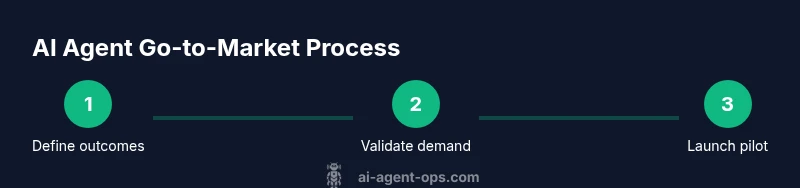
Define target outcomes and success metrics
Identify the specific problems the AI agent will solve and articulate measurable outcomes. Align outcomes with business goals and ensure stakeholders agree on what success looks like. Create a simple scorecard to evaluate pilots and post-launch performance.
Tip: Start with one high-value use case and define a clear ROI narrative. - 2
Map user personas and use cases
Develop distinct personas for decision-makers, operators, and end users. For each persona, outline 2–4 high-value use cases and map the buyer journey from discovery to adoption. Use these maps to tailor messaging and demos.
Tip: Use buyer journey templates to maintain consistency across teams. - 3
Build a minimal viable agent demo
Create a safe, working demonstration that showcases core capabilities with controlled data. The MVP should illustrate problem framing, action steps, and outcomes without exposing sensitive data. Prepare a sandbox environment for trials.
Tip: Keep the demo focused on value, not breadth of features. - 4
Validate demand with pilots
Launch lightweight pilots with a defined scope and time window. Collect feedback on value delivered, ease of use, and governance comfort. Document learnings and adjust scope or messaging as needed.
Tip: Use concierge-style pilots to reduce friction and accelerate learning. - 5
Define pricing and packaging
Develop tiered pricing that aligns with buyer budgets and procurement cycles. Include pilot options, usage-based components, and enterprise governance features. Test price sensitivity through landing pages and limited-time offers.
Tip: Anchor value in measurable outcomes to justify pricing. - 6
Plan channels and partnerships
Design channel playbooks for direct, marketplace, and partner routes. Prepare enablement materials, contracts, and joint marketing assets. Clear SLAs and support commitments reduce channel risk.
Tip: Leverage ecosystem partners to scale reach quickly. - 7
Establish governance and risk controls
Define data handling, consent, and audit trail policies. Implement guardrails, monitoring, and rollback procedures. Prepare documentation to support customer audits and regulatory inquiries.
Tip: Publish a transparent governance stance to build trust. - 8
Prepare GTM assets and launch plan
Assemble marketing collateral, demos, onboarding flows, and playbooks. Create a launch calendar aligned with procurement cycles and industry events. Ensure your tech stack supports rapid onboarding.
Tip: Coordinate cross-functional readiness early to avoid delays. - 9
Launch, monitor, and iterate
Execute the launch with pilots and marketing bursts. Monitor product usage, value realization, and governance adherence. Use feedback loops to refine messaging, pricing, and features for scale.
Tip: Treat the first 90 days as a learning period for rapid iteration.
Questions & Answers
What is an AI agent in this GTM context?
An AI agent in this context is a software component that can autonomously perform tasks, make decisions, or orchestrate workflows with user oversight. It operates within defined guardrails and governance to deliver measurable value.
An AI agent is a software component that can perform tasks and make decisions with user oversight, designed to deliver measurable value.
How can I validate demand for an AI agent quickly?
Use lightweight pilots and concierge tests, paired with targeted landing pages to gauge interest and willingness to try the agent. Collect feedback on usefulness and ease of integration to adjust scope fast.
Run small pilots and simple experiments to gauge interest and quick wins before a full rollout.
Who should be on the GTM team for AI agents?
A cross-functional team including product, marketing, sales, data/privacy, and customer success. Ensure governance and risk roles are clearly defined from the start.
Bring together product, marketing, sales, data privacy, and customer success to cover all GTM angles.
How should pricing be structured for AI agents?
Adopt a tiered pricing model with pilots, usage-based pricing for ongoing tasks, and an enterprise tier featuring governance and support. Validate with experiments and adjust as needed.
Use tiered pricing with pilot, usage-based, and enterprise options, validated through testing.
What governance issues should we address?
Address data privacy, consent, bias risk, auditability, and rollback procedures. Publish a governance stance to build customer trust and meet regulatory expectations.
Focus on privacy, consent, bias risk, auditability, and clear rollback processes.
Watch Video
Key Takeaways
- Define a clear value proposition for agentic AI.
- Validate demand with quick pilots and experiments.
- Build a scalable GTM with channels and partnerships.
- Measure outcomes and iterate to achieve repeatable growth.