AI Agent Adoption: A Practical Guide for Teams in 2026
A practical, step-by-step guide for developers, product teams, and leaders to plan, pilot, and scale AI agent adoption with governance, tooling, and measurable outcomes.


Goal: implement AI agent adoption across your organization with governance, shared practices, and measurable pilots. Start with 3–5 high-impact use cases, form a cross-functional adoption team, choose a flexible tooling stack, and establish governance and success metrics before scaling. This quick guide outlines the essential steps for 2026.
Why AI Agent Adoption Matters
AI agent adoption matters because it unlocks scalable automation, reduces manual toil, and enables faster decision-making across teams. According to Ai Agent Ops, adopting AI agents is best pursued with a deliberate, governance-driven approach that aligns with business goals and risk tolerance. When you treat AI agents as first-class components of your workflows, you can orchestrate agents alongside human tasks, ensuring accountability and traceability. This adoption mindset helps teams move from isolated pilots to repeatable, measurable improvements in how work gets done. In practice, AI agents can handle repetitive data processing, monitor systems, assist with customer interactions, and augment product development by prototype generation, testing, and deployment tasks. The most successful organizations connect adoption outcomes to business metrics, creating a shared language between engineers, product managers, and executives. By documenting use cases, setting guardrails, and enabling observability, you reduce the risk of surprise failures and create a foundation for continuous learning. The result is a climate where teams experiment responsibly and scale responsibly.
Brand note: Ai Agent Ops emphasizes governance, observability, and measurable outcomes as core pillars of adoption.
Core Concepts: AI Agents, Agentic AI, and Workflows
AI agents are software entities that can perform tasks autonomously or semi-autonomously, guided by prompts, policies, and access to data. Agentic AI refers to systems designed to reason across multiple steps, choose actions, and learn from outcomes within defined guardrails. In practice, teams build workflows where agents handle data gathering, decision support, automation, and orchestration alongside humans. A typical workflow combines input ingestion, agent reasoning, action execution, and result verification. Understanding these concepts helps teams design governance, monitoring, and rollback plans from day one. It also clarifies expectations about limits, failure modes, and accountability when agents operate in production. By aligning agent capabilities with business processes, developers can identify where agents add the most value and where human-in-the-loop oversight is essential. This foundation supports scalable adoption that remains controllable and auditable.
Building a Practical Adoption Roadmap
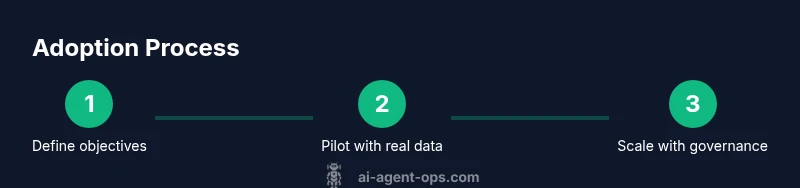
A practical adoption roadmap splits work into discovery, pilot, and scale phases. Start by mapping business problems to candidate agent use cases, then define success criteria and governance anchors. In the pilot phase, choose non-critical processes and a narrow data scope to validate reliability and safety. Ensure cross-functional representation from product, engineering, data, security, and operations. Create lightweight playbooks for provisioning, monitoring, and rollback. For scale, formalize guardrails, decision rights, and knowledge sharing practices. Emphasize modularity so new use cases can be added without rewriting the entire system. Finally, invest in training, documentation, and change management to build organizational capability that sustains adoption beyond a single project.
Governance, Risk, and Compliance for AI Agents
Governance for AI agents includes policy definitions for data privacy, access controls, and model governance. Establish risk assessment templates, incident response playbooks, and escalation paths for failures. Security reviews should cover data handling, authentication, and permissions, while compliance considerations vary by industry and region. A formal risk registry helps teams prioritize mitigations and track residual risk. Importantly, set clear accountability: who owns the agent’s decisions, who approves changes, and how decisions are audited. Regular audits, blue/green deployments, and defined rollback procedures reduce risk and increase trust in agent-enabled workflows. By embedding governance into the adoption lifecycle, organizations improve resilience, speed, and stakeholder confidence.
Data Readiness and Security Considerations
Data readiness is foundational for successful AI agent adoption. Ensure data quality, completeness, and lineage so agents have reliable inputs. Implement access controls, encryption, and data minimization to protect sensitive information. Data governance policies should define who can train, deploy, and modify agents, and how data is stored and deleted. Consider a privacy-by-design approach and obtain necessary approvals for data usage. Monitoring data drift and prompt quality helps maintain agent performance over time. Finally, establish incident response procedures for data-related issues and ensure that logs are stored for auditing and learning purposes.
Measuring Success: Metrics, ROI, and Value Realization
Measuring success requires a balanced set of indicators that reflect both technical and business outcomes. Track adoption metrics (number of active agents, use-case coverage) alongside operational metrics (cycle time, error rate, and retry frequency). Tie outcomes to business value by monitoring how agents influence throughput, cost, quality, and customer satisfaction. Use lightweight dashboards to visualize progress and enable continuous learning. Remember that ROI for AI agent adoption accrues as use cases scale and governance matures, not from a single pilot. Regular reviews with stakeholders ensure alignment and sustain momentum.
Common Pitfalls and How to Avoid Them
Common pitfalls include underinvesting in governance, treating pilots as finished products, and failing to involve stakeholders across teams. Avoid scope creep by maintaining a prioritized backlog and clear success criteria. Do not rush to production without guardrails, security reviews, and data governance. Keep human-in-the-loop for complex decisions and provide continuous training for teams on agent capabilities and limitations. Finally, document failures and lessons learned to prevent repeating mistakes and to accelerate future successes.
Starting Your First 90 Days: A Starter Playbook
In the first 30 days, align leadership, assemble a cross-functional team, and define 3–5 target use cases with clear success metrics. In the next 30 days, select tooling, establish governance, and run a pilot with real data in a controlled environment. In days 61–90, evaluate results, capture learnings, and prepare a scalable rollout plan with guardrails, training materials, and an ongoing improvement loop. Maintain transparency with stakeholders and share progress openly to build trust and momentum.
Tools & Materials
- Executive sponsorship and cross-functional steering committee(Clear mandate with budget authority and decision rights)
- Adoption framework and playbooks(Governance model, escalation paths, and success criteria)
- AI agent platform and tooling (PaaS/SaaS)(MLOps integration, orchestration, and observability)
- Data governance and access controls(Data lineage, privacy controls, and data access policies)
- Observability dashboards and alerting(KPIs, failure alerts, and audit trails)
- Training and change management resources(Workshops, runbooks, and user documentation)
- Security, compliance, and risk assessment templates(Threat modeling and regulatory checklists)
- Pilot plan with use-case backlog(Prioritized backlog with success criteria and timelines)
Steps
Estimated time: 4-8 weeks for initial pilot; full rollout 3-6 months depending on scope
- 1
Define objectives and success metrics
Clarify the business problems to solve with AI agents and specify measurable outcomes before any deployment.
Tip: Create a one-page objective and success criteria document. - 2
Assemble cross-functional adoption team
Bring product, engineering, data, security, and operations together; assign roles and responsibilities.
Tip: Appoint a product owner and governance liaison for accountability. - 3
Choose a baseline architecture and tooling
Select platforms and data interfaces that are modular and scalable to enable future use cases.
Tip: Prefer open standards to reduce vendor lock-in. - 4
Run a controlled pilot with real data
Pilot a non-critical process; validate data quality, guardrails, and monitoring in a safe environment.
Tip: Limit scope and duration to maintain focus and safety. - 5
Scale with governance and guardrails
Implement policies, escalation paths, and auditability as you expand use cases.
Tip: Document decision logs for future audits and learning. - 6
Measure, learn, and optimize
Review metrics, update prompts and workflows, and share learnings across teams.
Tip: Set a regular cadence for retrospective reviews.
Questions & Answers
What is AI agent adoption?
AI agent adoption is the process of integrating autonomous AI agents into business workflows with governance and clear success metrics to deliver measurable value.
AI agent adoption means adding autonomous AI agents to your workflows with rules and metrics to ensure value and safety.
What are essential prerequisites for adoption?
Successful adoption requires executive sponsorship, a cross-functional team, defined use cases, governance policies, and data readiness.
You need leadership support, a cross-functional team, clear use cases, governance, and ready data.
How long does an adoption program take?
Timelines vary by scope, but most programs progress from discovery to pilot, then scale over several weeks to months depending on complexity.
Timelines differ, but expect a few weeks for a pilot and several months to scale.
What metrics matter for AI agent adoption?
Metrics should cover adoption (active agents, use-case coverage), reliability (error rate, retries), and business impact (throughput, quality).
Track how many agents you use, how often they fail, and how they improve business outcomes.
Should teams build in-house or buy solutions?
The decision depends on capabilities, risk tolerance, and time to value. Start with a hybrid approach and evolve governance as maturity grows.
Consider both, but start with a hybrid approach and grow internal capability over time.
Watch Video
Key Takeaways
- Define clear adoption objectives and criteria.
- Assemble a cross-functional team with ownership.
- Prioritize governance and security from day one.
- Run pilots with measurable outcomes and learnings.
- Scale iteratively with guardrails and ongoing training.