Ai Agent Checklist: A Practical How-To Guide
Learn how to design and apply an AI agent checklist that guides governance, risk management, and deployment. This practical, educator-style guide helps developers, product teams, and leaders scale agentic AI with confidence and clarity.


By following an AI agent checklist, teams define goals, specify required capabilities, map data flows, and establish governance before building or deploying agentic systems. This practical 6-step approach helps reduce scope creep, align stakeholders, and speed up responsible deployment. Use clear criteria for evaluation, pilot plans, and ongoing monitoring to ensure measurable success.
Why AI agent checklists matter for teams
An AI agent checklist is not a one-size-fits-all form; it's a living framework that helps teams articulate objectives, set guardrails, and verify readiness before launch. According to Ai Agent Ops, disciplined checklists reduce rework, align stakeholders, and speed up responsible deployment. In practical terms, a good checklist captures five pillars: objectives, capabilities, data and governance, evaluation criteria, and operational readiness. When teams document these areas early, they create a shared language that scales with complexity: planning, training, integration, monitoring, and governance. The goal isn't to police every line of code but to ensure alignment with business outcomes, risk tolerance, and regulatory requirements. With an AI agent in production, you are effectively entrusting automated decision-making to systems that learn and adapt. A checklist helps you create transparency, traceability, and accountability across every stage of the lifecycle.
Key reasons to use a checklist include preventing scope creep, clarifying who approves changes, and providing a baseline for audits. It also creates a repeatable starting point for pilots, A/B tests, and phased rollouts. When the checklist is well designed, it becomes a shared contract between engineers, data scientists, product managers, security teams, and executives. The Ai Agent Ops team emphasizes that the checklist should be lightweight enough to be practical, but rigorous enough to surface gaps early. In practice, you’ll use the checklist as a decision gate: if criteria aren’t met, you pause, reassess, or adjust scope. If criteria are met, you proceed with confidence, knowing you’ve captured critical risks and success indicators.
Core components of an ai agent checklist
A robust ai agent checklist rests on clear governance and practical, repeatable criteria. At its heart are five pillars that guide every decision: objectives and success criteria, required capabilities and constraints, data governance and security, evaluation and testing protocols, and operational readiness including monitoring and incident response. For each pillar, teams should capture explicit questions, owners, deadlines, and evidence. This structure makes it easier to onboard new team members, align cross-functional stakeholders, and demonstrate progress to leadership. A well-scoped checklist also reduces ambiguity around who can approve changes and what constitutes a “done” state. The governance layer should reference policy documents, risk tolerance thresholds, and regulatory requirements where applicable. In practice, you’ll want to maintain a living document—updated as learning occurs, not a static artifact. By codifying expectations up front, you accelerate safe experimentation while preserving accountability across engineering, product, security, and compliance teams.
Categories to cover in your checklist
To keep a checklist usable, organize it into focused categories that map to real-world workstreams. Essential categories include: 1) Strategic alignment and objectives; 2) Data integrity, privacy, and provenance; 3) Capabilities and worst-case behavior; 4) Safety, ethics, and bias mitigation; 5) Compliance, auditing, and governance; 6) Testing, validation, and runbooks; 7) Deployment readiness and rollback plans; 8) Monitoring, observability, and incident response. Within each category, list concrete questions (e.g., “Are data sources licensed and compliant?”) and concrete evidence (e.g., data lineage diagrams, test results). This modular approach enables teams to tailor the checklist for different use cases—ranging from customer support agents to autonomous decision systems—without losing consistency or oversight. Incorporating diverse stakeholder input early—with owners for each category—ensures coverage of technical, legal, and business perspectives. As you grow, keep a lightweight review cadence to refresh these categories as policies, risks, and technologies evolve.
Step-by-step framework you can follow
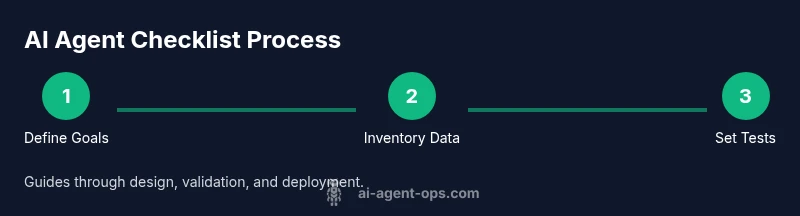
A practical framework helps translate the checklist into executable work. Start by framing the problem, then align on success criteria, identify required capabilities, map data flows, establish governance, design tests, run a pilot, and finally monitor and iterate. Each phase requires distinct artifacts: a goal statement, capability matrix, data inventory, governance policy, test plans, pilot plan, and monitoring dashboards. Maintain a living risk register and ensure owners sign off at each gate. Time-saving tip: reuse existing templates where possible and document decisions with rationale to support future audits. By adhering to this structured flow, you reduce ambiguity, improve collaboration, and create a scalable process for deploying agentic AI responsibly.
Tailoring the checklist to different AI agent types
Different AI agents have different failure modes and responsibilities. A planning or reasoning agent benefits from explicit guardrails on decision boundaries and explainability, while a perceptual or action agent emphasizes data quality and real-time monitoring. A hybrid agent, combining multiple capabilities, should inherit a composite checklist that includes cross-component interfaces and integrated testing. When tailoring, start with core categories, then add specialized checks for your domain—finance, healthcare, or customer service. Ensure that alignment with business goals is explicit in each tailored version: what problem is solved, for whom, and at what cost. Finally, institutionalize periodic reviews to retire obsolete checks and introduce new ones as technology and risk contexts evolve.
Governance, risk, and compliance considerations
Governance is not a checkbox; it is an ongoing discipline. Your ai agent checklist should embed risk assessment, data governance, privacy, security, and compliance controls. Define escalation paths for incidents, including clear ownership, response times, and post-incident reviews. Build in bias detection and fairness checks appropriate to your domain. Document data provenance and lineage to satisfy audits and regulatory demands. Establish an evidence-based evaluation framework with reproducible tests and objective metrics. Finally, ensure that governance requirements scale with deployment; what works for a pilot may need expansion for production. By embedding governance early, you reduce the likelihood of costly rework and create a defensible baseline for scaling agentic AI.
Templates and artifacts you can reuse
Templates are powerful because they accelerate setup and maintain consistency across teams. Reusable artifacts include a goal-and-scope brief, a capability matrix, a data inventory with lineage, a governance policy, a risk register, test plans, and a pilot playbook. Each artifact should include owners, due dates, and a lightweight version history. Consider turning templates into living documents stored in a central collaboration space, with a writable audit trail. When organizations adopt standardized templates, they reduce onboarding time for new teams and maintain uniform risk controls across projects. Ai Agent Ops suggests starting with a minimal viable checklist, then expanding sections as you learn what matters most in your environment.
How to implement and iterate the checklist in your organization
Implementation starts with executive sponsorship and a clear rollout plan. Distribute the checklist to product, engineering, security, and data teams; designate owners for each category; and set a cadence for reviews and updates. Use the pilot phase to validate the checklist's effectiveness, capturing lessons learned and adapting the artifacts accordingly. Track adoption through simple metrics like time-to-sign-off, number of identified gaps, and pilot outcomes. Iterate quarterly or after major project milestones, incorporating feedback from stakeholders and updating governance controls as needed. The goal is a sustainable, evidence-based process that improves with use while remaining lightweight enough to stay practical for fast-moving teams.
Tools & Materials
- Project charter or brief(Defines scope, objectives, stakeholders, and success criteria.)
- Checklist template (Notion/Jira/Sheets)(Collaborative, versioned, and easy to customize.)
- Data inventory and lineage document(Tracks data sources, quality, privacy considerations, and lineage.)
- Risk assessment framework(Helps quantify and prioritize mitigation actions.)
- Governance and policy documents(Covers compliance, ethics, and audit readiness.)
- Stakeholder contact list(Keeps escalation paths and approvals clear.)
- Pilot plan template(Guide for running a controlled, measurable pilot.)
- Monitoring dashboards(Provides visibility into performance and incidents.)
Steps
Estimated time: 45-90 minutes
- 1
Define objective and scope
Articulate the problem the AI agent will solve, success criteria, and boundaries. Align with business goals and identify primary risk areas.
Tip: Document the decision rationale and expected impact to support audits. - 2
Identify agent types and capabilities
Map the required behaviors, decision boundaries, and interfaces. Distinguish between planning, perceptual, and action components.
Tip: Create a capability matrix to avoid feature creep. - 3
Inventory data and governance needs
List data sources, privacy implications, provenance, and retention policies. Define access controls and security requirements.
Tip: Prioritize data quality and lineage for trust. - 4
Draft evaluation criteria and tests
Define objective metrics, success thresholds, and test scenarios (including edge cases). Plan both functional and non-functional tests.
Tip: Include bias and fairness checks where relevant. - 5
Plan pilot and governance controls
Create a pilot plan with a containment strategy, rollback path, and incident response protocol. Assign owners for each control.
Tip: Limit pilot scope to reduce risk and speed feedback. - 6
Pilot, monitor, and iterate
Run the pilot, collect evidence, adjust the checklist as needed, and scale with confidence once thresholds are met.
Tip: Publish a post-pilot review to share learnings.
Questions & Answers
What is an AI agent checklist?
An AI agent checklist is a structured set of criteria used to evaluate readiness, governance, data quality, and compliance before deploying an AI agent. It helps teams align stakeholders, reduce risk, and demonstrate responsible deployment.
An AI agent checklist is a structured guide to ensure readiness, governance, and safe deployment of AI agents.
How does it improve governance?
By codifying decision rights, data lineage, and risk controls, the checklist provides auditable evidence of due diligence. It clarifies ownership and escalation paths during incidents and changes.
It creates auditable records and clear ownership for decisions and changes.
Can it be used in enterprise settings?
Yes. Tailor the checklist to organizational policy, regulatory requirements, and risk appetite. Include cross-functional owners and periodic reviews to maintain relevance.
Absolutely—adapt it to policy, regulation, and cross-team governance.
What are common pitfalls?
Overly complex templates, missing data provenance, and skipping early governance reviews. Start with essential checks and expand as you learn.
Don't overcomplicate; start simple and build up with lessons learned.
How do you start building one?
Begin with objectives, key stakeholders, and a minimal data inventory. Add governance and tests in a phased approach, then pilot and iterate.
Begin with goals, owners, and data, then expand with governance and tests.
Watch Video
Key Takeaways
- Define scope before building
- Organize by governance and data pillars
- Use templates to accelerate adoption
- Pilot and iterate with metrics
- Embed accountability across teams