AI Agent Security Checklist: Protecting Agentic AI in Production
A developer-focused, comprehensive guide to building and maintaining secure AI agents, covering risk assessment, data governance, deployment, and incident response with a practical security checklist.


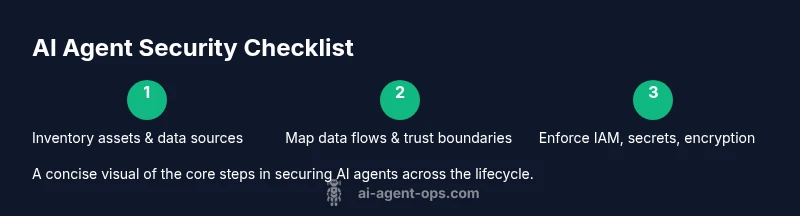
Build a rigorous ai agent security checklist by inventorying assets, mapping data flows, classifying risks, and enforcing controls across identity, data handling, and monitoring. Establish encryption, secrets management, access governance, and audit trails; implement secure deployment and incident response; and schedule regular reviews to keep defenses aligned with threat landscapes.
Why ai agent security matters
In modern software ecosystems, AI agents act as autonomous decision-makers that interact with sensitive data, external services, and end-user workloads. A security lapse in an agent can propagate across connected systems within minutes, exposing data, credentials, and operational capabilities. This makes a formal ai agent security checklist essential for product teams, developers, and operators who want reliable automation without compromising safety.
According to Ai Agent Ops, the most effective guardrails start in design and continue through deployment. A disciplined checklist aligns product goals with security objectives, enabling teams to identify gaps early and allocate resources accordingly. When you standardize on a defensible baseline, you reduce the blast radius of incidents and improve your ability to recover from failures.
Beyond compliance, a rigorous checklist supports trust with customers and partners. Businesses deploying agentic AI must demonstrate that data handling, model updates, and system boundaries are governed by repeatable practices. The ai agent security checklist described here emphasizes practical steps, concrete artifacts, and measurable outcomes rather than abstract theory. By applying these principles, you’ll create safer automations that scale with your organization, while keeping speed and agility intact.
Scope of the ai agent security checklist
This checklist covers (1) identity and access management for agents and users, (2) data governance and privacy controls, (3) model and environment security, (4) secure deployment and lifecycle practices, (5) monitoring, auditing, and incident response, and (6) governance and continuous improvement. It’s designed for teams using agentic AI in production, across cloud and on-prem environments. Use it as a living document that evolves with threat models, regulatory changes, and product evolution. Related areas include third-party risk, supply chain integrity, and policy-driven automation that enforces security at runtime.
Core security controls you must implement
- Identity and access management: enforce least privilege, robust authentication, and role-based access controls for all agents and humans.
- Secrets management: store credentials and API keys in a centralized vault; rotate regularly and avoid hard-coding secrets.
- Data encryption: encrypt data at rest and in transit; apply strict key management and rotation policies.
- Audit trails: log all agent actions, data access, and configuration changes with immutable records.
- Network security: segment agent environments, restrict outbound connections, and use zero-trust networking where possible.
- Secure coding and dependencies: pin dependencies, perform regular vulnerability scans, and enforce SBOMs for components.
- Monitoring and alerting: implement centralized telemetry, anomaly detection, and incident alerts with clear escalation paths.
- Incident response readiness: maintain runbooks, rehearsals, and post-incident reviews to learn and improve.
Data governance and privacy considerations
Protecting data in AI agent workflows means minimizing data exposure and ensuring appropriate handling of PII and sensitive information. Implement data classification to tag data by sensitivity, enforce data minimization (collect only what’s needed), and apply privacy-preserving techniques where feasible. Establish retention policies, secure deletion, and access controls that reflect data sensitivity. When third parties are involved, ensure data processing agreements are in place and that data flows are documented and auditable.
Threat modeling for AI agents
Begin with a structured threat model to identify potential attack surfaces. Use frameworks like STRIDE to categorize threats such as spoofing, tampering, repudiation, information disclosure, denial of service, and elevation of privilege. Consider data poisoning, prompt injection, model inversion, and supply chain risks from model and code provenance. Regularly update threat models to reflect new capabilities, deployment environments, and data sources. The goal is to translate threats into concrete controls and tests.
Secure deployment and lifecycle management
Adopt a secure deployment pipeline with immutable artifacts, signed images, and reproducible builds. Scan for vulnerabilities in dependencies, monitor for newly disclosed CVEs, and enforce automated patching where safe. Use infrastructure as code (IaC) with policy checks, enforce runtime boundaries, and segregate agent processes from control planes. Maintain a clear lifecycle for models and data, including versioning, rollback procedures, and deprecation strategies.
Incident response planning and drills
Prepare for incidents with a documented runbook covering detection, containment, eradication, and recovery. Define roles, communication plans, and escalation paths. Run regular drills that mirror realistic attack scenarios, including data leakage, model misuse, and credential compromise. After drills, perform blameless post-mortems to identify gaps and update the checklist accordingly.
Practical templates and checklists you can reuse
Templates help teams adopt a consistent approach. Key templates include: asset inventory sheet, data classification rubric, threat model template, runbook for common incidents, and a compliance checklist aligned with your regulatory needs. Customize templates for your tech stack, data flows, and risk tolerance to accelerate secure adoption.
Governance, metrics, and ongoing improvement
Security is a continuous effort. Establish governance with measurable metrics such as mean time to detection (MTTD) and mean time to recovery (MTTR), posture scoring, and quarterly security reviews. Align the ai agent security checklist with product roadmaps and risk appetite. The Ai Agent Ops team recommends embedding security into every sprint, ensuring the baseline remains effective as agents evolve.
Tools & Materials
- Checklist template (digital, editable)(Keep versioned; use a central doc for all teams)
- Secrets management tool(Examples: vaults or cloud KMS with rotation)
- Centralized logging/monitoring platform(Must support alerting and retention policies)
- Identity and access management (IAM) system(Enforce least privilege and MFA)
- Data classification rubric(Defines sensitivity levels and handling rules)
- Threat modeling methodology(Choose STRIDE or equivalent; document threat catalog)
- Incident response runbooks(Include contact lists, playbooks, and recovery steps)
- Asset inventory and network diagram(Visually map data flows and dependencies)
Steps
Estimated time: 2 hours
- 1
Inventory AI agents and data assets
Identify every agent, its data sources, and data recipients. Document ownership and security requirements for each asset.
Tip: Use automated discovery where possible to avoid missing assets. - 2
Map data flows and access points
Create a data flow diagram showing how data moves between agents, users, and services. Highlight trust boundaries and external integrations.
Tip: Label data types and retention rules to simplify later reviews. - 3
Classify data by sensitivity and risk
Assign sensitivity levels (e.g., public, internal, confidential) and align handling rules with policy.
Tip: Prioritize protections for high-sensitivity data first. - 4
Enforce least privilege and authentication
Ensure agents and users have only the permissions they need; enable MFA and strong session controls.
Tip: Regularly review and remove unused permissions. - 5
Implement secrets management and encryption
Store credentials in a secure vault and rotate regularly; encrypt data at rest and in transit.
Tip: Avoid exposing keys in logs or error messages. - 6
Instrument logging, monitoring, and alerts
Centralize logs, set anomaly alerts, and test alert routing to on-call engineers.
Tip: Use tamper-evident logs and secure log storage. - 7
Define incident response and run drills
Publish a runbook with roles, steps, and comms; run tabletop exercises and full drills.
Tip: Document lessons learned and update the checklist after each drill.
Questions & Answers
What is AI agent security checklist?
A structured set of practices and artifacts to protect AI agents, their data, and the environments they operate in. It covers identity, data handling, deployment, monitoring, and incident response.
It's a structured guide to protect AI agents across identity, data, deployment, and incident response.
How do I start building one?
Begin with asset inventory, data flow mapping, and risk classification. Then implement core controls like IAM, secrets management, and logging, followed by incident response planning.
Start with asset inventory and data flow mapping, then add core controls and an incident plan.
Which standards apply to ai agent security?
Apply organizational security policies and align with common governance frameworks, privacy regulations, and industry best practices relevant to your domain.
Follow your organizational policies and relevant privacy and security frameworks.
How often should the checklist be reviewed?
Review and update the checklist at least quarterly, or after major model updates, data source changes, or security incidents.
Review it quarterly or after big changes.
Can I automate parts of the checklist?
Yes. Automate data discovery, vulnerability scanning, and drift detection where possible, while keeping human oversight for risk judgments.
Automate discovery, scans, and drift checks, with human oversight for risk decisions.
Watch Video
Key Takeaways
- Define a security baseline early and maintain it.
- Map data flows to reveal exposure points.
- Automate reviews and governance in sprints.
- Drill incident response to improve readiness.
- Treat security as an ongoing governance discipline.