How to Protect AI Agents: A Practical Guide
Learn practical strategies to safeguard AI agents from misuse, data leakage, and manipulation. Covers governance, access control, monitoring, and incident response.


You will learn how to protect AI agents from data leakage, adversarial manipulation, and policy violations. The steps cover threat modeling, secure deployment, access control, encryption, monitoring, incident response, and ongoing compliance checks to maintain trust and reliability across cloud, edge, and hybrid environments. This framing aligns with Ai Agent Ops' standards for responsible AI and governance.
Why Protect AI Agents Matters
AI agents increasingly handle sensitive data, make decisions in real time, and interact with users, creating a broad attack surface. Protecting AI agents is not optional; it is essential to preserve trust, ensure regulatory compliance, and maintain operational resilience. For many teams wondering how to protect ai agents, the first step is recognizing where data flows, what decisions are made, and who can access the agent. According to Ai Agent Ops, security must be engineered in from the design phase and continuously enforced through deployment, feedback loops, and audits. A robust protection strategy aligns governance, engineering, and product management around shared objectives such as confidentiality, integrity, and availability. Start by mapping every data source the agent can read, every token or credential it uses, and every context in which it runs—from cloud services to edge devices. With this clarity, you can select, implement, and verify the controls that keep AI agents safe and reliable at scale.
Threat Model for AI Agents
To protect ai agents, you must understand potential threats across data, models, and deployment contexts. Threats include data leakage through logs or prompts, prompt injection that manipulates behavior, model theft or cloning via exposed APIs, adversarial inputs that degrade performance, and misconfiguration that creates silent backdoors. Supply chain risks—like compromised training data, third-party components, or insecure dependencies—also threaten agent integrity. Operational risks include drift in behavior, insufficient monitoring, and insecure secret storage. Ai Agent Ops highlights that a practical threat model anchors security choices in real-world scenarios: what data the agent processes, where it runs, who or what can interact with it, and how quickly you can detect anomalies. By enumerating assets, attackers, and attack paths, you create a prioritized defense plan rather than a reactive patchwork.
Governance and Policy Framework
Protection for AI agents requires formal governance that translates security into everyday practice. Establish a policy framework that defines data classifications, retention, access rights, and incident handling. Include roles and responsibilities for data stewards, security engineers, and product owners, plus a clear escalation path for suspected abuse or policy violations. Require audits and traceability for every decision point the agent can influence, and enforce least privilege across all agent interactions. Ai Agent Ops encourages organizations to publish a living security policy and to align it with regulatory expectations (for example, privacy, data minimization, and logging standards). Regular reviews, cross-functional training, and executive sponsorship help sustain the culture of protection and reduce the likelihood of risky deployments.
Access Control and Identity Management
Access control is foundational to protecting AI agents. Implement strong authentication for humans and service-to-service interactions, with multi-factor authentication where feasible and short-lived credentials for workflows. Use role-based or attribute-based access control to limit what each agent and operator can do. Centralize identity management so permissions are updated consistently across environments, and ensure that API keys, tokens, and secrets are stored in a dedicated vault with strict rotation policies. Enforce network segmentation to minimize blast radius and apply zero-trust principles whenever possible. Regularly review access logs and anomaly signals to detect unexpected changes in permission sets or usage patterns.
Data Protection and Secrets Management
Data protection begins with classification, encryption, and minimization. Encrypt data at rest and in transit, apply tokenization where sensitive fields are exposed, and implement robust secrets management to protect API keys, credentials, and other sensitive material. Use automatic rotation, short-lived credentials, and secure storage with access controls. Keep training and evaluation data segregated from production data, and apply data governance practices that prevent leakage through model outputs or logs. Consider data retention policies that balance analytics needs with privacy requirements, and ensure that data handling complies with applicable regulations and internal policies.
Monitoring, Logging, and Anomaly Detection
Continuous visibility is essential to protect ai agents. Implement centralized logging, structured metrics, and traceable event trails that cover inputs, decisions, and outputs while respecting user privacy. Use anomaly detection to flag unusual prompts, unexpected policy violations, or data access patterns. Calibrate alert thresholds to balance false positives with timely response. Regularly test monitoring pipelines and ensure log integrity through tamper-evident storage. Establish dashboards that reveal risk indicators, such as credential usage, secret access, and pattern drift in agent behavior. Documentation of all monitoring rules enables faster investigations and audits.
Incident Response and Recovery
Even with strong protections, incidents can occur. Develop an incident response plan that defines roles, communication templates, and escalation steps. Create runbooks for common scenarios—data leakage, prompt manipulation, credential compromise—and rehearse them through tabletop exercises or live drills. Ensure you can quickly revoke access, rotate secrets, and restore safe configurations. After containment, conduct a post-incident review to identify root causes and update controls accordingly. Align recovery objectives with business impact to minimize downtime and customer impact.
Secure Deployment and Update Practices
Secure deployment practices reduce exposure during software updates and model refreshes. Integrate security checks into CI/CD pipelines, including static and dynamic analysis, dependency scanning, and SBOM generation. Use signed packages and verified model weights, and validate configuration changes in a staging environment before production. Maintain an immutable deployment footprint and audit changes through version control and automated rollback capabilities. Keep supply chain controls up to date to prevent dependency tampering and ensure that monitoring and alerting continue to function across releases.
Validation, Testing, and Compliance
Regular validation, testing, and compliance verification are essential parts of protecting ai agents. Conduct threat-informed testing, red teaming, fuzzing of prompts, and stress tests to reveal weaknesses. Validate encryption, access controls, and data handling against defined classifications. Document and preserve evidence of compliance with internal policies and external regulations. Use metrics to monitor protection efficacy over time and adjust controls as needed. This discipline helps ensure that the protective measures remain effective even as agents evolve.
Practical Checklist for Everyday Protection
To operationalize the above guidance, adopt a concise, actionable checklist that product teams and security engineers can use daily. Start with defining data flows and access rights, then implement encryption, secrets management, and robust logging. Maintain a living governance document, run quarterly risk assessments, and schedule regular security reviews of agent components and integrations. Finally, empower teams to report concerns promptly and to rehearse incident response regularly. Following this checklist keeps AI agents protected without sacrificing performance or user experience.
Tools & Materials
- Threat modeling framework (e.g., STRIDE)(Document attack surfaces for each AI agent and data path)
- Identity and access management (IAM) system(Centralize user/service access with role-based controls)
- Secrets management tool(Store and rotate API keys, tokens, and credentials securely)
- Encryption library (at rest/in transit)(Use industry-standard algorithms and key management)
- Secure CI/CD pipeline(Integrate static/dynamic analysis and dependency checks)
- Audit logging system(Capture identity, access, and decision traces)
- Security testing suite(Include red-team, fuzzing, and simulated attacks)
- Data governance policy(Classify data and define retention and disposal rules)
Steps
Estimated time: 3-6 hours
- 1
Define Protection Goals
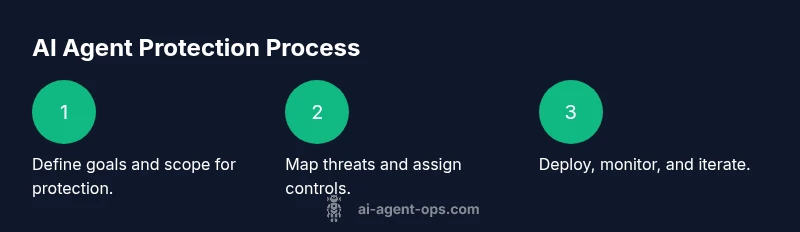
Articulate what needs protecting (data, decisions, access) and what acceptable risk looks like for each AI agent. Align goals with business objectives and regulatory requirements to ensure buy-in from stakeholders.
Tip: Document success criteria and tie protections to concrete metrics. - 2
Model Threats
Create a practical threat model focusing on data flows, agent interfaces, and third-party components. Prioritize risks by potential impact and likelihood to guide controls.
Tip: Use a simple matrix to rank risks and map to controls. - 3
Establish Access Controls
Enforce least privilege for users and services. Implement MFA, role-based/attribute-based access, and centralized secret management with rotation policies.
Tip: Review access monthly and after major changes. - 4
Secure Data Flows
Classify data, apply encryption, and minimize data exposure in logs and prompts. Separate production data from training data with strict controls.
Tip: Mask sensitive fields in logs and prompts. - 5
Harden Agent Deployment
Lock down configurations, sign weights and code, and verify integrity before deployment. Use immutable deployments where possible.
Tip: Implement automated integrity checks on every release. - 6
Implement Monitoring
Centralize telemetry for inputs, decisions, and outputs. Set anomaly detectors and alerting tuned to minimize noise.
Tip: Test alerts against known edge cases to reduce false positives. - 7
Prepare Incident Response
Define roles, runbooks, and communication templates. Practice drills to validate time-to-containment and recovery.
Tip: Keep runbooks version-controlled and accessible. - 8
Review and Iterate
Regularly review controls, update policies, and adjust defenses as agents evolve and threats change.
Tip: Schedule quarterly governance reviews with cross-functional teams.
Questions & Answers
What is AI agent protection and why is it important?
AI agent protection refers to the set of practices that safeguard agents' data, decisions, and interfaces from misuse or failure. It is critical to prevent data leakage, manipulation, and outages that could harm users and the business.
AI agent protection is about guarding data, decisions, and interfaces from misuse to prevent leaks and failures.
How do I implement access controls for AI agents?
Implement least privilege, MFA, and centralized secret management. Use RBAC or ABAC to restrict actions and regularly review permissions.
Use least privilege with multi-factor authentication and centralized secret management.
What monitoring is essential for AI agents?
Centralize logs, collect structured metrics, and enable anomaly detection for prompts, data access, and decisions. Regularly test and audit monitoring pipelines.
Centralized logs and anomaly detection are key to spotting unusual agent behavior.
How can I handle data governance with AI agents?
Classify data, define retention, ensure privacy, and separate training data from production data. Maintain policies that align with regulations.
Classify and govern data with clear retention and privacy policies.
What should I include in incident response for AI agents?
Define roles, templates, and runbooks for common incidents. Practice drills and post-incident reviews to improve defenses.
Have an incident plan with roles and regular drills.
How often should governance and security policies be reviewed?
Review policies quarterly and after major changes to agents, data sources, or regulatory requirements.
Review policies every quarter or after major changes.
Watch Video
Key Takeaways
- Define protection goals with business alignment.
- Model threats before building safeguards.
- Enforce least privilege and strong authentication.
- Protect data with encryption and secrets management.
- Plan for incidents and practice recovery.