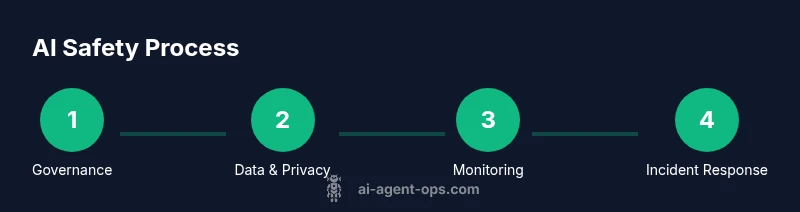
How to Prevent Artificial Intelligence: A Practical Guide to Safe AI
A comprehensive, step-by-step guide to preventing artificial intelligence misuse through governance, safeguards, and continuous monitoring—designed for developers, product teams, and business leaders.


To prevent artificial intelligence misuse, establish layered governance, safety controls, and continuous monitoring. Start with clear objectives, ethical guardrails, and risk assessments. Implement data governance, access controls, model monitoring, and incident response. Align teams with compliance, explainability, and accountability. This guide provides practical steps, tools, and best practices to reduce risk while enabling productive AI use.
Core Principles for Preventing Artificial Intelligence Risks
According to Ai Agent Ops, preventing artificial intelligence risks starts with clarity: define purpose, identify stakeholders, and implement guardrails that align with ethical and legal norms. The core principles below build a foundation for responsible AI use across teams and stages of development. Emphasize explicit objectives and guardrails, apply layered safeguards across data, models, and operational processes, and maintain continuous feedback loops to catch drift early. Accountability should be baked into every decision, with transparent communication channels for stakeholders. This combination creates a resilient baseline for any AI initiative and sets expectations for performance and safety.
- Clear objectives and guardrails provide a compass for all AI work and help prevent scope creep.
- Layered safeguards across data, model, and operational layers reduce single-point failure risk.
- Continuous monitoring and feedback enable rapid detection of anomalies and drift.
- Transparency and accountability foster trust among users, regulators, and partners.
- Inclusive risk assessment ensures diverse perspectives shape safety requirements.
Why this matters for how to prevent artificial intelligence misuse: a strong foundation reduces the chance of unintended consequences as AI systems scale across teams and use cases.
Ai Agent Ops note: governance decisions should be revisit-able as new risks emerge.
Governance and Oversight Framework
A robust governance framework aligns technical controls with organizational policy. Start by defining roles (responsible owner, reviewer, approver), establishing a cross-functional ethics and risk committee, and codifying decision rights in written policies. Create a safety charter that covers data usage, model selection criteria, monitoring requirements, and escalation procedures. Regularly review policies against evolving regulations and industry standards. Tie governance to measurable outcomes (risk reduction, audit readiness, and user trust) to keep efforts tactical and outcome-focused.
- Establish a governance charter that documents scope, authority, and accountability.
- Form a cross-functional committee that includes product, legal, security, and ethics representatives.
- Use decision logs and versioned policies to maintain traceability.
- Schedule regular governance reviews to adapt to new AI capabilities.
- Align governance with regulatory expectations and industry best practices.
Important: governance should scale with your AI program, not remain a one-off exercise.
Technical Safeguards: Data, Models, and Ops
Technical safeguards must cover the full lifecycle of AI systems. Start with data governance: ensure data provenance, privacy protections, and clean labeling. Enforce model integrity with access controls, versioning, and drift detection. Operational safeguards include deployment gates, anomaly alerting, and robust incident response playbooks. Remember that explainability is not a luxury; it’s a practical mechanism for auditing decisions. Implement automated checks at every stage—from data ingestion to model rollout—to catch issues before they affect users.
- Data provenance and privacy controls prevent leakage and misuse.
- Model versioning and access controls reduce unauthorized changes.
- Drift detection and continuous evaluation catch performance degradation.
- Deployment gates and anomaly alerts slow down risky releases until validated.
- Explainability supports auditing and user understanding of AI decisions.
How this ties to how to prevent artificial intelligence misuse: technical safeguards are the frontline defense against unsafe or biased outcomes.
People, Process, and Culture
People drive the effectiveness of any safety program. Invest in training for engineers, product managers, and operators on AI ethics, safety guardrails, and incident response. Define processes for risk assessment, change management, and post-incident reviews. Cultivate a culture of psychological safety so team members can raise concerns without fear of reprisal. Create clear escalation paths and a feedback loop from frontline operators to governance authorities. Regular tabletop exercises help teams rehearse responses to potential AI incidents and improve readiness over time.
- Offer ongoing ethics and safety training for all AI-related roles.
- Document risk assessment processes and decision-making criteria.
- Foster a culture that encourages speaking up about potential issues.
- Use drills and simulations to improve incident response readiness.
- Align performance metrics with safety and reliability goals.
Key takeaway for teams: safety requires both competent people and repeatable processes.
Practical Controls: Checklists and Incident Response
Operational checklists translate policy into daily practice. Start with development checklists that verify data governance, model controls, and privacy protections before code is merged. Extend to deployment checklists that require monitoring, alerting, and rollback procedures. Prepare incident response playbooks with clear roles, contact trees, and decision criteria. Exercise incident simulations to refine detection thresholds and escalation paths. These practical controls form a safety net that reduces the likelihood of unsafe outcomes reaching end users.
- Build checklists for data, model, and deployment phases.
- Define alert thresholds and automatic rollback triggers.
- Create incident response playbooks with step-by-step actions.
- Conduct regular drills to validate readiness and update playbooks.
- Document lessons learned to improve future safety controls.
Note on collaboration: safety is a team sport—ensure stakeholders across functions participate.
Measuring Success: Metrics and Auditing
Measuring progress is essential to validate prevention efforts. Track process metrics (policy coverage, review cadence), technical metrics (drift detection rate, incident response time), and outcome metrics (reduction in high-risk incidents, user trust indicators). Establish an auditing program that combines internal audits with external reviews to provide objective insights. Continuous improvement should be built into the cadence: revise guardrails as new data, models, and use cases emerge. Ai Agent Ops analysis shows that layered governance improves safety outcomes when combined with rigorous monitoring and transparent reporting.
- Use a balanced scorecard approach to monitor governance and safety.
- Quantify drift detection effectiveness and incident response efficiency.
- Schedule regular internal and external audits for independent validation.
- Prioritize remediation plans based on risk impact and feasibility.
- Maintain transparent reporting to stakeholders and regulators.
Common Pitfalls and How to Avoid Them
Avoid overengineering or under-communicating safety requirements. Do not treat governance as a checkbox; it must be embedded into product teams’ workflows. Beware scope creep that expands AI adoption without commensurate safeguards. Don’t rely on a single monitoring tool—diversify controls to cover data, model, and operational layers. Finally, resist the urge to generalize guardrails across all use cases; tailor a risk-based approach to each domain and audience. Regularly revisit assumptions as technology and regulations evolve.
- Guardrails must align with real-world use cases.
- Do not rely on one tool or vendor for safety.
- Revisit risk models as data, models, and users change.
- Maintain ongoing training and awareness across teams.
- Document decisions and trade-offs for future reference.
Putting It All Together: A Runbook for Your Organization
A practical runbook translates theory into action. Start with governance setup, then implement data and model safeguards, followed by deployment controls and incident response. Schedule quarterly governance reviews, monthly drift checks, and annual policy updates. Build an evidence trail for regulators and stakeholders with auditable logs and transparent reports. This runbook should be living, evolving with new AI capabilities and emerging risks. By following these steps, organizations can advance how to prevent artificial intelligence misuse while maintaining progress and innovation.
- Phase 1: establish governance and policies.
- Phase 2: implement data and model safeguards.
- Phase 3: deploy controls and monitoring.
- Phase 4: test incident response and governance cadence.
- Phase 5: audit, report, and improve.
Next Steps and Resources
To implement these concepts in your organization, start by mapping your AI lifecycle, identifying risk points, and assigning owners. Develop a lightweight pilot to validate governance, testing, and monitoring approaches. Use guardrails that reflect legal and ethical standards while enabling experimentation. For further learning, consult standards from reputable institutions and align with industry best practices. The path to safer AI is iterative and collaborative, but it starts with a clear plan and accountable teams.
Tools & Materials
- Risk assessment framework(Template aligned with your organization’s risk tolerance and regulatory context)
- Policy templates for governance and safety(Documents covering data usage, model governance, and incident response)
- Code review checklist for AI guardrails(Checklist for data handling, bias checks, and explainability)
- Model monitoring tooling (drift detection)(Choose from open-source or vendor solutions; ensure integration with CI/CD)
- Access control and authentication system(Role-based access controls and least-privilege & MFA)
- Incident response playbooks(Optional but recommended for rapid containment and recovery)
- Audit and logging solutions(Retention policies and tamper-evidence)
Steps
Estimated time: 2-3 hours
- 1
Define governance objectives
Draft a governance charter that clearly states the scope, decision rights, and accountability for AI initiatives. Include ethical guardrails, regulatory alignment, and expected safety outcomes. This step sets the tone for all later actions.
Tip: Document success criteria and obtain cross-functional sign-off. - 2
Identify risk domains
List the main risk areas for your AI program, such as data privacy, bias, security, safety, and regulatory compliance. Prioritize domains based on potential impact and likelihood.
Tip: Use a risk heat map to visualize where to focus controls. - 3
Assemble a governance team
Create a cross-functional team with representatives from product, legal, security, engineering, and ethics. Define roles such as owner, reviewer, and approver for AI decisions.
Tip: Establish meeting cadence and decision logs for traceability. - 4
Assess data quality and privacy
Evaluate data sources for provenance, labeling accuracy, and privacy protections. Implement data governance controls, including access restrictions and audit trails.
Tip: Run privacy impact assessments on sensitive datasets. - 5
Implement data governance controls
Apply data minimization, cleansing, and anonymization techniques. Enforce data handling policies and retention rules across the data lifecycle.
Tip: Automate data lineage tracking where possible. - 6
Design model monitoring and drift detection
Set up ongoing evaluation of model performance, fairness, and calibration. Detect shifts in data distribution and model outputs early.
Tip: Define thresholds and automatic alerts for drift events. - 7
Enforce access controls and authorization
Implement least-privilege access, strong authentication, and periodic access reviews for AI systems and datasets.
Tip: Use separate credentials for development and production environments. - 8
Create incident response and recovery plan
Draft documented steps for containment, investigation, communication, and recovery after an AI incident. Assign responders and update playbooks after each exercise.
Tip: Schedule regular tabletop exercises to test readiness. - 9
Establish auditing and governance cadence
Set a recurring schedule for internal audits, policy reviews, and external assessments. Track remediation progress and publish findings where appropriate.
Tip: Link audits to regulatory obligations and stakeholder expectations. - 10
Education and training for teams
Provide ongoing training on AI safety, ethics, and governance. Ensure teams understand guardrails and how to report concerns.
Tip: Incorporate safety training into onboarding for new hires. - 11
Continuous improvement and adaptation
Treat governance as a living program. Update guardrails, metrics, and incident playbooks as AI capabilities evolve and new use cases emerge.
Tip: Maintain a backlog of governance improvements for regular review.
Questions & Answers
What does it mean to prevent artificial intelligence misuse?
Preventing AI misuse means implementing governance, safeguards, and monitoring to ensure AI systems operate safely, ethically, and in compliance with laws. It involves data controls, model safeguards, and incident response planning to reduce risk across the AI lifecycle.
Preventing AI misuse is about governance, safeguards, and monitoring to keep AI safe and compliant.
What are the most common risks when deploying AI?
Common risks include data privacy violations, biased outcomes, security breaches, and operational failures. Effective prevention combines governance, data quality practices, and continuous monitoring to detect and mitigate issues early.
Top risks are privacy, bias, security, and reliability; governance and monitoring help mitigate them.
How can organizations implement governance across teams?
Organizations should establish a cross-functional governance body, documented policies, decision logs, and regular reviews. Clear roles, accountability, and escalation paths ensure consistent enforcement across product, engineering, and business units.
Create a cross-functional team, document decisions, and review policies regularly.
What tools support AI safety and governance?
Tools for data lineage, access control, drift detection, and incident response support AI safety. Use a combination of in-house solutions and third-party platforms aligned with your governance goals.
Use data lineage, drift detection, and incident response tools to enhance safety.
How often should governance be reviewed?
Governance should be reviewed on a regular cadence—quarterly for ongoing programs and after significant AI changes or incidents. Updates should reflect new risks, technologies, and regulatory developments.
Review governance quarterly and after major AI changes.
Is prevention possible without hindering AI progress?
Yes, with a balanced approach: integrate safety into product workflows, automate checks, and maintain transparency. This minimizes friction while preserving innovation and value.
You can protect safety without stalling AI progress by integrating guardrails into workflows.
Watch Video
Key Takeaways
- Define governance objectives with clear guardrails
- Implement layered safeguards across data, models, and operations
- Establish ongoing monitoring and auditing routines
- Engage cross-functional teams for accountability and ethics
- Adopt a continuous improvement mindset to adapt to new risks