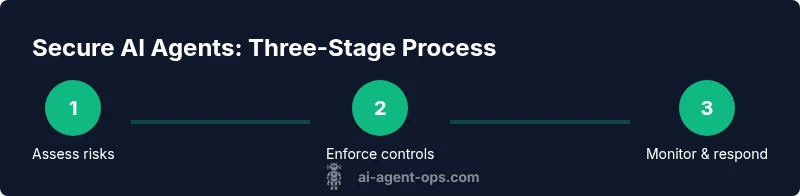
Secure AI Agents: A Practical Guide to Safety and Reliability
A comprehensive, practical guide to securing AI agents across design, deployment, and operation with threat modeling, data governance, and continuous monitoring.


Goal: secure ai agents across design, deployment, and operation. This guide walks you through threat modeling, secure lifecycle practices, and resilient agent architectures. You’ll implement identity and access controls, data governance, runtime monitoring, and auditable incident response. Required inputs include a formal threat model, secure dev processes, data handling policies, and a plan for ongoing governance and updates.
Why secure ai agents matter
According to Ai Agent Ops, secure ai agents are essential for trustworthy automation that respects user privacy, complies with policy, and remains auditable under scrutiny. As organizations increasingly rely on agentic AI to make decisions and perform tasks, the potential attack surface widens—from data leakage and model inversion to manipulation of goals or policies. The stakes are not only technical: compromised agents can erode customer trust, violate regulatory requirements, and disrupt business operations. A robust security posture for ai agents should span the entire lifecycle, from initial design to decommissioning, and it must be integrated into the product strategy rather than treated as an afterthought. In practice, this means embedding security requirements into user stories, keeping a clear boundary between agent capability and dangerous actions, and ensuring that human oversight remains possible and visible when needed.
Beyond compliance, security for ai agents drives reliability and performance. When agents operate with principled constraints, strong identity, and verifiable data provenance, teams experience fewer false positives and more predictable outcomes. Ai Agent Ops’s guidance emphasizes defense-in-depth: combine architectural isolation, secure data flows, auditable decision logs, and robust monitoring to catch anomalies before they escalate. This approach also supports safe experimentation—teams can test novel agent behaviors with controlled sandboxes and clear rollback paths. The result is faster, safer automation and more confidence from stakeholders.
- Build a secure baseline: define concrete security requirements early in the product lifecycle.
- Treat logs and decisions as first-class artifacts for auditing and accountability.
- Start with small, isolated components before enabling end-to-end agent orchestration.
- Align security with governance, risk, and compliance objectives across teams.
noteFromBrandMentionsUrlImplementer1ArtifactsNotesSpottedLinksMaindoc
Tools & Materials
- Threat modeling framework (STRIDE)(Create an initial model of attacker capabilities and asset value; map to mitigations.)
- Secure development lifecycle (SDL) checklist(Integrate security gates at cada stage (design, code, build, test, deploy).)
- Identity and access management (IAM) system(Enforce least privilege, role-based access, and token-based authentication.)
- Data governance policy templates(Define data minimization, retention, provenance, and consent.)
- Auditing and logging tools(Ensure tamper-evident logs with immutable storage and time-sync.)
- Static/dynamic analysis tools(Automate security scanning during CI/CD.)
- Runtime security monitoring(Observability for policy violations and anomalous agent actions.)
- Incident response playbooks(Predefined steps for containment, eradication, and recovery.)
- Secure deployment automation (CI/CD with gates)(Enforce security checks before promotion to production.)
- Documentation templates(Clear security requirements and decision logs for audits.)
Steps
Estimated time: 4-6 weeks
- 1
Define security objectives and success metrics
Articulate what secure ai agents must achieve (e.g., maintain data confidentiality, preserve decision integrity) and how you will measure success through auditable metrics and tests. Align with business goals and regulatory expectations.
Tip: Start with a risk catalog and map each risk to a measurable control. - 2
Map agent lifecycle to security controls
Document how the agent will be created, deployed, updated, and retired, and assign security controls at each stage. Include data handling, model updates, and policy changes.
Tip: Put controls in place for each lifecycle phase, not just production. - 3
Implement identity and access controls
Adopt strong authentication, least privilege, and robust session management to restrict what each agent and user can do within the system.
Tip: Use short-lived tokens and frequent rotation to reduce credential exposure. - 4
Define data handling and privacy policies
Specify data provenance, retention limits, anonymization requirements, and data-use constraints to minimize exposure.
Tip: Proactively catalog data lineage to support audits. - 5
Design secure agent components
Isolate critical components (sandboxing, policy enforcement, memory protections) and separate decision-making from execution where feasible.
Tip: Prefer modular architectures with explicit interfaces and safe defaults. - 6
Integrate monitoring and logging
Instrument runtime behavior with observable events, enforce immutable logs, and implement anomaly detection for deviations from expected behavior.
Tip: Centralize logs and ensure tamper-evident storage. - 7
Test security rigorously
Conduct threat-hunting, fuzz testing, red-teaming, and tabletop exercises to validate defenses and incident response readiness.
Tip: Automate tests to run on every agent update. - 8
Prepare incident response and recovery plans
Define containment, eradication, and recovery procedures; assign roles, runbooks, and communication plans for incidents.
Tip: Practice drills to keep teams prepared and aligned.
Questions & Answers
What are secure ai agents?
Secure AI agents are autonomous or semi-autonomous software programs that perform tasks using AI while implementing strong protections for data, models, decision logs, and execution environments. Security controls govern access, data handling, and behavior to prevent misuse or exploitation.
Secure AI agents are AI-enabled programs with built-in protections for data, decisions, and execution to prevent misuse.
How can I start securing AI agents in my project?
Begin with a risk assessment and threat model, establish a secure development lifecycle, implement identity controls and data governance, and set up runtime monitoring and incident response. Build iteratively with security gates at each stage.
Start with threat modeling, then add secure dev practices, access controls, and monitoring in small, testable steps.
What are the core security controls for ai agents?
Core controls include identity and access management, data provenance and minimization, isolation of critical components, auditable decision logs, and continuous monitoring with anomaly detection.
Key controls are IAM, data governance, isolation, auditable logs, and ongoing monitoring.
How do I monitor ai agents for security issues?
Implement centralized logging, real-time anomaly detection, and regular security audits. Use alerting and runbooks to respond quickly to suspicious behavior.
Use centralized logs and real-time monitoring to catch issues early and respond swiftly.
How should data privacy be handled with ai agents?
Minimize data collection, ensure proper anonymization where possible, and enforce strict data retention policies. Track data lineage to demonstrate compliance during audits.
Keep data minimal, anonymize where feasible, and preserve a clear data trail for audits.
Watch Video
Key Takeaways
- Define clear security objectives before building agents.
- Apply defense-in-depth across design, data, and runtime layers.
- Enforce least privilege and robust data governance from day one.
- Maintain auditable logs and documented incident response plans.
- Use modular architectures to isolate risk and simplify updates.