How to Buy AI: A Practical, Business-Ready Guide
A comprehensive, step-by-step guide for teams evaluating and purchasing AI solutions. Learn how to define needs, build evaluation criteria, run pilots, and scale AI responsibly with governance and security at the core.


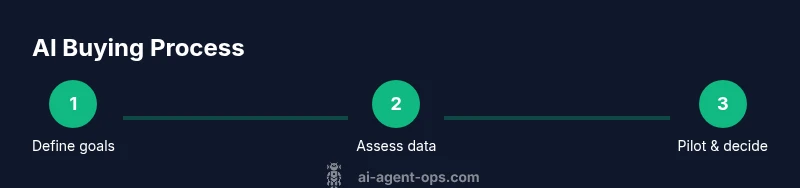
To buy AI effectively, start with needs discovery, define success metrics, and map procurement steps. Compare vendors using a formal evaluation rubric, run pilots, ensure governance and security controls, and plan for deployment and scaling. Document requirements, engage stakeholders early, and align budget with anticipated value. Prepare a vendor shortlist, request demonstrations, and establish a measurement plan for pilots.
Why buying AI requires a business-first approach
Buying AI is more than selecting a clever model or a shiny interface. It is a strategic business initiative that should start with outcomes, not features. A business-first approach helps you define the value you expect, align with strategic goals, and set guardrails for governance, privacy, and risk. When you frame decisions around measurable impact, you reduce scope creep and avoid purchasing capabilities that don’t translate into real gains. This perspective also guides the teams involved—product, security, legal, and finance—so that everyone understands what success looks like and how it will be measured over time.
Define your AI use cases and success criteria
Clear use cases are the backbone of a solid AI buying process. Articulate a problem statement for each scenario, identify stakeholders, and define success metrics that are as specific as possible. Distinguish between pilot-ready experiments and scalable deployments, and prioritize based on impact, feasibility, and strategic alignment. A concise evaluation rubric helps you compare options consistently and prevents feature fatigue or over-engineering. When success criteria are documented early, procurement conversations become evidence-based and outcome-driven.
Map governance, risk, and compliance to procurement
AI procurement must embed governance from the start. Define data handling rules, privacy protections, and security requirements that vendors must meet. Map regulatory considerations (data residency, auditability, explainability) to procurement stages to avoid late-stage red flags. Create a RACI (responsible, accountable, consulted, informed) for compliance, involve legal and security early, and document controls for ongoing risk monitoring. This upfront work pays off during vendor negotiations and deployment, reducing surprises during scale.
Build a formal evaluation framework for vendors
A formal framework makes vendor comparisons objective and repeatable. Establish non-negotiables (data rights, interoperability, support SLAs) and negotiable aspects (pricing tiers, customization options). Use a scoring rubric that covers product fit, technical architecture, data readiness, security, governance, and vendor viability. Include a roadmap alignment check to verify that the provider can scale with your organization. A robust framework minimizes bias and supports an auditable decision process.
Design pilots that prove value and drive adoption
Pilots should mimic real-world usage with clear success criteria and controls. Define scope, data sets, and success metrics before starting, and ensure adequate governance over data and access. Compare pilot outcomes against baseline measurements to quantify value, and involve end users early to foster adoption. Document lessons learned and use results to refine requirements, governance policies, and rollout plans.
Plan for integration, data readiness, and change management
AI solutions rarely operate in a vacuum. Assess data quality, availability, lineage, and governance requirements before deployment. Develop an integration plan that aligns with existing systems, APIs, and security policies. Prepare change management activities—training, stakeholder communication, and governance updates—to maximize uptake and minimize disruption. A practical deployment roadmap helps teams coordinate across IT, product, and business units.
Budgeting, cost of ownership, and licensing models
Budgeting for AI requires thinking beyond initial license or compute costs. Consider data processing, model maintenance, monitoring, security, and potential re-training needs. Compare licensing models (per-user, per-usage, or tiered) and plan for scalability as usage grows. A transparent total cost of ownership (TCO) view supports governance and ROI calculations, ensuring decisions are financially sound.
Tools & Materials
- Decision matrix or vendor evaluation rubric(Capture criteria across governance, security, data readiness, and ROI.)
- Stakeholder map(Identify owners for outcomes, data, and governance.)
- Pilot plan template(Define scope, data, metrics, and success criteria.)
- Data readiness checklist(Assess data quality, availability, and governance needs.)
- Legal and security review documents(Prepare standard questions for contract and risk assessment.)
- Budget and ROI framework(Outline TCO, licensing, and value realization timelines.)
Steps
Estimated time: 4-12 weeks
- 1
Define objective and success metrics
Document the business problem, expected outcomes, and how you will measure success. Align on which teams will own the outcomes and how results will be tracked. Establish a baseline to compare future performance after deployment.
Tip: Involve product, security, and finance early to prevent later delays. - 2
Gather requirements and stakeholders
Map stakeholders across affected functions. Gather must-have capabilities, data needs, and integration requirements. Prioritize requirements to avoid feature creep and to simplify vendor comparisons.
Tip: Create a centralized requirement bank everyone can access. - 3
Shortlist vendors and request demos
Screen vendors against your rubric and invite a focused set to demonstrate capability. Request security and governance documentation, data handling policies, and non-functional requirements. Schedule structured Q&A sessions to surface risks.
Tip: Ask for a reference call with a customer in a similar domain. - 4
Run pilot tests and compare results
Launch a controlled pilot with explicit success criteria and data governance boundaries. Collect quantitative outcomes and qualitative feedback from users. Compare results to baseline and document gaps.
Tip: Keep pilots lean and time-bound to preserve momentum. - 5
Negotiate terms and finalize procurement
Negotiate SLAs, data rights, privacy terms, and support commitments. Validate interoperability with existing systems and confirm exit conditions. Seek a clear roadmap for deployment and scaling.
Tip: Insist on data retention and portability provisions. - 6
Plan deployment, governance, and monitoring
Draft a deployment plan with phased rollout, monitoring dashboards, and governance updates. Define ownership for ongoing maintenance, security reviews, and model performance checks. Prepare training and change management activities.
Tip: Establish a recurring review cadence to reassess risk and value.
Questions & Answers
What is the purpose of AI procurement?
AI procurement is the process of identifying, evaluating, and acquiring AI solutions that align with business goals while meeting governance, security, and compliance requirements. It combines strategy, technology assessment, and risk management to ensure value and responsible use.
AI procurement aligns business goals with responsible buying practices to ensure value and governance.
How long does AI procurement typically take?
The timeline varies by organization, but a structured process often spans several weeks to a few months. It depends on stakeholder alignment, the complexity of data needs, and the rigor of the pilot program.
Expect several weeks to a few months, depending on scope and stakeholder alignment.
What should be included in an AI vendor evaluation rubric?
The rubric should cover product fit, technical architecture, security controls, data governance, interoperability, support, and total cost of ownership. Include a section for governance and risk considerations.
Include product fit, security, data governance, interoperability, and TCO in your rubric.
Can you pilot AI without heavy IT involvement?
Some lightweight pilots can be run with business-led teams and vendor-provided environments, but most meaningful pilots require IT collaboration for data access, security, and integration planning.
A successful pilot usually needs some IT collaboration for data access and security.
What governance controls are essential when buying AI?
Essential controls include data privacy, access controls, model monitoring, explainability where required, and clear data ownership and retention policies. Also ensure contract terms cover data rights and exit conditions.
Key governance: privacy, access, monitoring, explainability, and data rights.
Is there a standard contract for AI vendors?
Contracts vary by vendor and jurisdiction. Seek templates that cover data rights, security obligations, SLAs, privacy compliance, and termination rights, and have legal review to tailor terms to your use case.
Use contracts that clearly state data rights, security, and termination terms.
Watch Video
Key Takeaways
- Start with business goals and measurable outcomes.
- Use a formal evaluation rubric for vendor selection.
- Pilot before full-scale deployment to prove value.
- Plan governance, data readiness, and change management early.
- Document a clear procurement timeline and responsibilities.