AI Agent to Make Money: A Practical How-To for Teams
Learn how to monetize AI agents by automating revenue-driving workflows, identifying profitable use cases, and piloting monetizable deployments with governance and measurable ROI.


With an ai agent to make money, you can automate revenue-impacting workflows, scale service delivery, and reduce operating costs. This quick answer outlines how to identify profitable use cases, assemble an agent stack, test for ROI, and launch a monetizable pilot. Follow the step-by-step process to monetize responsibly and safely.
What this guide covers
This guide explains how to turn AI agents into revenue-generating assets. According to Ai Agent Ops, the fastest path is to target high-value, repeatable tasks that customers pay to optimize. You’ll learn how to identify profitable use cases, design a monetizable agent stack, and run ethical, governance-backed pilots. The discussion spans business value, technical architecture, risk management, and practical deployment advice so developers, product teams, and business leaders can move from idea to monetization with confidence.
What is an AI agent to make money?
An AI agent to make money is an autonomous software entity that performs tasks, makes decisions, or interacts with customers to create value that translates into revenue or cost savings. These agents can handle lead qualification, customer support, scheduling, invoice processing, or data-driven insights delivery. The goal is to replace or augment human effort with reliable automation that accelerates outcomes, improves accuracy, and scales when human labor cannot. Importantly, monetization derives not just from cost savings, but from revenue effects such as faster sales cycles or higher conversion rates.
Identify profitable use cases for monetizable AI agents
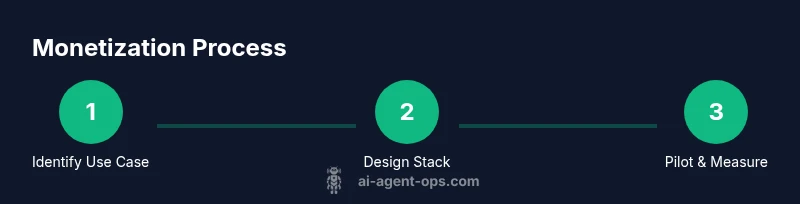
Start by mapping business outcomes to observable metrics. Look for workflows that are repetitive, high-volume, and time-sensitive. Pair each workflow with a quantifiable revenue or savings target (for example, reducing the sales cycle by a defined number of hours or increasing win rate with faster responses). Common high-impact areas include lead qualification, order processing, customer onboarding, invoicing, and data-driven decision support for pricing. Validate hypotheses with small experiments, and prioritize those with clear ROI potential. Ai Agent Ops analysis shows that early demos focused on customer-facing value tend to attract stakeholder buy-in and funding for pilots.
Designing the monetizable agent stack (architecture and tooling)
A practical monetization stack combines data inputs, an AI reasoning layer, and a delivery channel. Core components often include: data connectors to source inputs, a language model or decision engine for reasoning, a task executor (API calls, databases, or RPA), and a delivery surface (chat, email, or a web app). Emphasize observability: logging, tracing, success/failure rates, and explainability for governance. Security also matters: ensure data privacy, access controls, and audit trails. The goal is a modular, auditable architecture that can be extended or replaced as needs evolve while keeping the business outcome in sight.
Pilot planning: from concept to early revenue
Begin with a tightly scoped pilot that targets one clear business objective. Define success metrics (e.g., time saved, conversion rate uplift, or error reduction) and set a horizon for measurement. Build a sandboxed environment to test the agent's behavior, and involve real users early to surface issues and gather qualitative feedback. Establish governance for data handling and decision boundaries, then run iterative cycles to improve performance. A well-executed pilot demonstrates feasibility, builds stakeholder confidence, and creates a blueprint for broader rollout.
Metrics, ROI, and governance for monetization
Monetizing AI agents requires measurable ROI. Track time-to-value improvements, revenue leakage reductions, and customer satisfaction changes. Use dashboards that compare pre- and post-implementation baselines and attribute outcomes to the agent. Governance is essential: define guardrails for data usage, model bias, and escalation rules. Ai Agent Ops's guidance emphasizes starting small with disciplined experimentation, then expanding scope as confidence grows. Documentation and reproducibility are key to sustaining momentum and securing future funding.
Monetization models and pricing considerations
Monetization can take multiple forms: per-transaction fees, subscription access to an automation service, value-based pricing tied to outcomes, or revenue-sharing with internal teams. When choosing a model, align it with concrete business value and user willingness to pay. Consider hidden costs such as compute, data storage, and maintenance. Use pilots to validate price sensitivity and ensure the economics are favorable before full-scale deployment. Avoid overengineering pricing before you prove value.
Real-world considerations: ethics, privacy, and risk management
As you monetize, address customer consent, data privacy, and regulatory compliance. Build in transparency about when an agent is deciding and how outputs are used. Implement robust security controls, data minimization, and access governance. Regularly audit models for bias and accuracy, and establish escalation paths for human review when needed. A principled approach reduces risk and builds trust with customers and partners.
Implementation checklist and timeline
- Define the revenue goal and success metrics.
- Map high-ROI workflows to AI-enabled automation.
- Design the agent stack and governance framework.
- Create a small, controlled pilot with real users.
- Measure outcomes and adjust the model, data, and rules.
- Scale in phases with ongoing governance and cost controls.
- Document learnings to accelerate subsequent monetization cycles.
- Review security, privacy, and compliance before broader rollout.
Real-world examples and guardrails
While concrete case studies vary by industry, the common pattern is to start with a narrow scope that yields tangible value, then expand. Guardrails include data access controls, user consent prompts, and escalation to humans for edge cases. Ai Agent Ops emphasizes that successful monetization blends practical automation with disciplined governance to sustain value and minimize risk. A careful, iterative approach often yields repeatable, scalable improvements across teams.
Tools & Materials
- Development laptop with high-speed internet(At least 16GB RAM; modern CPU; capable GPU optional for heavy ML tasks)
- Access to AI platforms and APIs(Examples include OpenAI, Azure OpenAI, or similar services)
- Sample business workflow data(Non-sensitive data for prototyping and testing)
- Cloud compute budget(Allocate a modest budget for experiments and pilots)
- Security and governance guidelines(Policies, consent forms, and compliance docs)
- Measurement framework template(KPIs, ROI model, and data capture plan)
Steps
Estimated time: 4-8 weeks
- 1
Define revenue goals and success metrics
Identify the primary revenue or cost-savings target for the AI agent. Establish specific, measurable metrics and a time horizon to evaluate success. Align with business strategy to ensure stakeholders share the same objective.
Tip: Document the expected impact in dollars or hours saved to avoid vagueness. - 2
Map candidate workflows to ROI
List workflows that are repetitive, high-volume, and have clear handoffs. Estimate potential ROI by comparing current costs to projected automation benefits for each workflow.
Tip: Start with 1-2 workflows to reduce risk and accelerate learning. - 3
Assemble the monetizable agent stack
Choose data inputs, AI reasoning, and execution components. Ensure modular design for future upgrades and governance. Plan for observability from day one.
Tip: Prioritize components with clear data lineage and audit trails. - 4
Build and test in a sandbox
Develop the agent in a controlled environment with synthetic or masked data. Validate behavior, fix edge cases, and collect performance metrics before any real user exposure.
Tip: Use feature flags to enable/disable new capabilities without redeploying. - 5
Run a controlled pilot with real users
Introduce the agent to a small group of users. Gather both quantitative outcomes and qualitative feedback. Monitor for safety and privacy issues during the pilot.
Tip: Provide clear escalation paths and human-in-the-loop options if needed. - 6
Measure ROI and scale with governance
Compare pilot results to baseline, quantify ROI, and decide on scaling. Update governance policies to reflect lessons learned and ensure ongoing compliance.
Tip: Iterate in 2- to 4-week cycles to keep momentum and manage risk.
Questions & Answers
What is an AI agent to make money?
An AI agent to make money is a software entity that autonomously performs revenue-driving tasks or optimizes operations to generate income or savings. It combines data inputs, reasoning, and actions to deliver measurable business value. The goal is to replace or augment human effort with scalable automation.
An AI agent to make money is a software tool that performs revenue-driving tasks automatically, delivering measurable business value by saving time or increasing revenue.
How long should a monetization pilot run?
Pilot duration depends on scope, but a typical pilot runs 4 to 8 weeks with clear milestones. Use this period to gather performance data, user feedback, and governance alignment before scaling.
Most pilots run a month or two. Use it to gather data and adjust before a bigger rollout.
Which AI use cases tend to monetize best?
Lead qualification, customer onboarding, invoicing and payments, scheduling, and data-driven decision support are common high-ROI areas. Start with one or two use cases where you can demonstrate tangible value quickly.
Top use cases include lead qualification, onboarding, and billing automation because they impact revenue and efficiency quickly.
What metrics should I track for ROI?
Track time saved, conversion rate changes, processing speed, error reduction, and overall cost per outcome. Align metrics with the defined revenue goal and monitor continuously.
Track time saved, conversion rates, and costs per outcome to measure ROI.
What are the main risks when monetizing AI agents?
Data privacy, model bias, escalation failures, and security threats are key risks. Address them with governance, monitoring, transparent disclosures, and clear escalation paths.
Main risks include privacy, bias, and security—mitigate with governance and ongoing monitoring.
Do I need specialized skills to start?
A basic mix of data literacy, software engineering, and product thinking is enough to start. As you scale, you’ll want deeper understanding of AI workflows, data governance, and DevOps practices.
You’ll need some data and engineering know-how to start, with deeper AI governance as you scale.
Watch Video
Key Takeaways
- Identify high ROI workflows to monetize first.
- Prototype with a clear revenue model.
- Pilot, measure ROI, and iterate governance.
- Scale thoughtfully with budget and risk controls.
- Document learnings for repeatable monetization.