How to Monitor AI Agents: Practical Guide for 2026
Learn practical, governance-focused methods to monitor AI agents with metrics, telemetry, dashboards, and runbooks. This 2026 guide covers tools, safety, and best practices for reliable, responsible agent performance.


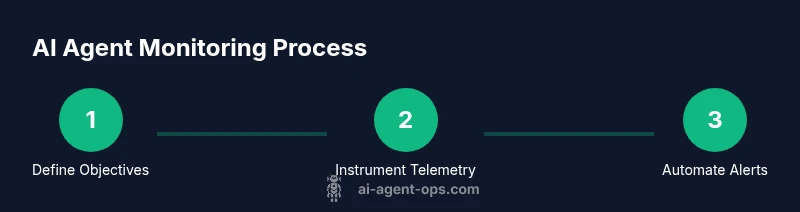
Monitoring AI agents involves defining objectives, selecting signals, instrumenting telemetry, and automating response. This quick answer helps you set up end-to-end visibility, dashboards, and runbooks to detect drift, misuse, and failures early while upholding governance and safety. It lays out the essential tooling and processes for responsible agent performance monitoring.
What monitoring AI agents means
Monitoring AI agents is the ongoing practice of observing their behavior, performance, and safety as they autonomously execute tasks across digital environments. It goes beyond simply logging uptime; it requires a structured set of signals, baselines, and governance to ensure agents act within desired boundaries. When you ask how to monitor ai agents, you’re asking how to detect drift in decision logic, identify anomalous prompts, and verify that the agent's outputs align with business goals and ethical standards. Effective monitoring combines quantitative metrics—latency, success rate, accuracy—with qualitative signals such as user feedback, policy compliance, and security alerts. A well-designed program provides early warning of failures, reduces risk, and increases stakeholder confidence. The Ai Agent Ops team emphasizes that monitoring should be treated as a product itself: establish clear objectives, build repeatable instrumentation, and automate both detection and response. In 2026, teams increasingly rely on end-to-end visibility across the agent’s data plane, decision logic, and user-facing interactions. This section sets the foundation for a practical monitoring program that scales as your agent ecosystem grows.
Core monitoring metrics and signals
When planning what to monitor for AI agents, you need a clear map of signals that reflect both technical performance and ethical boundaries. Core metrics fall into several domains:
- Performance and reliability: latency, throughput, request success rate, and timeout frequency. These reveal whether the agent can keep up with demand and where bottlenecks occur.
- Accuracy and alignment: task success rate, predicate accuracy, and alignment with business goals. You want to catch drift in decision logic before user impact occurs.
- Model drift and data quality: data freshness, input distribution changes, feature drift, and data quality flags. Shifts often precede degraded outputs.
- Safety and policy compliance: prompt injection resistance, adherence to guardrails, and monitoring for unsafe or biased responses.
- Resource usage and cost signals: CPU/GPU utilization, memory, and egress. These help optimize scaling and budgeting.
Context matters: define target baselines based on your domain, then track deviations against those baselines. Use a mix of automated thresholds and human reviews to balance false positives and negatives. The Ai Agent Ops team notes that tying signals to business outcomes (conversion, error rate, user satisfaction) makes monitoring actionable and testable.
Telemetry, logging, and observability setup
Observability requires a cohesive telemetry pipeline that captures signals from every AI agent in production. Start with three pillars: metrics (telemetry), logs (events), and traces (causal paths). Instrument agents with lightweight telemetry collectors and ensure that all key events—input prompts, decisions, outputs, and user feedback—are captured. Use standards like OpenTelemetry to bridge across environments (on-prem, cloud, edge). Route metrics to a time-series store (e.g., Prometheus or a cloud equivalent), logs to a centralized log system (e.g., Loki or Elastic), and traces to a distributed tracing backend (e.g., Jaeger or Tempo). Dashboards in Grafana or a cloud-native equivalent will visualize trends, anomalies, and correlations. Establish sampling rules to manage data volume without missing critical incidents. Finally, implement automated alerting rules for breaches of thresholds or safety policies, ensuring on-call teams receive timely notifications. This telemetry backbone makes it practical to audit, reproduce, and improve agent behavior over time.
Architecture and tooling for monitoring AI agents
A robust monitoring architecture separates data and decision planes, enabling scalable governance. Key components:
- Data plane instrumentation: agents emit metrics, logs, and traces that reflect input data, decision logic, and outputs.
- Control plane governance: policy engines, guardrails, and privacy controls govern what the agent can do, with auditable change history.
- Observability stack: a typical stack includes OpenTelemetry collectors, Prometheus for metrics, Grafana for dashboards, Loki for logs, and Jaeger/Tempo for traces. This combination provides end-to-end visibility from prompt ingestion to action execution.
- Incident management: integrate alerts with paging and runbooks to ensure consistent responses to drift or unsafe behavior.
- Data retention and access controls: define retention windows, encryption at rest, and least-privilege access for operators. Adopt a modular, pluggable architecture so you can swap components as your monitoring needs evolve. The goal is to enable rapid detection, root-cause analysis, and safe remediation without disrupting user value.
Governance, safety, and compliance considerations
Monitoring AI agents entails handling potentially sensitive data. Establish privacy-by-design practices: minimize data collection, anonymize PII where feasible, and apply data retention policies aligned with regulations. Maintain auditable logs that record decisions, prompts, and outcomes to support accountability, governance reviews, and compliance audits. Define roles and access controls so only authorized personnel can view or modify monitoring configurations. Regularly review guardrails, red-team test prompts, and drift scenarios to ensure safety policies stay effective against evolving threats. Document incident response playbooks and ensure they align with legal and regulatory requirements in your jurisdiction. Finally, balance transparency with security: share summaries for stakeholders while protecting sensitive internals during external audits. The outcome is a monitoring program that reduces risk while preserving user trust.
Practical runbooks and examples
Runbooks translate monitoring signals into repeatable actions. Example flows:
- If metric drift is detected beyond a tolerance, verify recent data changes, run a controlled rollback on the agent, and re-evaluate outputs before resuming production.
- If a safety guardrail is violated, isolate the agent, trigger an automated containment protocol, notify on-call staff, and start an incident record with context and affected users.
- If latency spikes occur during peak load, scale resources, switch to a degraded mode if needed, and log the incident for post-mortem.
- If input data quality flags rise, pause automated actions and route prompts through human review until quality stabilizes.
- If a new drift pattern appears, run a targeted test with synthetic data to confirm whether the issue is data-related, model-related, or policy-related. Each runbook should have a defined owner, expected timing, and clear exit criteria so teams can restore normal operation quickly.
Designing an ongoing monitoring program
An effective program is iterative, not a one-off task. Start with a baseline of metrics, establish dashboards and alerts, and publish governance docs. Schedule regular reviews (e.g., monthly) to adjust thresholds, add new signals, and retire unused ones. Build a culture of continuous improvement by triaging incidents, performing blameless post-mortems, and updating runbooks accordingly. Incorporate synthetic testing and red-teaming exercises to simulate adversarial prompts and drift conditions. Finally, align your monitoring program with business outcomes and user experience goals to demonstrate tangible value and secure ongoing executive support.
Tools & Materials
- Telemetry and monitoring stack(OpenTelemetry collectors, Prometheus, Grafana; ensure agents emit metrics, logs, and traces)
- Logging platform(Loki or ELK stack; centralize event logs and enable efficient searching)
- Time-series data store(Prometheus or cloud-native equivalents for long-term metric storage)
- Distributed tracing backend(Jaeger or Tempo to visualize causal paths across components)
- Dashboard and alerting(Grafana or cloud-native dashboards; configure alert rules with on-call routing)
- Incident management(PagerDuty, Opsgenie, or similar for on-call escalation)
- Access control and secrets management(IAM roles, secrets vaults, and audit trails)
- Documentation and runbooks(Living docs for governance, drift handling, and escalation procedures)
Steps
Estimated time: 90-180 minutes
- 1
Define monitoring objectives
Identify the business outcomes you want to protect and the risk scenarios you must detect. Align these objectives with stakeholder expectations and regulatory requirements. Document what success looks like and what would trigger action.
Tip: Tie objectives to measurable outcomes (e.g., user impact, cost, safety violations). - 2
Identify signals and KPIs
Map signals to the defined objectives: latency, accuracy, drift, guardrail violations, data quality, and resource usage. Create a metrics catalog with normal baselines and acceptable variation ranges.
Tip: Use both quantitative and qualitative signals to capture full context. - 3
Instrument telemetry in agents
Add lightweight telemetry points to agents for inputs, decisions, outputs, and environment changes. Ensure minimal performance impact and respect privacy constraints. Validate telemetry integrity before production.
Tip: Prefer structured, machine-readable events for easier querying. - 4
Set up data collection pipelines
Configure collectors to route metrics, logs, and traces to the appropriate backends. Implement sampling to control data volume while preserving critical signals. Validate end-to-end delivery with test traffic.
Tip: End-to-end tests help catch gaps between components early. - 5
Build dashboards and alerting rules
Create dashboards that reveal drift, latency spikes, and guardrail breaches. Set alert thresholds with clear on-call rotations and escalation policies. Include runbook references in alerts for rapid response.
Tip: Prefer fewer, high-signal alerts over noisy, numerous rules. - 6
Create runbooks and automation
Draft concrete, repeatable actions for common incidents: containment, rollback, and remediation. Automate non-sensitive responses where safe, and document manual steps where human judgment is required.
Tip: Automations should be tested in staging before production use. - 7
Test monitoring under drift and failure scenarios
Simulate data drift, adversarial prompts, and system outages to validate detection and response. Use synthetic data to reproduce edge cases without impacting users.
Tip: Regularly repeat tests to catch evolving failure modes. - 8
Governance and privacy controls
Apply privacy-by-design, data minimization, and access controls. Ensure logs are auditable and compliant with applicable laws. Update policies as the agent ecosystem evolves.
Tip: Keep a living mapping of data flows and retention policies. - 9
Review and iterate the program
Schedule periodic reviews of metrics, dashboards, and runbooks. Incorporate learnings from incidents, user feedback, and changes in the agent ecosystem to continuously improve.
Tip: Treat monitoring as a product; solicit stakeholder feedback regularly.
Questions & Answers
What is an AI agent?
An AI agent is a software component that autonomously performs tasks by perceiving its environment, making decisions, and taking actions. Monitoring these agents ensures they operate safely, efficiently, and in alignment with business goals.
An AI agent is a software component that acts on its own to perform tasks. Monitoring helps ensure it behaves safely and effectively.
What signals should I monitor for AI agents?
Key signals include latency and throughput, decision accuracy, drift in inputs or outputs, safety policy compliance, data quality, and resource usage. Tracking these signals helps detect performance issues and policy violations early.
Monitor latency, accuracy, drift, safety compliance, data quality, and resource usage to catch issues early.
How often should monitoring runbooks be reviewed?
Review monitoring runbooks on a regular cadence (e.g., quarterly) and after any incident. Update signals, thresholds, and remediation steps to reflect changes in the agent ecosystem.
Review runbooks quarterly and after incidents to keep them relevant.
How do I handle privacy when monitoring AI agents?
Limit data collection to what is necessary, anonymize sensitive data, and enforce strict access controls. Ensure logs and prompts comply with applicable regulations and internal policies.
Limit data collection, anonymize, and enforce strict access controls to protect privacy.
What are common pitfalls in monitoring AI agents?
Overly noisy alerts, missing drift signals, and treating monitoring as a one-time project. Build a defensible baseline, consolidate signals, and automate where safe.
Watch out for noisy alerts and missed drift; build a solid baseline and automate thoughtfully.
How can I integrate monitoring with existing systems?
Use standards-based telemetry (OpenTelemetry) and connect metrics and logs to your current observability stack. Define integration points with incident management and CI/CD pipelines.
Bridge monitoring with your current tools using standard telemetry and integrations.
What constitutes a good baseline for AI agent monitoring?
A good baseline captures normal operating ranges for each signal under typical workloads. It should be updated as usage patterns evolve and new features are released.
A baseline reflects normal ranges and evolves with usage and features.
What is the role of governance in monitoring AI agents?
Governance defines guardrails, data handling policies, and incident response. It ensures monitoring aligns with ethical standards and regulatory requirements while enabling rapid, safe action.
Governance sets guardrails and policies to guide monitoring and response.
Watch Video
Key Takeaways
- Define clear monitoring objectives and success criteria.
- Instrument end-to-end telemetry across the agent lifecycle.
- Automate alerts and runbooks for rapid response.
- Incorporate privacy, safety, and governance from the start.
- Iterate the program based on incidents and stakeholder feedback.