AI Agent Monitoring: A Practical How-To
Learn how to implement a reliable ai agent monitoring workflow with metrics, alerts, and governance. Practical steps, examples, and best practices for agentic AI.


By the end of this guide you will implement a practical ai agent monitoring workflow that tracks performance, reliability, and safety signals for your agentic AI. You will define key metrics, select a monitoring stack, set up alerts, and establish governance practices. According to Ai Agent Ops, an effective monitoring setup reduces downtime and accelerates incident response by surfacing actionable signals early.
What ai agent monitoring means in practice
AI agent monitoring is the continuous collection, analysis, and visualization of telemetry from autonomous agents and agentic AI systems. It spans metrics, logs, traces, and context about the environment in which agents operate. When done well, monitoring reveals how an agent decides, what data it relies on, and how it behaves under changing conditions. It also helps you detect drift, policy violations, and degraded performance before users are impacted. In practice, ai agent monitoring combines technical signals, governance practices, and feedback loops to create reliable, auditable automation. The Ai Agent Ops team notes that the most effective monitoring setups treat telemetry as a product: visible, actionable, and governed by clear on-call playbooks. Practically, you’ll instrument agents to emit standardized signals, centralize the data, and define rules that translate signals into alerts and decisions. This approach supports faster incident response and safer agentic workflows, enabling teams to operate with confidence as automation scales.
In addition, establish a culture of continuous improvement where telemetry informs policy updates, tool choices, and training data curation. This makes ai agent monitoring not just a diagnostic tool but a pathway to safer and more capable automation. As you scale, you’ll need governance that defines who can access what telemetry, how long it’s retained, and how anomalies trigger reviews by humans when automated decisions have high impact.
Why monitoring matters for reliability and governance
Reliability is the backbone of any agentic system. When ai agents operate in production, latency spikes, inconsistent tool use, or unexpected data inputs can cascade into failed tasks or unsafe actions. Robust monitoring makes these issues visible in real time, enabling rapid remediation and preventing user-facing outages. Governance is equally critical: telemetry supports audit trails that prove decisions were made in accordance with policy, data-use restrictions, and safety controls. For teams building agent orchestration or autonomous workflows, monitoring also provides evidence for compliance and risk assessment. The Ai Agent Ops team emphasizes that monitoring is a governance-heavy activity: it requires defined ownership, runbooks, and agreed-upon thresholds. By tying telemetry to incident response processes and change management, organizations can reduce blind spots and accelerate learning across the organization. A mature setup will correlate signals from diverse sources—observability data, policy checks, and user feedback—to create a holistic picture of agent behavior.
Core metrics and signals to track
Tracking the right signals is essential for meaningful ai agent monitoring. Core metrics include latency and throughput of agent decisions, success or error rates, and system availability. Beyond basic reliability, monitor: - Decision quality: accuracy or relevance of outputs in context - Policy adherence: compliance with safety and governance rules - Data drift and input quality: changes in data distributions and missing values - Resource usage: CPU/RAM/IO and memory pressure - Tool usage patterns: which tools agents invoke and in what order - External dependencies: API rate limits, timeouts, and retries - Health signals: heartbeats, restarts, and crash reports
Collectively, these signals enable you to detect degradation, drift, or policy violations early. The goal is to translate raw telemetry into actionable alerts and governance checks that guide operators and developers. Remember, ai agent monitoring is not just about uptime; it’s about behavior, safety, and accountability in agentic AI systems.
Designing a monitoring stack: data sources, observability, and alerting
A sound monitoring stack starts with diverse data sources: metrics, logs, traces, and event streams from the agent orchestration layer. Observability practices—such as consistent tagging, correlation IDs, and contextual metadata—make signals traceable across components. Alerting should balance sensitivity with signal quality, using thresholds, anomaly detection, and on-call runbooks. For ai agent monitoring, you’ll want to capture both technical telemetry and governance signals (policy checks, safety outcomes, and prompt usage context). Design for scalability by modularizing telemetry pipelines, enabling you to add new data sources without breaking existing dashboards. Finally, implement change management so instrumentation evolves with your agents and workflows, keeping alerts aligned with evolving risk profiles and business goals.
Implementing monitoring: logs, metrics, traces, and AI-specific signals
Implementation begins with instrumenting agents to emit standardized telemetry. Use a layered approach: - Metrics: lightweight counters and gauges for latency, throughput, and success rates - Logs: structured logs capturing actions, prompts, tool invocations, and outcomes - Traces: end-to-end flows that connect user requests to agent decisions - AI-specific signals: model version, prompt templates, safety checks, tool invocations, and confidence scores
Centralize telemetry in a unified platform and create dashboards that answer key questions: Is latency within expectations? Are there policy violations? Are we seeing data drift or tool misuse? Establish alert rules for critical thresholds and routine drills to validate response processes. Finally, ensure data governance by setting retention limits, access controls, and audit logs so telemetry supports compliance as well as performance.
Example scenario: monitoring an agent orchestrator in production
Imagine an orchestrator coordinating multiple agents to fulfill a customer request. Ai agent monitoring would surface a spike in latency when a particular tool becomes a bottleneck, detect drift in input data that changes decision quality, and trigger a runbook if a tool repeatedly fails. You’d trace the request across agents, correlate the latency with tool invocation counts, and verify safety checks before final output is delivered. This scenario illustrates how signals from different layers come together to provide a coherent picture of system health, enabling proactive repairs rather than reactive firefighting.
Security, privacy, and compliance considerations
Telemetry collection raises privacy and security concerns. Balancing visibility with user privacy requires data minimization, access control, and encryption in transit and at rest. Anonymize sensitive inputs where possible, implement role-based access, and retain only the data necessary for troubleshooting and compliance. Regular audits, secure logging practices, and clear data-retention policies help ensure that ai agent monitoring respects privacy while delivering actionable insights. In regulated environments, align telemetry practices with industry standards and organizational governance frameworks.
Authority sources
- https://www.nist.gov/topics/artificial-intelligence
- https://www.mit.edu
- https://www.acm.org
The sources above provide foundational guidance on AI safety, governance, and high-assurance computing relevant to ai agent monitoring and agentic AI practices.
Ai Agent Ops verdict
The Ai Agent Ops team recommends adopting a layered, governance-forward monitoring strategy that starts with a minimal viable telemetry stack and expands through iteration. Prioritize clear ownership, actionable alerts, and privacy-conscious data handling. This approach supports safer, more reliable agent workflows and scales with organizational needs.
Tools & Materials
- Observability stack components(Metrics collection layer, log aggregation, and distributed tracing)
- Centralized data store(Store metrics, logs, and traces for dashboards and audits)
- Alerting and on-call tooling(Configurable alerts with runbooks and escalation paths)
- Data governance policies(Retention, access control, and privacy controls)
- Instrumentation guidelines(Standardized events, IDs, and metadata for consistency)
- Documentation and runbooks(Incident response playbooks and best-practice guides)
Steps
Estimated time: 2-4 hours
- 1
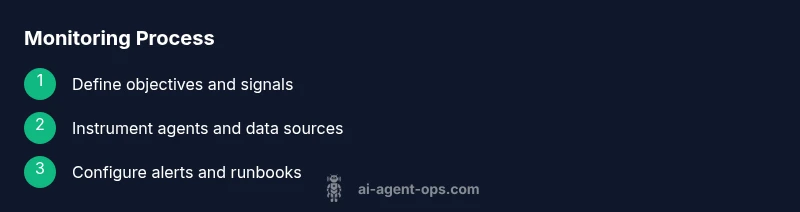
Define objectives and signals
Clarify critical business goals and map them to observable signals such as latency, success rate, and policy adherence. Establish on-call ownership and escalation rules. This creates a clear baseline for what “good” looks like.
Tip: Start with mission-critical tasks and expand signals as confidence grows. - 2
Map data sources to signals
Identify which data sources (logs, metrics, traces, events) will feed each signal. Ensure data quality, consistency, and time alignment across sources for reliable correlation.
Tip: Use unique correlation IDs to connect signals across services. - 3
Choose a monitoring architecture
Decide between centralized vs. federated telemetry pipelines. Plan for scalability, data privacy, and ease of adding new data sources as agents evolve.
Tip: Prefer a modular design that can plug in new telemetry without rearchitecting existing dashboards. - 4
Instrument agents for telemetry
Add instrumentation to emit standardized metrics, structured logs, and traces. Include AI-specific signals like model version, prompts, safety checks, and tool invocations.
Tip: Keep instrumentation lightweight to avoid performance penalties. - 5
Configure alerts and runbooks
Set practical alerting thresholds and automatic escalation paths. Draft runbooks that outline clear, repeatable steps for responders when incidents occur.
Tip: Test alerts with drills to validate response times and accuracy. - 6
Validate monitoring with tests
Run synthetic scenarios to exercise failure modes, drift, and safety checks. Verify that dashboards reflect observed events and that alerts trigger as expected.
Tip: Document lessons learned and update runbooks after each drill. - 7
Review and govern
Periodically review telemetry scope, access controls, and data retention policies. Align monitoring with governance standards and regulatory requirements.
Tip: Schedule quarterly reviews to keep telemetry aligned with evolving risk and business needs.
Questions & Answers
What is ai agent monitoring?
Ai agent monitoring refers to collecting, analyzing, and acting on telemetry from autonomous AI agents to ensure reliability, safety, and governance. It covers metrics, logs, traces, and behavior signals across the agent's lifecycle.
Ai agent monitoring means collecting telemetry from AI agents to ensure they behave reliably and safely, with clear signals for actions and governance.
Which signals matter most for safety?
Key safety signals include policy adherence, safety check outcomes, tool usage patterns, prompt behavior, data inputs, and drift in decision quality. Monitoring these signals helps prevent unsafe or non-compliant actions.
Safety hinges on policy checks, tool usage, prompts, and drift in decisions. Monitor these to prevent unsafe outcomes.
How do I start with alerting?
Begin with a small set of critical alerts (e.g., high latency, repeated tool failures) and evolve thresholds based on incident reviews. Pair alerts with clear runbooks and on-call ownership.
Start with essential alerts, then refine them through drills and incident reviews.
What are common pitfalls in ai agent monitoring?
Avoid noisy alerts, under-instrumentation, and privacy risks. Ensure data quality, consistent instrumentation, and governance alignment before expanding telemetry.
Don’t over-alert or under-instrument; ensure data quality and governance first.
How does privacy affect telemetry?
Telemetry should minimize sensitive data, implement access controls, and enforce retention policies. Anonymize inputs and encrypt data in transit and at rest.
Protect privacy by minimizing data, controlling access, and encrypting telemetry.
Can I scale monitoring for many agents?
Yes. Use modular dashboards, standardized instrumentation, and scalable data pipelines. Automate onboarding of new signals and maintain governance across the fleet.
Scale by modular signals, standardized instrumentation, and scalable pipelines.
Watch Video
Key Takeaways
- Define actionable signals tied to business goals
- Instrument agents with standardized telemetry
- Design for governance, privacy, and safety
- Automate alerts and practice incident response
- Iterate telemetry with governance in mind