Where AI Agents Are Hosted: Practical Hosting Guide for Teams
Explore where ai agents are hosted across cloud, edge, and on-prem, with security, cost, and latency considerations for scalable agentic AI workflows.


Where are ai agents hosted? In practice, most deployments run in cloud infrastructure, with on-prem and edge options for sensitive data and low latency. The hosting choice hinges on latency, data sovereignty, and cost, plus how the agent interacts with other services in the workflow.
Where are ai agents hosted
The question "where are ai agents hosted" sits at the intersection of architecture, governance, and operational strategy. In practice, teams map each agent’s responsibilities to an optimal hosting profile, often combining cloud, on-prem, and edge components within a single workflow. This hybrid approach lets teams sidestep one-size-fits-all constraints: cloud for elastic compute, on-prem for sensitive data and control, and edge for latency-critical tasks. According to Ai Agent Ops, successful agent deployments begin with a clear data-flow map that identifies which data travels where, who controls access, and where the data must physically reside. With that map, you can design a hosting plan that minimizes data egress, enforces policy, and aligns with budgetary constraints. Remember that hosting decisions also influence monitoring, logging, and incident response—so integrate these considerations from day one. In short, where ai agents are hosted is not a single location but a composition of environments tuned to use-case, policy, and performance goals.
Hosting models: cloud, on-prem, and edge
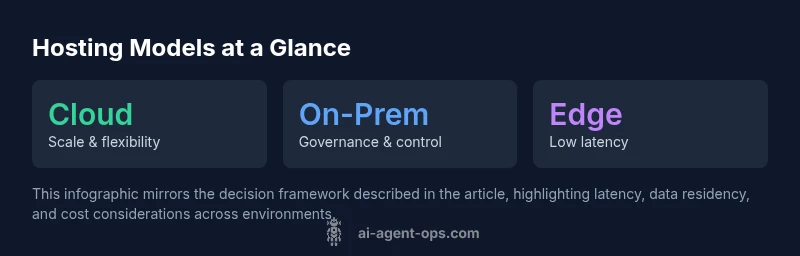
Cloud hosting remains the default for many teams due to its scalability, managed services, and broad ecosystem. Providers offer specialized AI accelerators, containerized runtimes, and integration with data lakes, making it easier to deploy and scale agents across multiple regions. On-premises hosting provides maximum control over data governance, security policies, and regulatory compliance, at the cost of capital expenditure and in-house maintenance. Edge deployments bring computation to the point of use, reducing round-trip latency and easing bandwidth requirements, but introducing constraints in hardware, updates, and orchestration. The Ai Agent Ops framework encourages a deliberate staging path: start in the cloud for rapid experimentation, then incrementally move sensitive workloads on-prem or push selective workloads to edge devices when latency or data residency demands justify it.
Edge vs cloud: tradeoffs and decision guide
Choosing between edge and cloud is a classic latency vs. governance tradeoff. Cloud offers broad compute, sophisticated monitoring, and easier cross-region collaboration, but may incur egress costs and data transfer delays for certain workloads. Edge excels when sub-50 ms response times are non-negotiable or when devices generate data that cannot leave the premises; however, it demands more intricate orchestration, lifecycle management, and hardware considerations. A practical guide is to classify workloads by latency sensitivity and data locality: use cloud for non-time-critical analysis and model updates, edge for real-time inference on local data, and on-prem for regulated data that must stay within the organization. Hybrid architectures often combine all three, routing requests through a centralized orchestration layer that balances load and policy. The result is an adaptive hosting model that scales with demand while preserving governance.
Security, privacy, and compliance considerations
Security begins with data classification and access control. In any hosting arrangement, enforce encryption at rest and in transit, robust identity and access management, and strong audit trails. Data residency requirements may compel you to keep certain data in specific geographies or within your own data centers, while privacy laws influence how you handle model outputs and logs. Agent orchestration should include policy enforcement points, immutable logs, and anomaly detection across environments. The Ai Agent Ops guidance highlights the importance of standardized security controls across clouds, on-prem, and edge, to prevent configuration drift and ensure consistent incident response. Regular third-party assessments and automated compliance checks help maintain trust in multi-environment deployments.
Cost, pricing, and scalability considerations
Pricing models vary by hosting location. Cloud hosting scales with demand but can accumulate data-transfer and egress costs, especially with multi-region workloads. On-prem deployments incur capital expenditures and ongoing maintenance but can yield lower long-term costs for stable, high-volume workloads. Edge infrastructure requires upfront hardware investment and ongoing software updates, yet it can dramatically reduce latency and bandwidth usage. A practical approach is to estimate total cost of ownership (TCO) across three scenarios: cloud-first with optional edge offload, on-prem with cloud-backed burst capacity, and full-edge with cloud for orchestration. Compare not only raw compute costs but also data transfer, security tooling, and personnel time for maintenance and updates.
Practical decision framework for teams
To operationalize hosting decisions, use a practical checklist: 1) inventory all AI agents and data flows; 2) categorize workloads by latency sensitivity and data residency; 3) map to hosting models with clear SLAs and cost targets; 4) design a multi-environment orchestration plan that routes tasks to the optimal environment; 5) implement consistent monitoring, logging, and security controls across environments; 6) plan for a staged migration path from cloud-only to a hybrid architecture as requirements evolve.
Future trends in hosting AI agents
As agentic AI workflows mature, we expect deeper integration across clouds, with more sophisticated orchestration, policy-aware routing, and privacy-preserving techniques such as confidential computing and federated learning. Serverless and function-based patterns may blur the lines between edge and cloud, enabling micro-deployments that scale on demand. Multi-cloud strategies will continue to grow to avoid vendor lock-in and to optimize data locality. Teams that pursue a modular, policy-driven hosting strategy will be best positioned to adapt to changing requirements without sacrificing performance or governance.
Comparison of hosting models for AI agents
| Hosting Model | Typical Latency (ms) | Data Residency | Cost Index |
|---|---|---|---|
| Cloud (multi-region) | 30-120 | Global geographies | Medium |
| On-Premises | 50-200 | Localized within org | High |
| Edge | 5-50 | Local/Facility | Low-Medium |
Questions & Answers
What is the most common hosting model for AI agents?
Most teams start with cloud hosting for flexibility and scale, then evaluate on-prem or edge for latency or data sovereignty. This approach lets you prove value quickly while planning for governance needs.
Most teams start in the cloud for flexibility, then assess on-prem or edge for latency and data rules.
Can AI agents be hosted across multiple clouds?
Yes, multi-cloud architectures are common for resilience, data locality, and avoiding vendor lock-in. A central orchestration layer coordinates workloads across providers.
Yes, you can host across multiple clouds for resilience and locality.
What about cost implications of hosting AI agents?
Costs vary by model and region. Cloud often scales well but can incur data transfer costs; on-prem reduces ongoing cloud fees but requires upfront investment and maintenance.
Costs vary; consider total ownership including transfers and maintenance.
How do I ensure data residency compliance?
Select hosting regions that meet regulatory requirements, enforce encryption and access controls, and establish clear data governance policies across all environments.
Choose the right region and enforce strong data controls.
What is agent orchestration in hosting?
Orchestration tools coordinate multiple AI agents, data flows, and tasks across cloud, on-prem, and edge environments to meet performance and policy goals.
Use orchestration to coordinate many agents across environments.
What is the recommended starting point for new teams?
Begin with cloud hosting to validate use-cases, then iteratively adopt on-prem or edge where latency or governance require it.
Start in the cloud, then tailor with on-prem or edge as needed.
“Hosting AI agents is not one-size-fits-all. The right setup balances latency, data governance, and total cost of ownership across cloud, on-prem, and edge.”
Key Takeaways
- Start with cloud to validate use-cases and model performance.
- Layer in on-prem or edge for latency and governance needs.
- Design end-to-end security and data-residency policies from day one.
- Use a flexible orchestration layer to route tasks across environments.