Where to Build AI Agents: A Practical Guide for 2026
Explore where to build AI agents—cloud, on-prem, or hybrid. This guide covers environments, governance, cost, and deployment patterns for reliable agentic AI workflows.


To determine where to build AI agents, start by mapping data locality, governance, latency, and cost considerations. Then compare cloud, on-prem, and hybrid options against your workloads, security requirements, and scaling needs. This guide walks you through a decision framework and practical deployment patterns.
Why the location matters for AI agents
Where to build ai agents directly shapes how data is accessed, how quickly decisions are made, and how governance and compliance are enforced. According to Ai Agent Ops, choosing the right environment affects latency, reliability, and total cost of ownership. A well-chosen location also clarifies ownership of data, permissions for agent actions, and the ability to audit decisions in real time. In practice, the location you pick should align with your product goals, regulatory constraints, and organizational risk tolerance. Start by listing workloads that the agents will support, such as real-time decision making, batch processing, or user-facing automation, and note any data locality or privacy requirements. Then translate those needs into a shortlist of candidate environments (cloud, on‑prem, or hybrid).
Cloud, on-prem, or hybrid: evaluating environments
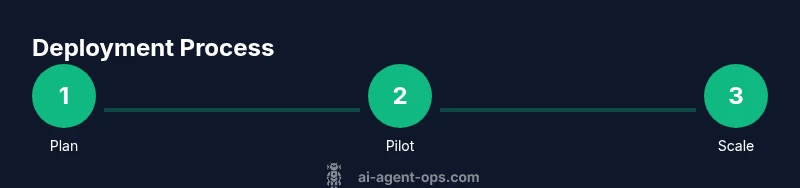
Cloud environments offer rapid scaling, managed runtimes, and broad AI-service ecosystems, which is why many teams start here. On‑prem deployments give maximum control over data, hardware, and policy enforcement, and can reduce data egress costs for sensitive workloads. Hybrid approaches blend both, allowing sensitive data to stay on premises while leveraging cloud models for experimentation and burst compute. The decision hinges on data residency, latency tolerance, and governance needs. For AI agents that must operate near users or within regulated domains, a hybrid or on‑prem approach often reduces risk while preserving agility. Ai Agent Ops recommends a staged evaluation: pilot a small subset in cloud, run a compliance-focused on‑prem pilot, then compare total cost of ownership and latency under peak load.
Data governance and security implications
Regardless of location, data governance should be baked into your design. This means data minimization, consent management, audit trails, and robust access controls. Security considerations include identity and access management (IAM), encryption at rest and in transit, and secure model retrieval and update procedures. When data leaves your control plane, ensure you have private networking, isolated environments, and clear data flow diagrams. In many organizations, data sovereignty rules drive a preference for on‑prem or private cloud connections for sensitive training data, while public cloud can be used for non-sensitive inference. Clear vendor and data-map documentation helps compliance teams verify policy adherence and demonstrates due diligence during audits. Ai Agent Ops’s framework emphasizes least-privilege access, versioned governance, and continuous monitoring of data flows.
Cost, scale, and performance trade-offs
Cost considerations aren’t just about compute prices; they include data transfer, storage, governance overhead, and operational labor. Cloud options often reduce upfront costs but can incur higher ongoing data egress and inference costs at scale. On‑prem setups require capital expenditure and ongoing maintenance but can stabilize long‑term TCO for predictable workloads. Hybrid models incur integration costs but can optimize data locality and latency. Performance depends on network bandwidth, hardware acceleration (e.g., GPUs or TPUs), and the efficiency of your orchestration layer. When planning, build a cost model that covers data movement, model updates, monitoring, and incident response. Ai Agent Ops analysis shows that aligning workload patterns with deployment topology drives the best balance of cost and performance.
Practical patterns: agent frameworks and deployment models
Several deployment models suit AI agents depending on your goals: centralized orchestration with edge inference for latency-sensitive tasks, federated data processing to keep data local, and sandboxed experimentation environments for rapid iteration. Agent orchestration often relies on a control plane that schedules tasks, manages prompts, and enforces policies across multiple agents. Use containerization and standard interfaces to decouple agents from infrastructure, which makes it easier to switch environments later. When choosing an agent framework, focus on interoperability, security hooks, and observability. This ensures you can track decisions, audit prompts, and rollback updates efficiently. The best patterns keep data localization in mind and separate governance from runtime logic for flexibility in future migrations.
A checklist to decide your deployment location
- Inventory workloads and latency requirements for each agent.
- List data sources by sensitivity and residency requirements.
- Compare cloud, on‑prem, and hybrid options with a simple RACI matrix.
- Design a governance model with access controls, auditing, and model/version management.
- Create a pilot plan with measurable success criteria and rollback paths.
- Plan for scale from day one: monitoring, alerts, and automated testing. Ai Agent Ops suggests starting with a small pilot to validate assumptions before committing to a large deployment.
Real-world examples and pitfalls
Organizations often start in the cloud to prove value, then add on‑prem controls for sensitive data. A common pitfall is underestimating data transfer costs and governance overhead when moving from experimentation to production. Another pitfall is inflexible architectures that lock teams into a single cloud or vendor. A balanced approach uses a hybrid model with a clear data-flow map, defined ownership, and automated compliance checks. Remember that the environment must support updates to prompts, models, and policies without interrupting production workloads. Ai Agent Ops highlights that ongoing governance and monitoring are as important as initial deployment to maintain trust and reliability.
Tools & Materials
- Cloud compute credits or on‑prem hardware(Provision sufficient CPU/GPU capacity; plan for peak load and model refresh cycles.)
- Identity and access management (IAM) setup(Implement least-privilege roles and centralized policy management.)
- Secure data sources and private networking(Use private links, VPNs, or dedicated connections for sensitive data.)
- Monitoring, logging, and observability stack(Include metrics on latency, model drift, and data quality.)
- Container runtime and orchestration (Docker/Kubernetes)(Standardize deployment units for portability across environments.)
- Experimentation sandbox and governance documents(Maintain separate environments for development, testing, and production.)
- Compliance and governance tooling(Policy enforcement, audits, and versioned model catalogs.)
- Data catalog and lineage tooling(Track data provenance and usage across agents and tasks.)
Steps
Estimated time: 2-6 weeks
- 1
Define goals and workload profiles
Clarify the business outcomes you expect from AI agents and map each agent’s workload (real-time inference, batch processing, or human-in-the-loop tasks). Establish success metrics, governance requirements, and data sensitivity levels. This step anchors the rest of the deployment decisions.
Tip: Document 2–3 concrete use cases with measurable success criteria. - 2
Inventory data sources and access controls
Catalog all data inputs, outputs, and transformation steps. Identify sensitive datasets and specify who can access them, along with retention and deletion policies.
Tip: Apply least-privilege access from day one to minimize risk. - 3
Choose a deployment model (cloud/on-prem/hybrid)
Assess latency, data residency, and compliance constraints to select a primary environment, with a defined fallback path for exceptions or bursts.
Tip: Pilot important workloads in multiple environments to compare performance and cost. - 4
Design governance, security, and observability
Implement role-based access, encryption, model/version management, and comprehensive monitoring. Define alerting thresholds for drift, latency, and policy violations.
Tip: Create a single source of truth for policies and model metadata. - 5
Build a modular agent framework
Develop using portable interfaces and containerized components to decouple runtime from infrastructure. Ensure compatibility across environments to reduce migration risk.
Tip: Favor standardized APIs and clear data contracts. - 6
Pilot and validate in controlled environments
Run a limited deployment to validate performance, security, and governance controls. Collect feedback and iterate on prompts, policies, and routing rules.
Tip: Use synthetic data or non-production data to minimize risk. - 7
Plan for scale and ongoing governance
Document rollout plans, scaling rules, and continuous improvement loops. Prepare for model updates, policy changes, and cross-team coordination.
Tip: Set up automated tests for drift, prompts, and data quality.
Questions & Answers
What deployment model is best for my AI agents?
There isn’t a one-size-fits-all answer. Start with a cloud pilot for speed and add on‑prem or private links for data-sensitive workloads. Hybrid models often offer the best balance between agility, control, and cost.
There isn’t a single best choice; start in the cloud for speed and add on‑prem components for sensitive data as needed.
How do I assess data locality requirements for AI agents?
Map data flows to determine where data is generated, processed, and stored. Align the data residency with regulatory constraints, then design the architecture to keep sensitive data within defined boundaries while leveraging cloud capabilities for non-sensitive parts.
Map data flows and match residency to regulations; keep sensitive data within approved boundaries.
What security controls are critical for AI agents?
Critical controls include strong IAM, encryption, secure model retrieval, authenticating prompts, and continuous monitoring for anomalies. Regularly audit access and enforce policy versioning.
Use strong access controls, encryption, and continuous monitoring to protect AI agents from misuse.
Can I use cloud AI services vs. custom agent frameworks?
Cloud AI services accelerate time-to-value but may limit customization and data control. Custom frameworks offer flexibility and governance but require more engineering. Choose based on data sensitivity, control needs, and speed to market.
Cloud services are fast but less flexible; custom frameworks give control but take more work.
How should I plan for scaling AI agents across teams?
Define standardized interfaces, governance policies, and shared observability. Use modular components and centralized model catalogs to simplify rollouts and ensure consistent behavior across teams.
Plan with standard interfaces and governance so you can scale smoothly.
What are common pitfalls to avoid when choosing a deployment location?
Avoid underestimating data transfer costs, governance overhead, and vendor lock-in. Ensure a clear data-flow map and rollback procedures before production rollout.
Watch out for data transfer costs and getting tied to a single vendor; plan with clear data flows.
Watch Video
Key Takeaways
- Define workloads before choosing a location
- Hybrid models balance latency and governance
- Guard data with strong IAM and auditing
- Pilot early to de-risk deployment
- Plan for scale with modular, portable components