Difference Between an AI Agent and a Custom GPT
Compare AI agents and custom GPTs to understand autonomy, integration, and governance. A practical guide for developers and leaders navigating agent-based workflows in 2026.


According to Ai Agent Ops, the difference between an AI agent and a custom GPT centers on autonomy, orchestration, and integration scope. An AI agent executes multi-step tasks across systems with built-in workflows, while a custom GPT remains a programmable language model guided by prompts and fine-tuning. For teams, this distinction informs architecture choices, governance, and how much control is delegated to automated agents versus human oversight.
What is an AI agent?
An AI agent is a software construct designed to perform autonomous tasks by making and executing decisions within a defined operating context. Unlike a simple bot, an AI agent typically includes perception, goal-setting, and action components that allow it to interact with external systems, fetch data, and trigger downstream processes without manual intervention. The Ai Agent Ops framework emphasizes agents that can plan a sequence of steps, monitor outcomes, and adapt when inputs change. In practice, an AI agent may orchestrate a workflow across CRM, ERP, and messaging platforms, maintaining state and reasoning about next actions. It is not just about generating text; it is about controlling behavior and outcomes over time, with safety guards and audit trails to keep governance intact.
For developers, building an agent often implies defining a canvas of capabilities, connectors to services, and a decision policy that determines when to escalate to a human. Operational reliability hinges on clear win conditions, observability, and robust error handling. The autonomy of agents comes with a responsibility to monitor drift, ensure compliance, and validate outputs against business rules. The Ai Agent Ops team emphasizes that the most effective agents are designed with explicit boundaries and repeatable patterns rather than unbounded creativity.
What is a custom GPT?
A custom GPT is a tailored instance of a general language model that is fine-tuned, prompted, or configured to perform domain-specific tasks. It excels at language-rich activities such as drafting, summarization, and conversational interactions within a narrowly defined scope. Custom GPTs rely on carefully crafted prompts, system messages, and, where appropriate, fine-tuning data to shape behavior, tone, and domain knowledge. They can be embedded in apps, used as assistants, or deployed as customer-facing chatbots with constrained capabilities. The strength of a custom GPT lies in linguistic flexibility, rapid prototyping, and the ability to specialize without building a full autonomous workflow from scratch. Governance remains crucial to ensure safety, hallucination mitigation, and adherence to brand guidelines.
From a developer perspective, the core effort is prompt design, memory strategies, and data handling within prompts. Fine-tuning may be employed to anchor model behavior to a specific persona or knowledge domain, but the model still operates under the limits of prompt-driven control. The Ai Agent Ops perspective highlights the balance between expressive power and predictability when using custom GPTs in production.
Core differences at a glance
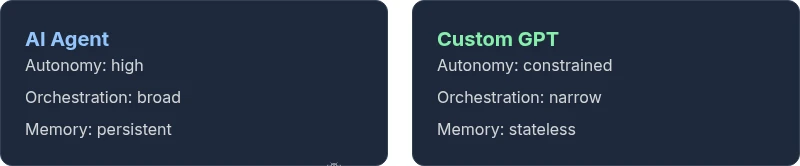
- Autonomy: AI agents operate with decision-making and action over time; custom GPTs respond to prompts and generate content but don’t autonomously execute multi-step workflows without integration.
- Orchestration: Agents are built to orchestrate multiple systems; custom GPTs generally focus on language tasks within a defined boundary.
- State and memory: Agents maintain state across sessions and can adapt plans; custom GPTs rely on stateless prompts unless integrated with external memory modules.
- Governance: Agents require lifecycle management, monitoring, and escalation rules; custom GPTs require prompt governance and output safety controls.
- Deployment scope: Agents suit complex, cross-system automation; custom GPTs excel at domain-specific content and conversational capabilities.
Asking the right questions: The differences matter when deciding whether to automate end-to-end processes or to augment human work with domain-specific language capabilities.
Comparison
| Feature | AI agent | Custom GPT |
|---|---|---|
| Autonomy and decision-making | High autonomy with built-in decision policies and task planning | Low autonomy; relies on prompts and external orchestration |
| Orchestration and integration | Broad system orchestration across services and data sources | Primarily prompts-driven; integration is via external tools/APIs |
| Data handling and memory | Maintains state, context, and logs for long-running tasks | Generally stateless; uses prompts and external memory if connected |
| Customization approach | Programmable workflows, planners, and rule-based guards | Prompt engineering plus optional fine-tuning for domain tone and knowledge |
| Governance and safety | Comprehensive governance: audits, alerts, escalation policies | Output safety relies on prompts, rate limits, and content filters |
| Best use case | End-to-end automation of multi-step processes | Domain-specific content creation and assistant-style tasks |
Positives
- Explicit orchestration enabling complex workflows
- Easier governance and auditable behavior
- Clear separation between decisioning and content generation
- Better suitability for enterprise-scale automation
What's Bad
- Higher up-front integration and development effort
- Ongoing maintenance of agent workflows and connectors
- Requires robust monitoring to prevent drift and outages
- Can introduce latency due to cross-system calls
AI agents generally provide stronger capabilities for end-to-end automation and system orchestration, while a well-tuned custom GPT excels at domain-specific language tasks and rapid prototyping.
If your goal is to automate diverse, multi-step processes across multiple tools, an AI agent is usually the better choice. For fast, domain-focused content and conversational tasks, a custom GPT often delivers quicker value with lower upfront integration. Ai Agent Ops's verdict is to align your choice with the desired scope and governance needs.
Questions & Answers
What is an AI agent and how does it differ from a traditional bot?
An AI agent combines perception, decision-making, and action to autonomously perform multi-step tasks across systems. Traditional bots typically respond to prompts or events without sustained orchestration or long-running plans. The agent model emphasizes planning, state management, and governance to ensure reliable outcomes.
An AI agent plans and acts across tools, not just answering prompts like a typical bot.
What defines a custom GPT and when should I consider one?
A custom GPT is a tailored language model configured for specific domains through prompts and fine-tuning. It shines in domain-focused content, drafting, and interactive assistants where broad generalization is less important than precise phrasing and tone.
A custom GPT is ideal when you need domain-specific language and fast prototyping.
Which approach is better for complex automation tasks?
For complex automation involving multiple systems, an AI agent is typically more capable due to its orchestration and decision-making abilities. A custom GPT can support parts of the workflow, especially in content generation or user-facing interactions, when used in concert with other components.
For complex automation, go with an AI agent; for content tasks, a custom GPT helps.
How do data privacy and governance differ between the two?
AI agents require explicit governance: data handling policies, access controls, and audit trails across the workflow. Custom GPTs rely on prompt design and model safety features; governance focuses on data handling in prompts and responses, with external systems often needed for persistence and compliance.
Governance for agents is broader, covering the entire workflow.
What are typical cost considerations?
Costs vary with deployment: AI agents may incur higher upfront integration costs but can reduce long-term operational overhead through automation. Custom GPTs can be quicker to deploy but may incur ongoing prompts management and potential retraining costs for domain accuracy.
Agents can save time long-term; custom GPTs cost depends on usage and tuning needs.
Can AI agents and custom GPTs be combined effectively?
Yes. A common pattern is to use an AI agent to orchestrate tasks and fetch data, while a custom GPT handles domain-specific language tasks within each step. This hybrid approach can balance autonomy with content quality and governance.
A hybrid setup often gives the best of both worlds.
Key Takeaways
- Assess autonomy needs before choosing
- Plan integration and governance early
- Balance long-term maintenance with initial speed
- Favor AI agents for cross-system automation
- Use Ai Agent Ops guidance to tailor your architecture